How to Advertise My Roofing Business: Every Real Option
How to advertise my roofing business comes down to three numbers: what a channel costs, how long it takes to produce a job, and how much of a crew's week it eats. Most advice skips those numbers and hands over a list of 90-plus ideas. This guide covers the nine channels that matter for a small roofing crew: referrals, Google, yard signs, door hangers, truck wraps, direct mail, Local Services Ads, paid search, and radio. Each one gets an honest read on cost, effort, and payoff, plus the one thing that decides whether any of them turns into booked jobs.
How to Advertise My Roofing Business: The Short Answer
Spend in this order, and stop at whichever step already fills the calendar:
- Own what is free. Referrals, the Google Business Profile, and reviews cost only time, and they compound.
- Buy local visibility that lasts. Yard signs, door hangers, and a truck wrap keep working long after the print bill is paid.
- Add paid dollars last. Local Services Ads first, then paid search, then anything broader.
Owners deciding how to advertise roofing business services usually overweight the loud channels and underweight the free ones. The order above exists because every channel funnels into the same place. 94% of homeowners start their contractor search online. A homeowner who sees the yard sign or hears the radio spot still checks the company on Google before dialing, so the free tier has to hold up before any paid tier makes sense.
The Free Channels a Roofing Company Already Owns
The cheapest advertising a roofing company will ever run is the finished roof itself. The neighbors watched the crew show up on time for three days straight. Asking the homeowner for a referral and a review on the day the job wraps costs nothing, and it lands at the exact moment she is happiest with the work.
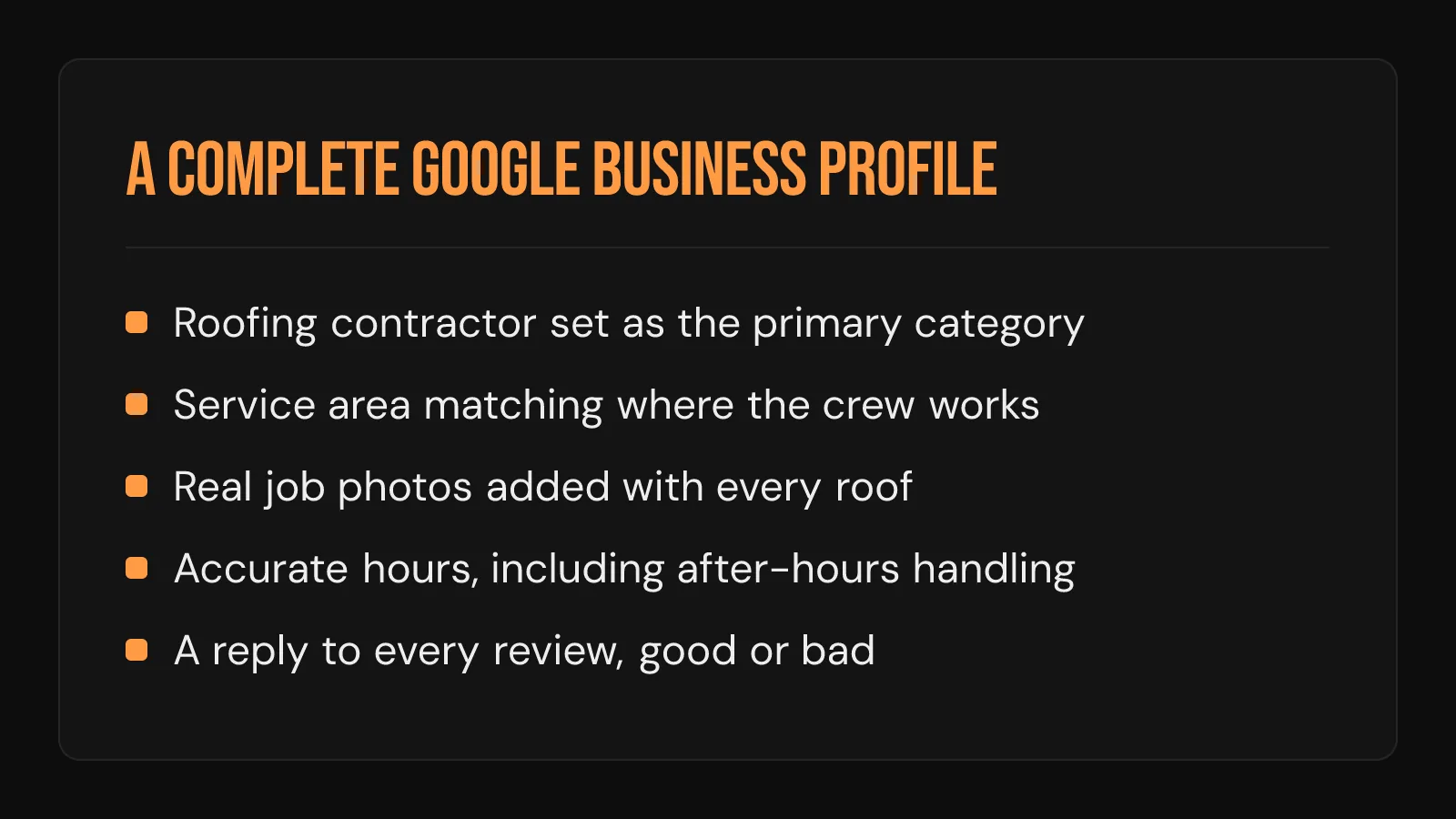
The Google Business Profile is the other free channel, and most companies leave it half-built. 56% of local businesses have never even claimed their Google Business Profile. Claiming it takes an afternoon and instantly beats every unclaimed competitor in town. A complete profile needs:
- The right categories, with roofing contractor as the primary
- A service area that matches where the crew actually works
- Photos from real jobs, added steadily, a few with every roof
- Hours that are accurate, including how after-hours calls get handled
- A reply to every review, good or bad
Review replies are advertising too. Every future homeowner who opens the profile reads how the company talks to the last one. A Google Business Profile program built for roofing companies covers what a fully built profile looks like when it is doing its job.
Offline Advertising That Still Works for a Small Crew
Offline channels get dismissed as old-school, and for a crew working visible jobs in tight neighborhoods that dismissal is expensive. Canvassing for roofing leads covers the knock-on-the-door version of the same territory. Here is the honest comparison for the print side:
| Channel | Cost | Crew effort | What it is good at |
|---|---|---|---|
| Yard signs | Low, printed once | Minutes per job | Turning every finished roof into a block-level ad |
| Door hangers | Low per batch | An afternoon per street | Reaching the houses around an active job |
| Truck wrap | One larger print bill | None after install | Daily impressions on every drive for years |
| Direct mail | Print plus postage per piece | Low, mostly list picking | Hitting a chosen neighborhood right after a storm |
The pattern in that table: offline works best when it rides on a job the crew is already doing. A yard sign plus door hangers around one active roof puts the company in front of the exact homes most likely to need the same repair. For the direct mail row, roofing advertising postcards breaks down formats, timing, and mailing lists.
Paid Channels: LSA, Search Ads, Social, and Radio
Paid advertising buys speed. It skips the months organic visibility takes to build, and it charges accordingly, which is why it comes last in the sequence.
Local Services Ads are the first paid dollar for most roofing companies. The format sits above regular search results, carries the Google Guaranteed badge, and charges only when a homeowner actually reaches out, so a wasted impression costs nothing. LSA marketing for roofing companies explains the screening, the badge, and how the lead pricing works.
Paid search is the sharper, more expensive tool. A roofing lead from Google Ads averages $228, and top performers still pay under $75, according to LocaliQ. The gap between those two numbers is landing pages, response speed, and tight keyword lists. Google Ads for roofing companies gives the straight answer on when that math works.
The broader channels round out the list:
- Social ads buy cheap impressions with weak intent. Best for staying visible between storms and retargeting people who already visited the site.
- Radio buys reach with almost no tracking. It suits a recognizable company with budget for awareness, and it punishes a new one. The same trade runs one step further on television, where the buy is the easy part and the attribution is the hard part.
For a side-by-side ranking of the paid and offline options in one place, the best advertising for roofing runs the full comparison.
| Channel | How you pay | When it makes sense |
|---|---|---|
| Local Services Ads | Per lead | First paid channel; charges only when a homeowner reaches out |
| Paid search | Per click | After the site and follow-up are proven to convert |
| Social ads | Per impression or click | Retargeting and staying visible in the off-season |
| Radio | Per airtime slot | An established name buying awareness at scale |

What Makes Any Roofing Ad Dollar Convert
Every channel above ends the same way: a homeowner searches the company name or calls the number. What happens in the next five minutes decides whether the ad spend was an investment or a donation. 78% of homeowners go with the first company that responds. The channel that produced the call stops mattering at that point.
The same three leaks quietly drain most advertising budgets:
- A website that fails to earn trust on a phone screen
- Inbound calls that ring out after hours or mid-tear-off
- Follow-up that dies after the first attempt
Reviews sit underneath all of it. 98% of consumers read reviews before choosing a local business. An ad that drives a search toward a three-review profile pays for the click and then loses the comparison.
The Trust Process does not run ad campaigns or manage ad spend. The work here is the search presence and follow-up that make any ad dollar convert: the website, the Google Business Profile, and the automated SMS follow-up that answers a lead inside minutes. Whatever mix a crew picks, how to advertise my roofing business stops being a guess once every booked job is traced back to the channel that produced it.
Frequently Asked Questions
What is the best way to advertise my roofing company on a small monthly budget?
The best way to advertise a roofing company on a small budget is the free tier first: referrals asked for on the day the roof wraps, a claimed and complete Google Business Profile, and a steady flow of reviews. Add one paid channel at a time only after the free tier produces, and track every job back to its source. When paid search makes the cut, a full guide to running your own Google Ads for a roofing company keeps that first test controlled.
What is the best advertisement for roofing services right after a storm?
The best advertisement for roofing services after a storm is whichever one shows up fastest. Local Services Ads and the map pack can reach homeowners the same day, while print and mail need a week or more to land. Yard signs and door hangers around the first repaired roofs then carry that visibility through the rest of the season.
How long should I run a roofing ad channel before judging whether it works?
Give a paid channel at least one full season before calling it, because roofing demand swings with the weather and a single slow month can sink a fair test. The judgment only counts if every booked job gets traced back to the channel that produced it. A channel producing calls that never book is failing the test no matter how busy the phone sounds.
Why did the roofing ads I already ran produce calls that never became jobs?
Calls that never became jobs usually point at what happened after the phone rang: slow answers, follow-up that stopped at one attempt, and a website that talked the homeowner out of trusting the company. The ad did its job the moment the phone rang. Fixing the response side usually rescues a channel that looked dead.