Local SEO for Roofing Companies
Local SEO for roofing companies decides who owns the map 3-pack.
Local SEO for roofing companies is the work that puts you in front of homeowners before they ever call a competitor. Most searches for "roofer near me" do not scroll past the three results Google pins to a map.
You do not have a lead problem. You have a visibility problem.
Most roofing contractors run ads the moment calls slow down. The ads bring clicks. The clicks go to a Google Business Profile that has not been touched in two years, a website that loads slow on a phone, and a review section where the last response was 14 months ago. The homeowner sees that and moves on to the next result.
Local SEO for roofing companies fixes the foundation before the traffic. It gets you into the map 3-pack for the searches that matter, keeps you there through consistent signals, and makes sure the homeowner who clicks your listing finds a profile worth trusting. The broader roofing SEO picture includes organic rankings and content, but the map pack is where most local roofing jobs start.
How local SEO for roofing companies wins the map 3-pack
When a homeowner types "roof repair [city]" or "roofer near me," Google returns a map with three pinned results above the organic listings. Those three spots get the majority of local clicks. The contractors in them did not get there by accident.
Google ranks the roofing Google Maps results on three factors: relevance (does your profile match what the homeowner searched), distance (how close are you to where they are), and prominence (how well known and trusted is your business based on reviews, citations, and website authority).
Most roofing contractors lose on relevance and prominence before distance ever becomes a factor. An incomplete Google Business Profile, a thin review section, and a website with no city-specific content tells Google your business is not the clearest answer. A competitor with a complete profile, 80 recent reviews, and dedicated pages for each suburb you both serve ranks above you, even if you have been in business longer.
The five pillars of local SEO for roofing contractors
01. Google Business Profile optimization
Your GBP is the single highest-return local SEO asset. It needs the right primary category, a full services list with descriptions, a company description that includes the cities you serve, accurate hours, and a steady stream of photos from real jobs. Most roofers set it up once and never return. Google notices the difference between an active profile and a dormant one. If you are about to pay someone for this work, read what to check before hiring a local SEO agency for roofing companies first.
02. Review velocity and owner responses
Total review count matters less than you think. Review recency matters more. A contractor with 60 reviews and five new ones this month outperforms a contractor with 200 reviews and nothing since last spring. Responding to every review, positive and negative, signals to Google that the business is active. It also signals to the homeowner that there is a real person behind the listing. We build a review machine into your post-install follow-up so the ask goes out at the right moment, when the job is fresh and the homeowner is satisfied.
03. Service-area and city pages
Each city or suburb you want to rank in should have a dedicated page on your website. These pages confirm to Google that you actively serve that area and give the homeowner landing content specific to their location. Generic pages that just swap the city name do not work. Pages that reference real local context, common roof types in that climate, permit requirements, storm history, perform. We build them with genuine utility. No templated filler. See how we approach Texas roofing SEO for a state-level example of this in practice.
04. NAP consistency
Your business name, address, and phone number need to match exactly across every directory that lists you. Yelp, Angi, the BBB, Houzz, Nextdoor, local chamber directories, and dozens more. One variation in a suite number or a phone number formatted differently splits the trust signal. A citation audit finds every mismatch and brings everything into alignment.
05. Local content and internal linking
Blog posts and field notes that answer real homeowner questions, specific to your market, build topical authority over time. An article on what roofing materials hold up best in a hail corridor signals to Google that this company knows this region. Internal links between your service pages, city pages, and content compound that signal. This is slower than the first four pillars but the most defensible long-term.
What a managed Google Business Profile looks like
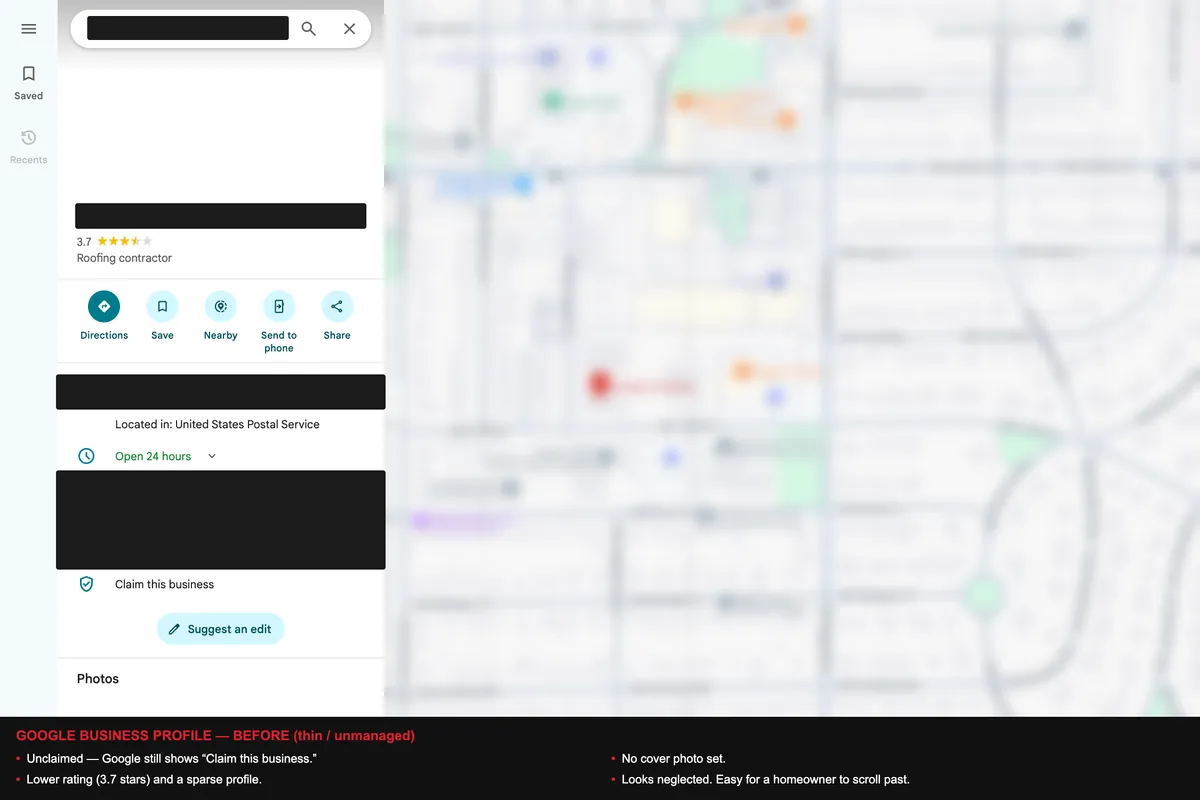
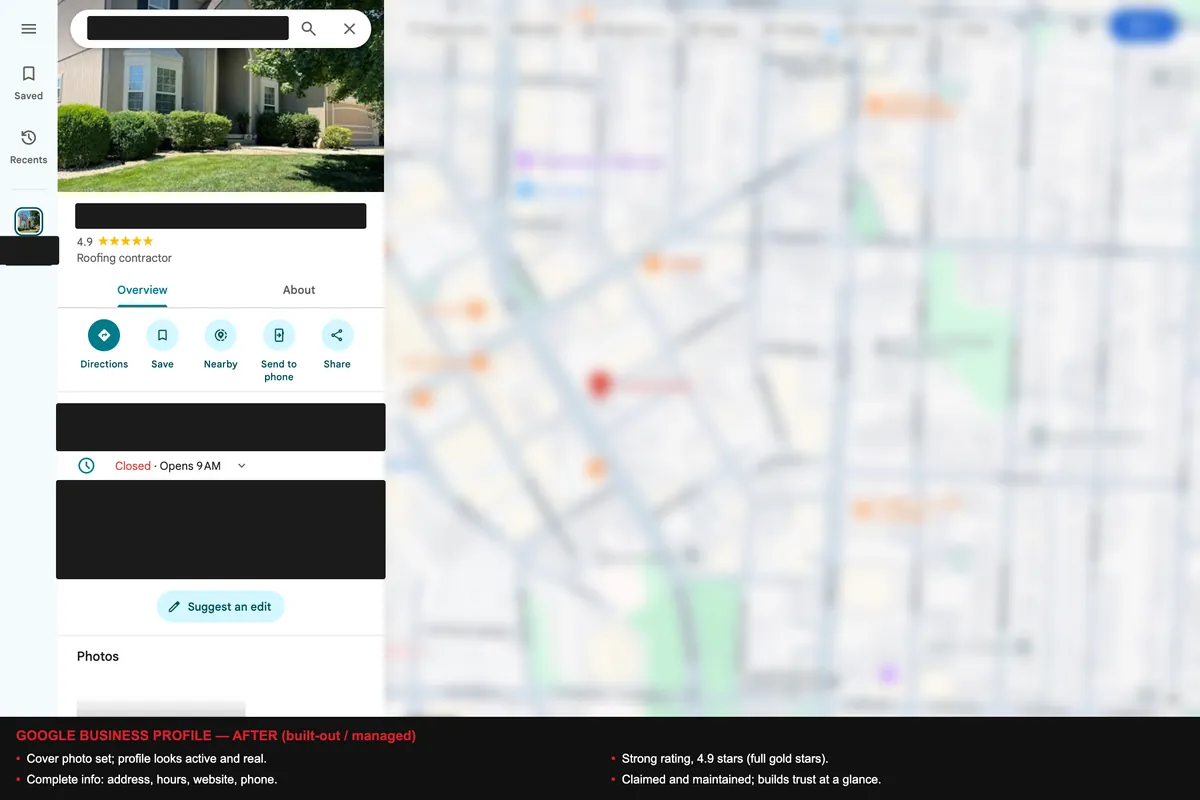
The same kind of roofing listing, before and after the profile is claimed, built out, and kept active. This is the difference a homeowner sees in the map pack before they ever reach your website.
Before
After
What we check in the Digital Trust Walkthrough
- Google Business Profile completeness: categories, services list, description, hours
- Photo coverage: real crew photos, recent job photos, before-and-after
- Review count, average rating, and recency over the past 90 days
- Owner response rate on existing reviews
- NAP consistency across top 40 directories
- Website mobile speed and click-to-call setup
- Service-area city pages: which metros you serve, which pages exist
- On-page signals: title tags, H1s, and schema markup for each city page
- Internal linking between service pages and city pages
- Competitor map-pack gap: who is in the 3-pack, what they have that you do not
Six areas we audit in every local SEO review
Google Business Profile
The profile that earns the click
We audit every field: business category, service list, description, hours, Q&A, photo count, and posting recency. Most contractors leave half the profile empty. Every empty field is a ranking signal Google ignores.
Review velocity
Recency beats volume
We check total count, average rating, and how many reviews arrived in the past 30 days. Then we look at your response rate. Google rewards active profiles. A review machine built into your post-install follow-up catches that window when the homeowner is happiest.
City pages
One page per market you serve
We identify every city and suburb where you want jobs, then map that against the pages that currently exist on your site. The gap is where competitors are appearing and you are not. We build pages that are genuinely useful. No thin placeholders.
NAP consistency
One story across every directory
We pull your citations from the top 40 directories and flag every mismatch in business name, address, or phone. Inconsistent citations split your ranking power. A clean NAP audit gives Google a clear signal to work with.
Competitor gap
What the top three have that you do not
We look at who is holding the 3-pack positions in your primary market and document exactly what they have built. Not to copy it, but to close the gaps faster than starting blind.
Site signals
The page behind the profile
Your GBP links to your website. If the landing page is slow, has no city-specific content, or buries the phone number, the profile click does not convert. We check mobile speed, above-fold call path, and local keyword targeting.
Map-pack visibility is the start. Converting that click is what pays.
A homeowner clicks your map listing. They see your review score, a handful of job photos, and a link to your website. That is the moment most contractors lose the job before the phone ever rings. The website is slow on mobile. The phone number is buried. There is no clear next step.
Local SEO for roofing companies works best when the full conversion path is clean. Map pack visibility brings the homeowner to your door. A mobile-first site with a click-to-call above the fold keeps them there. An automated SMS follow-up catches the ones who called and got voicemail. That is the system we build across the four layers of the Trust Process. Local SEO is Layer 04. It does not work in isolation.
If you want to understand what a full conversion rebuild looks like, read through our roofing marketing overview.
Run a metal roofing crew? The way a homeowner researches a standing seam roof changes what your local presence has to do, which is why it is worth setting up metal roofing local SEO as its own focus.
Who this is for
Good fit
- Owner-operator roofing crews with five to 20 people, serving a defined metro area
- Contractors not appearing in the Google map 3-pack for their primary city
- Roofers with fewer than 30 reviews or a review section with no owner responses
- Companies that serve multiple suburbs but have no city-specific pages on their website
- Contractors running ads but converting at a rate that does not justify the spend
Probably not a fit
- National roofing franchises or multi-state operations with a dedicated internal marketing team
- Contractors who want results in 30 days (local SEO compounds, it does not spike)
- Roofers already holding top-three map-pack positions in all of their target markets
If your leak is somewhere else, we will tell you in the Walkthrough. The 15 minutes are yours either way. And if you would rather hire this out than run it yourself, here is what a roofing SEO company near you should actually be doing before you sign with anyone.
Common questions about local SEO for roofers
What is local SEO for roofers?
Local SEO for roofers is the set of signals Google uses to decide which roofing contractors appear in the map 3-pack when a homeowner searches 'roofer near me' or 'roof repair [city]'. The main signals are your Google Business Profile completeness, review count and recency, NAP consistency across directories, and service-area pages on your website. A roofer who controls these signals appears above competitors who do not, without paying for ads. If you have been searching for roofer near me SEO, this set of signals is what that phrase actually covers.
How do I rank in the Google map pack as a roofer?
Three things move the needle fastest: a fully built-out Google Business Profile with real photos and an accurate services list, a steady flow of recent reviews with owner responses on every one, and a website with city pages for each metro you serve. Beyond those, your business name, address, and phone number need to match exactly across every directory that lists you. One mismatched phone number can drag down your pack position.
How many Google reviews does a roofing company need to rank locally?
There is no fixed number, but in most Texas and Sun Belt metros, contractors in the top three map spots carry 40 to 120 reviews with an average of 4.7 or higher and at least three to five new reviews in the past 30 days. Review recency matters as much as total count. A crew with 200 reviews and nothing new in six months often loses ground to a crew with 60 reviews and a steady monthly pace.
How long does local SEO take for a roofing company?
Google Business Profile cleanup and review velocity improvements show movement in four to eight weeks. City pages on your website compound over three to six months. Full map-pack stability, where you hold a top-three position across your service area, is a six to twelve month build depending on how crowded the market is. The roofers who rank consistently did not get there in 30 days, but the ones who started early hold ground that paid ads cannot buy.
What is a roofing city page and do I need one?
A city page is a dedicated page on your website targeting a specific metro or suburb, for example 'Roof Repair in Frisco TX' or 'Roofing Contractor Katy TX'. Google uses these pages to confirm that your business actively serves that area. Without them, your map listing has to carry all the location weight on its own. Contractors who serve five or more cities without matching pages are leaving map-pack positions open for competitors who do have them.
What is NAP consistency and why does it affect my local ranking?
NAP stands for Name, Address, and Phone. When your business is listed on Yelp, Angi, the BBB, Houzz, or any other directory with even a small variation, such as 'St.' on one site and 'Street' on another, Google treats those as potential separate businesses. That dilutes the trust signal your primary listing earns. A NAP audit finds every inconsistency and brings every citation into alignment so all signals point to the same place.
Proof
An endorsement from the web and SEO side
I've had the pleasure of working with Vanja Vukas on our content writing. His work has consistently demonstrated exceptional writing quality and strong alignment with brand voice and objectives. Vanja's writing is clear, engaging, and well-structured. He has a strong command of tone and pacing, and consistently tailors his language to match both audience and platform.

Last one
Your map-pack position is not fixed.
15 minutes. We run the signals live and show you exactly where the gaps are.
Book the Digital Trust Walkthrough