How to Start TV Advertising Roofing Company Owners Can Run
How to start tv advertising roofing company owners can afford comes down to picking a delivery route, buying a run of spots on it, and proving afterward that the spots did anything. Streaming platforms made the first part cheap and fast. The last part is where most roofing television money quietly disappears. This guide covers the three routes to air, the vocabulary a station rep uses on the first call, what a spot costs to produce, what to measure before anything runs, and the honest test for whether a roofing company belongs on television at all.
How to Start TV Advertising Roofing Company Owners Can Buy Without an Agency
Three routes put a roofing company on a screen, and they run from lowest commitment to highest:
- Self-serve streaming. The streaming platforms sell their own inventory through ad managers that work the way search platforms do: a card, a geographic target, an uploaded spot, a daily budget.
- Direct with a local station. An affiliate's sales rep sells airtime on that station's signal, quoting a schedule, a run length, and a rate that moves with the time of day. Real reach, real contract.
- Through a media buyer. A buyer negotiates across stations, cable zones, and streaming for a fee, which earns its keep once the budget is large enough for negotiated rates to cover it.
For a crew of four to 20 people testing the channel, route one is the realistic starting line, and the only one that can be switched off on a Tuesday afternoon. The channel-by-channel read on every advertising option a roofing company has covers where television sits against the rest.
Broadcast, Local Cable, and Connected TV Advertising Compared
The three routes are different products that happen to end up on the same screen:
- Local broadcast is the affiliate station: one signal covering the whole designated market area, the metro-plus-surrounding-counties footprint the ratings services draw. Broadcast pays to reach that entire market whether the crew services all of it or a corner of it.
- Local cable is sold in zones. The operator's regional ad-sales arm, often through an interconnect bundling neighboring systems, sells a geographic slice of the footprint. Zone buying is the closest traditional television comes to matching a service area.
- Connected tv advertising is the streaming version, bought against an audience and a geography inside a platform, priced on impressions, and reported like a digital campaign. Targeting can go tighter than a cable zone, down to postal-code level on many platforms.
| Route | Geography | Pricing | Entry commitment |
|---|---|---|---|
| Local broadcast | The whole market on one signal | Negotiated by time of day and program | Multi-week run, contracted in advance |
| Local cable zone | A zone-sized slice of the cable footprint | Negotiated per spot, lower per unit than broadcast | Multi-week run, usually a monthly floor |
| Connected TV | Audience plus geography, often to postal code | Cost per thousand impressions, set in the platform | Daily budget, stopped at will |
Only the third row lets a roofing company find out what television does without signing anything. How the six advertising channels rank against each other puts that trade in context.
How Local TV Advertising Actually Gets Priced and Bought
A first call with a station rep runs on vocabulary most roofing owners have never needed. Local tv advertising is sold on these terms:
- Daypart. The block of the day a spot runs in: morning news, daytime, early news, prime, late news, overnight. Rates track audience, so the same 30 seconds costs different money block to block.
- Reach and frequency. Reach is how many different households saw the spot. Frequency is how many times the average one saw it. Heavy reach with light frequency is forgotten by the weekend.
- Rating point and cost per point. A rating point is one percent of the market's households, and schedules are often negotiated on what a single point costs.
- CPM. Streaming is priced on cost per thousand impressions, which does not translate cleanly to cost per point.
- Scatter and upfront. Upfront inventory is committed in advance at a negotiated rate. Scatter is what remains, bought closer to air, at whatever the market bears.
- Preemptible and fixed position. A preemptible spot costs less and gets bumped when someone pays more. A fixed-position spot holds its place.
- Flight. The stretch of weeks a schedule runs. Stations sell in flights because one week of spots reaches almost nobody often enough to be remembered.
Ask for the cost per point on the dayparts being proposed. Reps expect the question, and the answer lets two competing proposals sit side by side honestly.
What a Roofing TV Commercial Costs to Produce
Production is a separate bill from airtime, and it climbs in three rungs.
| Production tier | What it buys | When it fits |
|---|---|---|
| Station-produced | A voiceover, stock footage, the logo, a phone number, often folded into an airtime commitment | A first traditional buy, where the schedule matters more than the craft |
| Local production house | Real crews on real roofs, with a 15-second and a 30-second cut from one filming day | A company committing to more than one flight |
| Concept and director | A written idea, a director, hired talent | Almost never worth its cost for a regional roofing company |
Streaming changed this bill too. Several self-serve platforms assemble a usable spot out of footage a company already has, which can shrink the production line to almost nothing on a first test.
Footage already shot for social media is usually enough raw material for a first roofing tv commercial. The video types that actually book roofing jobs covers what to film. This section is only about cutting that footage into a spot.
Instrument the Attribution Before the First Spot Airs
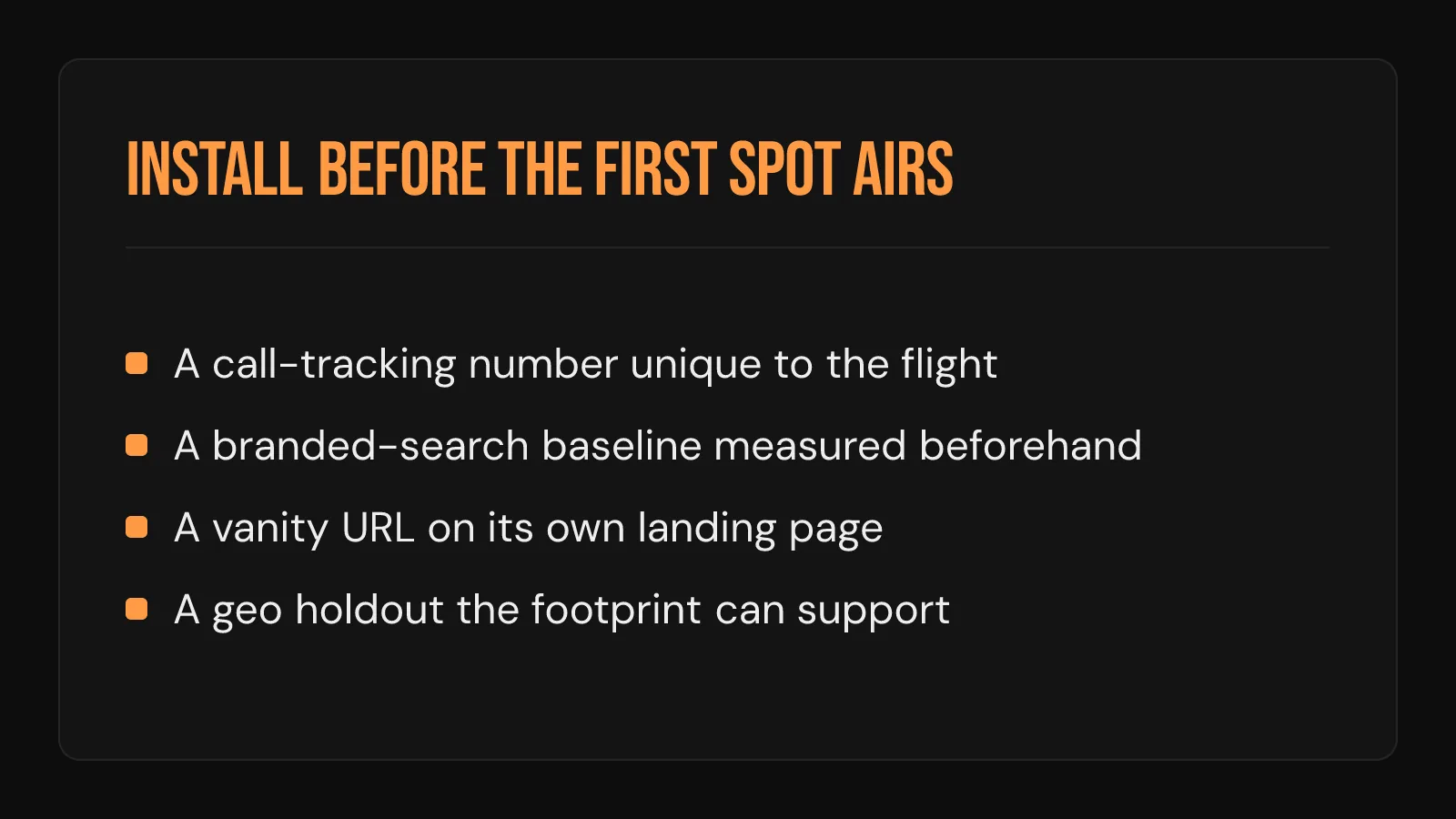
Television leaves no click behind. A homeowner sees a spot on Tuesday, remembers the name on Saturday when the ceiling stains, searches it, and books through Google. Every line of that job's paper trail says search. Instrumentation has to exist before the first airing, because a baseline cannot be measured backwards. Four things to install first:
- A dedicated call-tracking number per flight, read aloud in the spot, so television calls separate from every other channel on the phone log.
- A branded-search baseline, counted for a few weeks before anything airs. Lift against it is the most honest signal a flight produces.
- A vanity URL, short and sayable, resolving to its own page so the spot has a destination that logs traffic.
- A geo holdout: run the flight across part of the service area, leave a comparable part dark, compare booked jobs.
| Method | What it can tell you | What it cannot |
|---|---|---|
| Call-tracking number | How many people dialed the number in the spot | Anything about viewers who searched the name instead |
| Branded-search lift | Whether awareness moved while the flight ran | Which spot, daypart, or station moved it |
| Vanity URL | How many viewers typed the address in | The larger group who skipped the URL |
| Geo holdout | The closest thing to a read on incremental jobs | Anything reliable, if the areas differ in storms or capacity |
Every path there ends in the same two places: a search result and a ringing phone. 62% of consumers skip a business they cannot find online. A viewer who searches the name after a spot and lands on a thin website has already been paid for and lost. The phone side is harsher. 27% of calls to home services businesses ring out with nobody picking up. 85% of callers who reach voicemail never try again. What happens to a roofing call after the phone rings decides what a television budget is worth.
When TV Makes Sense for a Roofing Company and When It Does Not
Here is the honest read. For a crew of four to 20 people, television usually loses to search and follow-up, and it keeps losing until the service area and the crew capacity justify broad reach. Television pays to reach everyone inside a footprint, and most of those households have a roof that is fine this year. Search reaches the homeowner who already knows something is wrong.
The cost side says the same thing. A roofing lead from Google Ads averages $228, and top performers still pay under $75, according to LocaliQ. That money buys a measurable lead with a traceable source, which is a different purchase from a run of impressions.
Television earns its place when all of these are true:
- The service area genuinely matches a market footprint or a cable zone.
- The crew can absorb a demand spike without the schedule collapsing.
- The name is worth reinforcing, with reviews and a website that hold up when someone searches it.
- The budget survives a multi-month flight without starving the channels that already produce jobs.
- The measurement above is installed and has a baseline behind it.
Television is the wrong buy when any of these are true:
- The service radius covers a fraction of the market's footprint.
- The website or the Google Business Profile loses the comparison after someone searches the name.
- The phone goes to voicemail during a tear-off.
- The budget covers one short flight, which reaches everyone once and nobody enough.
- The company cannot say which channel produced last month's booked jobs.
Most crews will recognize themselves in the second list, and everything on it is cheaper to fix than airtime. Search visibility built for a roofing company's own service area and a phone that gets answered out-earn a first television flight in almost every small market.
The Trust Process does not buy media or run ad campaigns. The work here is the search presence, the website, and the automated follow-up a television viewer lands on once the spot has done its job.
How to start tv advertising roofing company owners can defend is mostly a question of timing, and for most crews the honest answer is not this year.
Frequently Asked Questions
How does a roofing company advertise on TV without hiring an agency?
A roofing company gets on TV without an agency by buying through a streaming platform's ad manager or by calling a local station's rep directly. The self-serve route needs a finished spot, a geographic target, and a card on file. The station route needs a signed schedule, and the rep walks a first-time buyer through the rate card.
Is a TV commercial the best advertisement for roofing services in a small market?
A TV commercial is rarely the best advertisement for roofing services in a small market, because the broadcast footprint usually covers far more territory than a small crew can service. Cable zones and streaming inventory narrow that waste considerably. Where the footprint and the service area line up, the math gets friendlier.
How long does a roofing company have to commit to a TV buy?
Commitment length depends on the route. Station and cable schedules sell in flights of several weeks, contracted in advance, so the first traditional test is a multi-week spend. A self-serve streaming buy carries no flight commitment and can be paused the same day.
How do I tell whether a TV spot produced a roofing job or a Google search did?
A single job usually cannot be attributed cleanly, because the spot creates the memory and the search closes it. The workable read sits at the flight level: measure branded-search volume and booked jobs before the flight, then compare during and after. A geo holdout gets closest to proof.
Do I need TV on top of the marketing I already pay for?
Adding TV to an existing marketing spend makes sense only once that spend is measurably producing and the crew has capacity to spare. Ask whoever handles the current work which channel produced last month's booked jobs. If that answer comes back vague, television will make it vaguer, and a Google Business Profile program built for roofing companies is the cheaper next dollar.