Canvassing for Roofing Leads: What It Actually Costs
Canvassing for roofing leads means putting a rep on doors instead of a dollar into Google Ads, and the trade only pays off if you track what it actually costs. Most owners treat it as free labor because nobody writes a check to a platform. That is the expensive part. A crew member knocking doors for eight hours costs the same whether he brings back three appointments or zero, and that payroll adds up fast against an already thin margin. The real comparison runs against the leads you already buy or generate, why most canvassing programs quit before they ever prove out, and where the tactic runs into legal limits before a program gets built around it.
What Canvassing for Roofing Leads Actually Costs
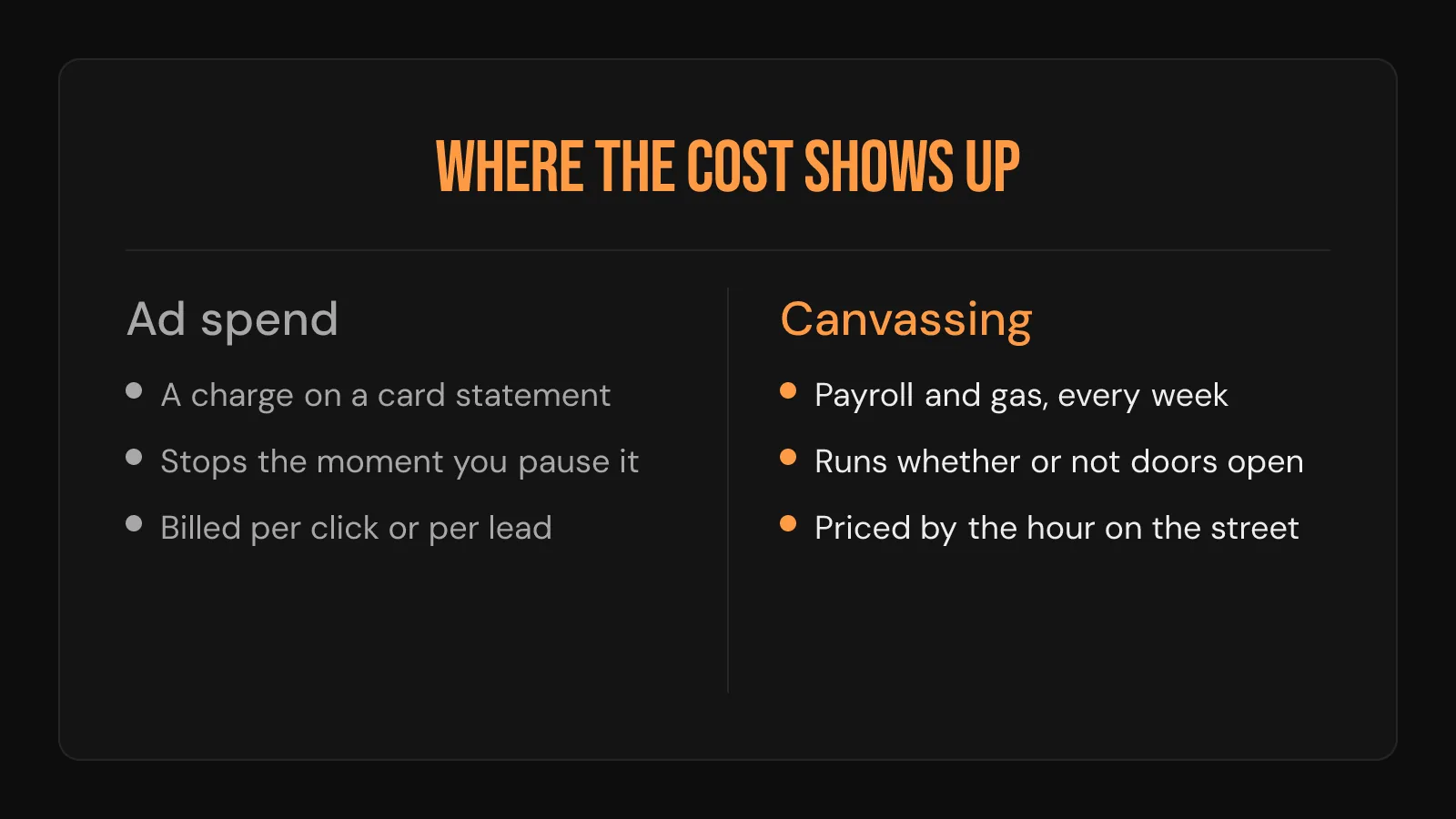
Ad spend shows up on a card statement. Canvassing shows up as payroll, gas, and the hours a rep spends walking a street instead of running a job. Both are real costs. Only one of them gets tracked.
According to LocaliQ, a roofing lead from Google Ads averages $228, and top performers still pay under $75. Industry close rates run 15 to 27 percent, and top crews clear 30 percent. Shared leads from the big marketplaces close at 5 to 15 percent, because the same inquiry gets sold to you and three or more other contractors at once. What shared leads really sell you breaks down that math in full.
| Lead source | What you actually pay | Close rate |
|---|---|---|
| Canvassing (owned crew) | Payroll and gas per rep, no per-lead fee | Depends on rep skill and follow-up |
| Google Ads | Averages $228 per lead | Falls in the industry's 15 to 27 percent range |
| Shared marketplace leads | A flat fee per lead, split 3 or more ways | 5 to 15 percent |
Canvassing skips the marketplace fee entirely. You are paying a rep instead of a platform. That only beats the alternatives once you count the hours it actually takes to knock a street and log the results. Roofing leads that actually close covers what owning a lead pipeline looks like across every channel, canvassing included.
That math prices the knock. Whether canvassing is worth running depends on what happens after the door closes, because even a full appointment book only pays off at the close rate you can expect from those leads.
How Roofing Companies Run a Canvassing Program
Roofing canvassing follows the same basic shape at almost every company that runs it well:
- Pick the target streets. Storm-damage-adjacent blocks first, then work outward by neighborhood age and roof type.
- Knock every door on the list, including the ones that do not look promising from the street.
- Run the same opener every time. A consistent script beats an improvised one, because it lets you tell what is actually working.
- Log the outcome of every conversation, even the "not interested" ones. That log is the only way to measure the program at all.
- Schedule the follow-up knock or call. A homeowner who says "maybe next month" still needs a follow-up on the calendar.
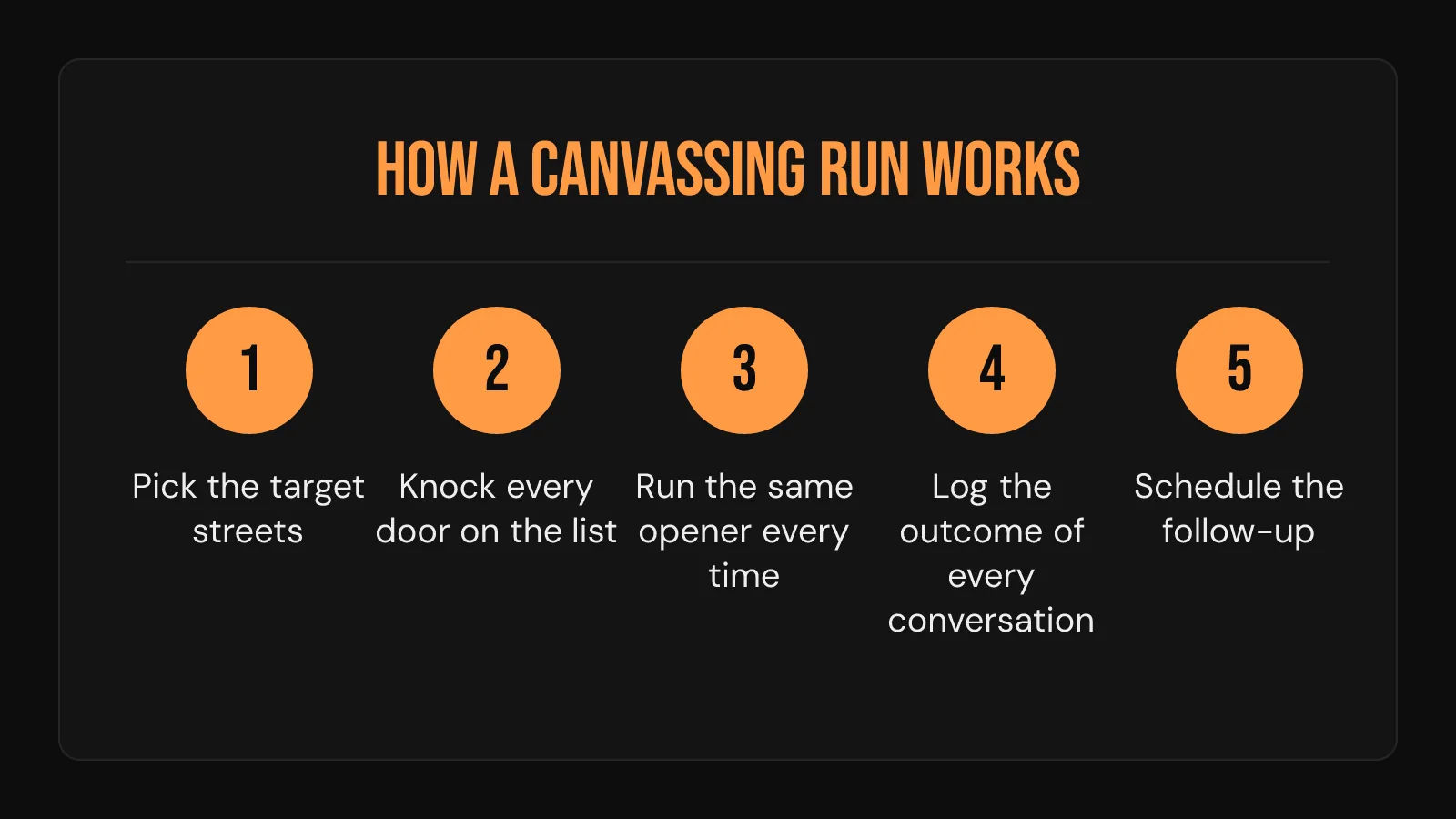
That fifth step is where most programs actually fall apart, and it has nothing to do with the pitch.
Why Most Canvassing Programs Quit Too Early
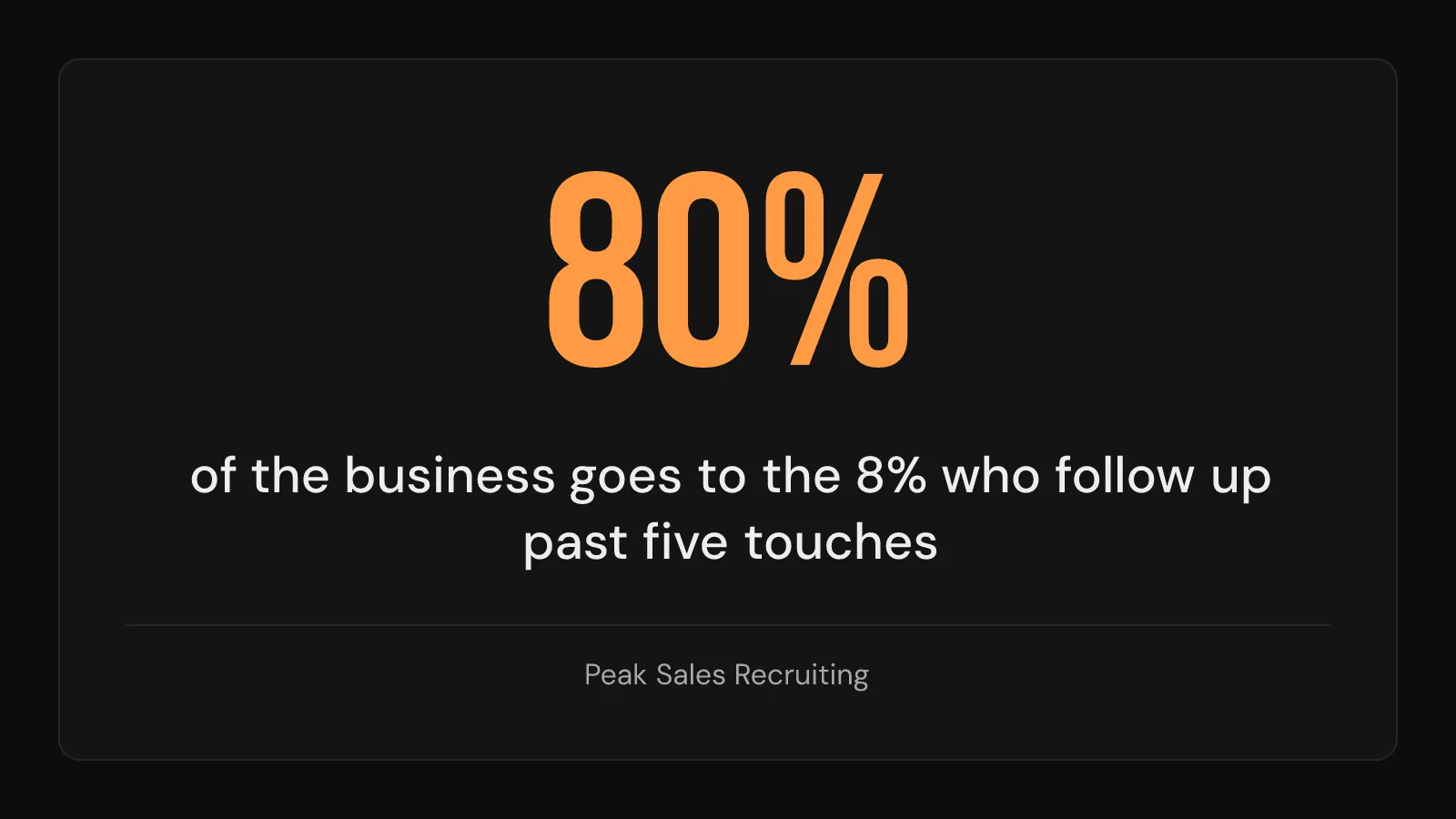
Peak Sales Recruiting found that only 8 percent of salespeople make more than five touches on a prospect. That 8 percent wins 80 percent of the business. The fifth knock is where canvassing actually pays off, and almost no one on a ladder crew makes it that far.
Programs stall for a handful of repeatable reasons:
- No follow-up system. The rep logs a "maybe" and never calls back.
- Treating the first no as final. Most homeowners are not ready to decide on the doorstep.
- No lead log at all. Without a record of every knock, you cannot tell a bad script from a bad week.
- Sending an inexperienced rep out alone. The first two weeks on a new crew member's own are usually the worst data you will ever collect.
Persistence gets you most of the way. The rest depends on what your city actually allows.
Where Canvassing Runs Into Legal and Practical Limits
Canvassing for roofing leads runs into legal limits long before it runs into diminishing returns. Solicitation ordinances vary by city, and some are stricter than roofing owners expect.
A few practical things worth checking before you send a crew out:
- Whether your city requires a solicitor's permit for door-to-door sales.
- Whether the neighborhoods you want to work sit inside an HOA that bans door-to-door activity entirely.
- Whether a posted "no soliciting" sign carries real legal weight in your city, beyond being a homeowner's preference.
This is not legal advice. Check your city's solicitor-permit rules and any HOA restrictions before you send a crew out. Skipping that check costs more than the knock ever saves.
Canvassing vs Owning Your Search Visibility
Canvassing for roofing leads and owning your search visibility both take real labor. The difference shows up after you stop paying for either one.
| Canvassing | Owned search visibility | |
|---|---|---|
| Cost driver | Payroll per rep, every week you run it | Time to build, then largely fixed |
| Weather dependency | Stops when the crew cannot work the street | Keeps running regardless of weather |
| What happens if you stop | Leads stop the same week | Rankings hold for months after you pause |
According to LeadAngel, 78 percent of homeowners go with the first company that responds. That holds true whether the lead came from a doorstep conversation or a search result. A canvassing program that does not answer fast still loses the job to whoever calls back first.
Organic roofing leads that never enter the four-way race at all keep showing up whether or not a rep is on the street that week. The same owned-versus-rented argument gets a full breakdown in owning your own demand.
Canvassing is worth building into a real program when a few things line up:
- You have, or can hire, a rep who will make it past the first few weeks of no's.
- Your market gets enough storm or renovation activity to justify a dedicated route.
- You already run a follow-up system that will not let a "maybe" go cold.
If those are not true yet, the labor is usually better spent on the search visibility that keeps working whether or not someone is on the street that day. For the online-first playbook that replaces the knock entirely, see how to get roofing leads without door knocking. For neighborhood-level plays that ask for less full-time labor than a canvassing crew, a rundown of creative roofing marketing tactics worth testing first covers yard-sign pushes and local sponsorships that run alongside whatever else is already working.
Frequently Asked Questions
How much does a roofing canvasser make, and what does that mean for your cost per door?
Most roofing canvassers work on a base rate plus commission per set or signed job, which means your real cost per door is payroll plus whatever bonus structure gets a rep to knock the next house instead of coasting. Price the commission the same way you would price a per-lead fee, because that is functionally what it is.
How does the cost per canvassing lead compare to a purchased roofing lead?
A canvassing lead costs whatever your rep's hourly or commission rate works out to per appointment set, with no separate platform fee attached. A purchased roofing lead carries a flat fee before you even get the homeowner on the phone, and you are usually not the only contractor who bought it. The math tends to favor canvassing once a rep is experienced enough to set appointments consistently.
What is canvassing for a roofing company?
Canvassing is a rep going door to door in a target neighborhood, usually after a storm or during a renovation season, to find homeowners who need a roof inspection or replacement. It is one of the oldest lead-generation methods in the trade, older than any digital channel on this list. The owned channels that bring residential homeowners in without a rep walking a street are the subject of how to generate residential roofing leads.
Why does a canvassing program sometimes produce no leads at all?
Most failed canvassing attempts trace back to one of two things: no follow-up system, or a rep who stopped after one or two doors said no. Canvassing produces almost nothing on the first pass through a neighborhood. It produces results on the third and fourth pass, which is the part most owners give up before reaching.