What CRM Do Most Roofing Contractors Actually Use?
What CRM do most roofing contractors actually use is a question the vendor lists never answer straight, since every list ends with the author's own product on top. The honest landscape has three layers: two roofing-specific platforms that dominate the conversation, a set of general field-service tools holding the edges, and a large share of small crews running the whole operation from a shared spreadsheet. This piece maps who runs what, why adoption clusters the way it does, and how a crew in the four to 20 range should read the pattern before signing up for anything.
What CRM Do Most Roofing Contractors Actually Use Day to Day
Ask the question in a contractor forum and the same handful of names comes back every time. AccuLynx and JobNimbus are the two roofing-specific platforms cited most often, with the rest of the field split between general tools and no tool at all.
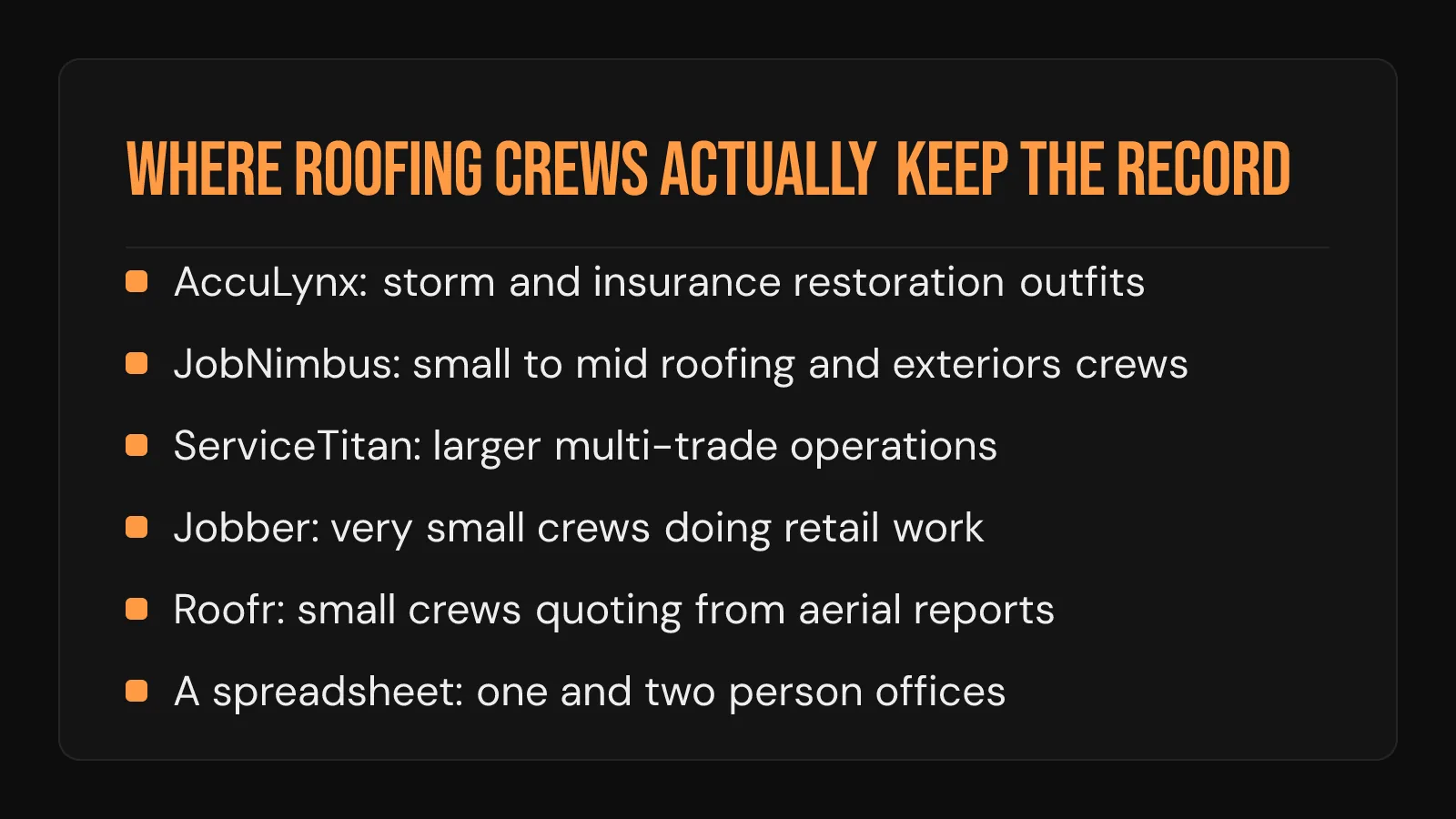
| Platform | Where it shows up most | Why it lands there |
|---|---|---|
| AccuLynx | Residential storm and insurance restoration outfits | Claims, supplements, and aerial measurements live inside one job record |
| JobNimbus | Small to mid roofing and exteriors crews | A board-style pipeline that bends to a crew's real stages |
| ServiceTitan | Larger multi-trade operations | Built for shops running several trades, with office staff to feed it |
| Jobber | Very small crews doing retail work | Cheap to start and simple enough that people keep opening it |
| Roofr | Small crews that quote from aerial reports | The measurement-to-proposal flow is the whole point |
| A spreadsheet and a calendar | One and two person offices everywhere | Free, familiar, and workable until volume breaks it |
That picture comes from three kinds of evidence, each with its own bias:
- Contractor forums, where storm crews name AccuLynx and smaller exteriors crews name JobNimbus over and over
- Vendor customer counts, which are real numbers presented by the people selling the software
- Independent comparison guides, which keep pairing the same two incumbents head to head
No audited market-share number exists for roofing CRMs, so anyone quoting a precise percentage is guessing or selling. Commercial crews also sit slightly apart from the table above: how a commercial roofing crm juggles bid deadlines and layered decision-makers is its own landscape, and it pushes those operations toward the heavier platforms.
Why Adoption Clusters the Way It Does
The pattern is stable because three constraints do the sorting long before any feature comparison starts:
- Insurance paperwork sorts the storm side. A crew living on claims needs the adjuster's name, the claim number, and the current supplement stage inside the job record. The roofing-specific platforms grew up around exactly that workflow, so storm markets standardize on them.
- Measurement integrations sort the estimate-heavy side. Crews quoting from aerial reports gravitate to whatever turns a measurement into a signed proposal fastest, which is the ground Roofr built on.
- Crew size sorts everything else. A multi-trade suite assumes an office staff to run it. A four person crew with no office manager picks whatever one person can keep current from a truck, or keeps the sheet.
There is a fourth force, quieter than the other three: crews copy the crews around them. A platform that wins one metro's storm market tends to keep it, because every experienced hire arrives already knowing the software. Feature-level differences do less of this sorting than owners expect, though the automation triggers each platform documents split along the same roofing-specific and general field-service line.
The Honest Most Common Answer Has No Logo
Any honest reading of what CRM do most roofing contractors actually use has to include the setup nobody advertises: a shared spreadsheet, a website contact form, and a calendar. In contractor threads this is the most commonly described starting point, and for a one or two person office it is a rational one:
- Software spend competes directly with fuel and materials
- The learning curve costs evenings the owner does not have
- The sheet never asks anyone to change how they work
The ceiling shows up later, when follow-up starts slipping between tabs and two versions of the same estimate go out the door. How far a free roofing crm tier stretches is the natural next question for a crew at that stage, because free tiers exist precisely to catch crews outgrowing the sheet.
Reading the Landscape at Four to 20 People
Popularity is evidence of fit for somebody. The useful move is working out whether that somebody runs jobs the way your crew does:
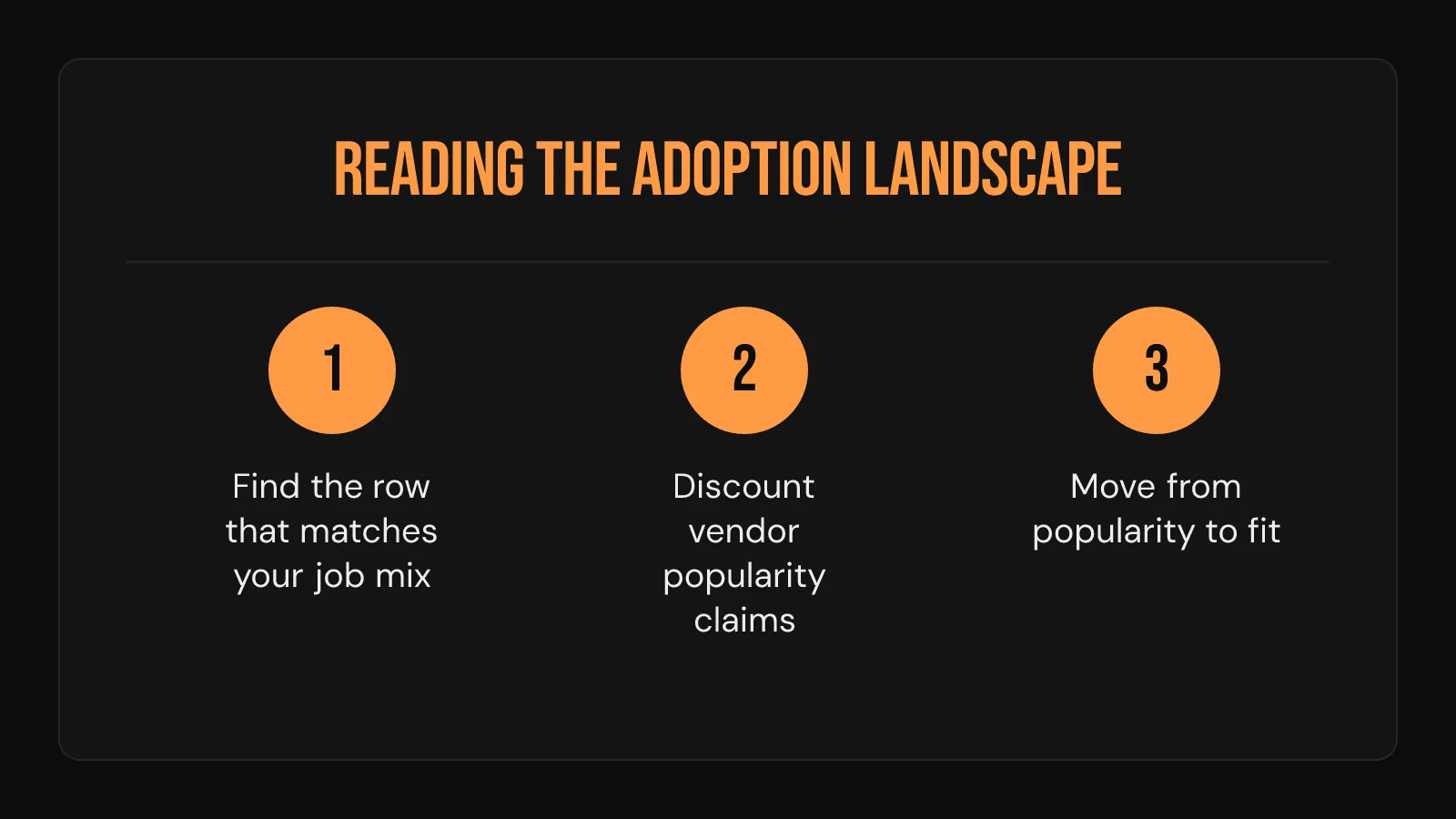
- Find the row that matches your job mix. Storm and claims work points at the roofing-specific pair. Retail work at small scale points at the general tools or the sheet.
- Discount every popularity claim that comes from a vendor. A customer count is marketing. A crew your size describing what it still opens daily after a year is data.
- Move from the popularity question to the fit question. How to choose a crm for roofing walks through the evaluation criteria, the pricing-tier homework, and the migration traps this landscape piece deliberately leaves alone.
| Crew profile | Where crews like it usually land | What to check before following them |
|---|---|---|
| Storm and insurance restoration, four to 20 people | AccuLynx or JobNimbus | Whether the supplement workflow matches how your office actually files |
| Retail-only, under five people | Jobber or a spreadsheet | Whether the tool survives the jump to a second crew |
| Quoting daily from aerial reports | Roofr | Whether per-report billing fits your quote volume |
| Multiple crews across several trades | ServiceTitan | Whether the onboarding lift fits the season you plan to switch in |
Adoption follows the job mix. Read your own job mix before following the crowd.
Where The Trust Process Fits
The Trust Process has no CRM to sell and no setup service to attach to any vendor named above. The work here is the response layer that runs underneath whichever record a crew keeps: the Automated SMS Delivery and Lead Nurturing System follows up with new leads on schedule, and the Inbound Voice Agent catches the calls that land while everyone is on a roof.
That layer matters in every row of the adoption table. Only 4.7% of companies respond to a new lead inside five minutes. 85% of callers who reach voicemail never try again. Whichever platform ends up holding your record, those two numbers get decided by the response layer, which is why the five-minute window settles more jobs than the software brand does. The response-time work a crm for roofing company depends on picks this same layer up from the buying side.
Frequently Asked Questions
Do storm restoration roofers use a different CRM than retail crews?
Usually, yes. Storm and insurance work pulls crews toward AccuLynx and JobNimbus because claim and supplement tracking sits inside the job record. Retail crews carry none of that paperwork, so cheaper general tools or a spreadsheet hold that side of the market.
Is the most widely used roofing CRM automatically the best one for a small crew?
No. Wide adoption only proves the platform fits the crews that adopted it, and many of those are 40 person restoration outfits with office staff. Match your job mix first and treat popularity as a tiebreaker between finalists.
Which CRM is the most commonly used by roofing companies overall?
No audited count exists, so the honest answer is a pattern. AccuLynx and JobNimbus are the two names cited most often as roofing-specific standards, while spreadsheets almost certainly hold the biggest share of very small crews. Treat any precise market-share percentage you read as marketing.
What happens when a roofing crew buys a popular CRM and stops using it?
The record goes stale within weeks, and the crew quietly falls back to texts and memory while the subscription keeps billing. That usually means the platform's stages fought the crew's real workflow from day one. It is also why adoption clusters by job mix rather than by feature count.