Commercial Roofing CRM: What a Bid Pipeline Needs to Track
A commercial roofing crm holds the same basic pieces as a residential one: a contact record, a pipeline stage, a note field for the last call. What a commercial account needs that record to actually do is different. A property manager, a facility manager, and sometimes a general contractor can all sit on one deal, and a bid or RFP submission date is a calendar deadline the record has to surface on its own. The Trust Process does not build, sell, license, or set up CRM software. This page covers what the record itself needs to track once a commercial pipeline is running.
What Makes a Commercial Roofing CRM Different From a Residential One
Most guides to picking roofing crm software walk through the same checklist: pipeline stages, mobile access, integrations, price tiers. Those comparisons matter for choosing a platform, and a step-by-step checklist for choosing a roofing CRM covers that side of the decision. None of them touch what changes once the account on the other end is commercial.
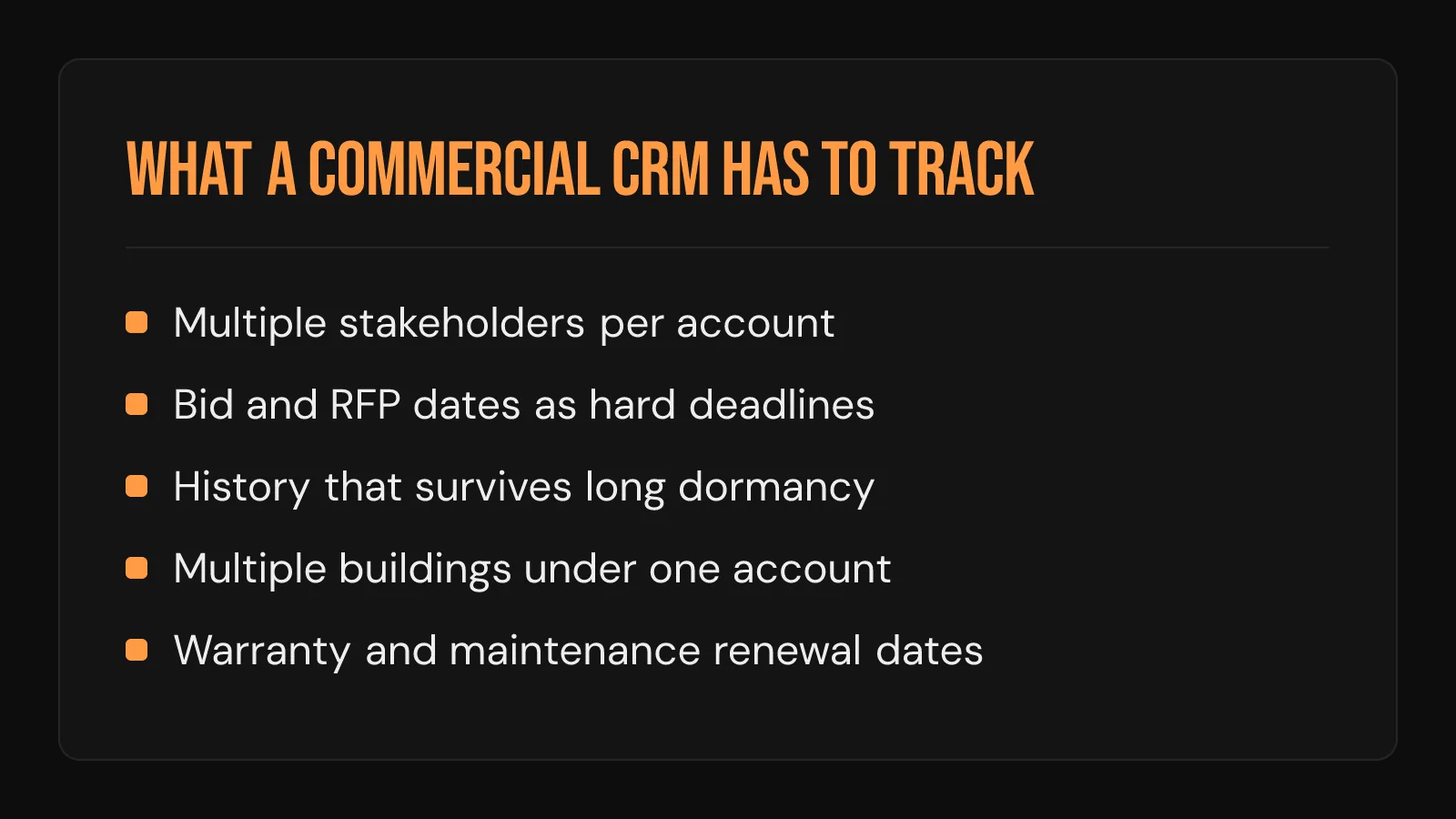
Five structural differences show up once the account on the record is commercial:
- Multiple decision-makers on one account. A facility manager, a property manager, and sometimes a GC or a board can all touch the same deal, each one needing a separate contact record and a distinct role on the account.
- Bid and RFP dates as hard deadlines. A submission date is a calendar event. The record has to surface it on its own, separate from a generic day-three reminder.
- Long dormancy between touches. Weeks or months can pass between a first conversation and a decision, and the account has to still be there, with its history intact, when the buyer resurfaces.
- Multi-site portfolios under one account. A facility group can manage a dozen buildings, and this year's roof is next year's different roof on the same account.
- Warranty and maintenance renewals as their own event. A signed contract turns into a return date years out, a different kind of opportunity than a brand-new lead.
A commercial roofing crm has to hold all five, or the record is just a residential template with bigger dollar amounts typed in.
One Deal, Multiple Decision-Makers
A residential lead record needs one name, one phone number, and one address. A commercial account works differently, and the contact chain usually moves in a predictable order:
- A facility manager fields the first call or form and may have no authority to sign anything.
- A property manager reviews the proposal against other bidders and building priorities.
- A GC coordinates timing and scope if the job runs through a general contractor.
- A building owner or board approves the spend once the contract crosses a set threshold.
A record built for a single contact buries that chain. A record built for a commercial account keeps every stakeholder visible, with a role and a note history of their own, on the same account:
| Attribute | Residential lead record | Commercial account record |
|---|---|---|
| Contacts per deal | One homeowner | Two to four roles across the chain above |
| Decision timeline | Days | Two to eight weeks, sometimes months |
| Job scope tracked | One roof, one visit | Multiple buildings, multiple jobs, one relationship |
| Recurring events | None | Warranty and maintenance-contract renewal dates |
A crew that only has one contact field per account finds this out the hard way, usually when the person who answered the first call turns out to be someone other than the one who could actually sign.
Bid and RFP Dates Are Hard Calendar Deadlines
A homeowner's roof quote sits on the homeowner's own timeline. A commercial bid or RFP does not work that way. Property managers and GCs run their own review calendar, and a submission that lands a day late is usually out of the running before anyone reads it.
It needs a way to hold that submission date as its own field, distinct from the generic "follow up in three days" task a residential pipeline runs on. At minimum, that field should carry:
- The exact submission date and time, tracked to the hour whenever the RFP provides one
- Which documents the RFP requires and whether they are attached
- Who internally owns getting the bid submitted
- The property manager or GC's own review or decision date, if known
Missing a bid deadline means missing an appointment with a decision that already happened without the crew in the room.
Long Dormancy and Multi-Site Portfolios Under One Account
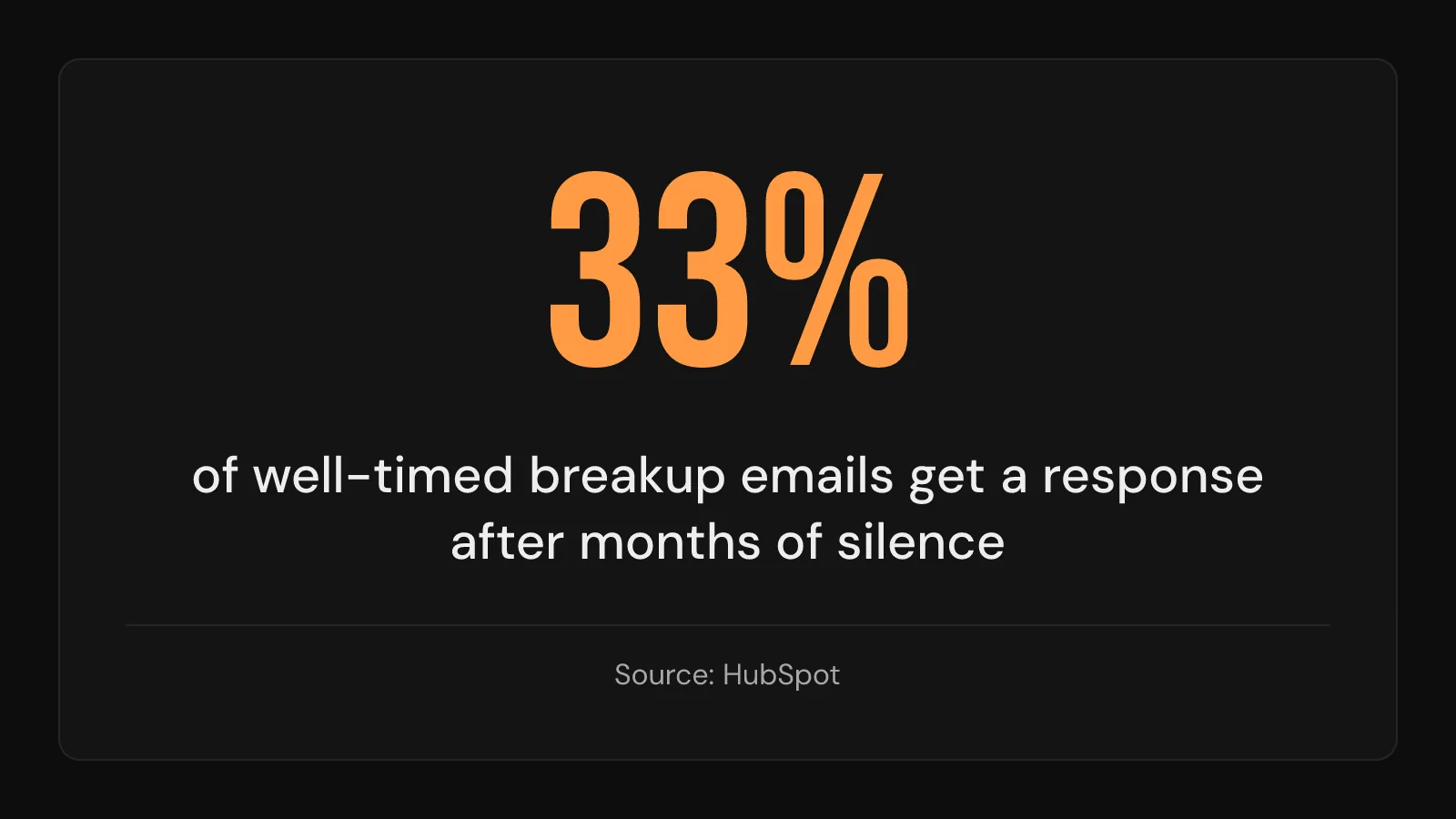
A commercial buying cycle can run for weeks between a real conversation and a real decision, longer once a property manager is comparing bidders on someone else's schedule. Getting the account into the pipeline is covered in how those commercial accounts get found in the first place; staying in it once it goes quiet is this section's problem. A well-timed breakup email gets a response about a third of the time. That only works if the record still holds the deal's full history when the email finally goes out months later.
A crm roofing setup built only around new-bid follow-up misses the second half of this problem: a single facility group can hold a dozen buildings under one account, and next year's inquiry about a different roof on that same property list is the same account picking back up. A dormant commercial account record should still hold:
- The date and outcome of the last real conversation with a person, separate from the last automated touch
- Every building or site tied to that account, beyond the one currently in play
- The name of whoever holds decision authority today, since that person changes
- A next scheduled check-in date, even if it sits months out
Warranty and Maintenance Renewals Are Their Own Event Type
A signed commercial roof job does not end at the final invoice. Warranty terms and maintenance contracts carry return dates years out, and those dates are a different kind of opportunity than a brand-new bid:
| Attribute | New commercial bid | Tracked renewal |
|---|---|---|
| Relationship | Starting from zero | Already established |
| Competing bidders | Usually two or more | Often none, if the renewal date is caught |
| Close-rate ceiling | Bounded by the industry benchmark below | Does not compete inside that same ceiling |
The industry closes 15 to 27% of its leads. Top crews clear 30%. Shared leads from the big marketplaces close at 5 to 15%. A tracked renewal on an account the crew already serviced does not compete inside that same ceiling, because the relationship and the roof history already exist. Commercial roofing software built for estimating or production solves a different problem, and a renewal date sitting years out is easy to lose track of there. A record that only tracks new inquiries and lets renewal dates fall out of view is quietly ignoring its easiest closes.
What The Trust Process Does and Does Not Do Here
The Trust Process does not build, sell, license, or set up CRM software for a roofing company, full stop. Few checklists for the best crm for roofing companies ask whether the record holds a facility manager, a property manager, and a GC on one account across a multi-year relationship. Fixing which platform holds the record is separate from fixing whether anyone acts on what it already shows.
The actual mechanism The Trust Process builds runs underneath whatever CRM or spreadsheet already holds a commercial account, on top of the credibility work covered in full in how commercial roofing leads actually get won. The Automated SMS Delivery and Lead Nurturing System:
- Reaches out to an existing contact on a fixed schedule, without waiting for someone to open the CRM that day
- Keeps working through the dormancy window between real conversations described above
- Runs on top of whatever CRM or spreadsheet already holds the account
Text follow-ups get 45% response rates and convert 112.6% higher than any other channel. That is the mechanism a long, multi-stakeholder decision window needs running in the background while the record itself sits untouched between calls.
Every stakeholder change, bid deadline, and renewal date the record tracks still needs someone or something checking it on schedule.
That is the same problem covered from the ad-spend side in the follow-up cadence a multi-week bid decision actually needs.
Frequently Asked Questions
What makes something the best roofing crm for commercial accounts?
There is no single answer that fits every crew, since The Trust Process does not build or sell CRM software and does not rank vendors. The real test is structural: does the record hold multiple contacts per account, a hard bid deadline field, and a renewal date, or does it treat every commercial account like a single-contact residential lead.
What does a commercial roofing crm need to track that a residential lead record does not?
It needs to hold multiple stakeholders on one account, a bid or RFP date as a calendar deadline, dormancy-proof history across a multi-week decision, multiple buildings under one portfolio, and a warranty or maintenance renewal date as its own event. A residential lead record only ever needed one contact and one short decision window.
Do we need a commercial roofing crm if we already track bids in a spreadsheet?
A spreadsheet can hold the same fields a CRM does for a small number of active bids, until multiple people need to update it at once, a submission date passes with no reminder, or a cell gets overwritten and the history disappears with it. A crew bidding a handful of commercial jobs a year can often run a spreadsheet safely. A growing bid volume is the real signal to move, more than any fixed rule of thumb.
Is commercial roofing software the same thing as a CRM?
Not exactly. Commercial roofing software often covers estimating, measurements, or production scheduling. A commercial roofing crm specifically holds the contact records, bid deadlines, and renewal dates described above, and some platforms sell both under one login, but the two solve different problems.
Does The Trust Process build or sell a commercial roofing crm?
No. The Trust Process does not build, sell, license, or set up CRM software for a roofing company, full stop. The Automated SMS Delivery and Lead Nurturing System is the actual mechanism sold here, and it runs on top of whatever CRM or spreadsheet already holds a commercial account's contacts, deadlines, and renewal dates.