The Free Roofing Marketing Blueprint, In the Correct Order
This free roofing marketing blueprint puts four stages in the order that actually produces jobs, foundation first, paid spend last. Most marketing content for roofing companies reads like a grab bag of tactics: run ads, post on social, ask for reviews, rebuild the website, with no order attached to any of it. An owner running the business alone cannot chase all four at once, and the stage that comes first changes what every later stage can actually do. This blueprint fixes that: four stages, in the order that makes each one worth running, starting with the part most companies skip and ending with the paid channels every vendor pitches first. For why this order matters at all, why is marketing important for roofing companies covers the stakes.
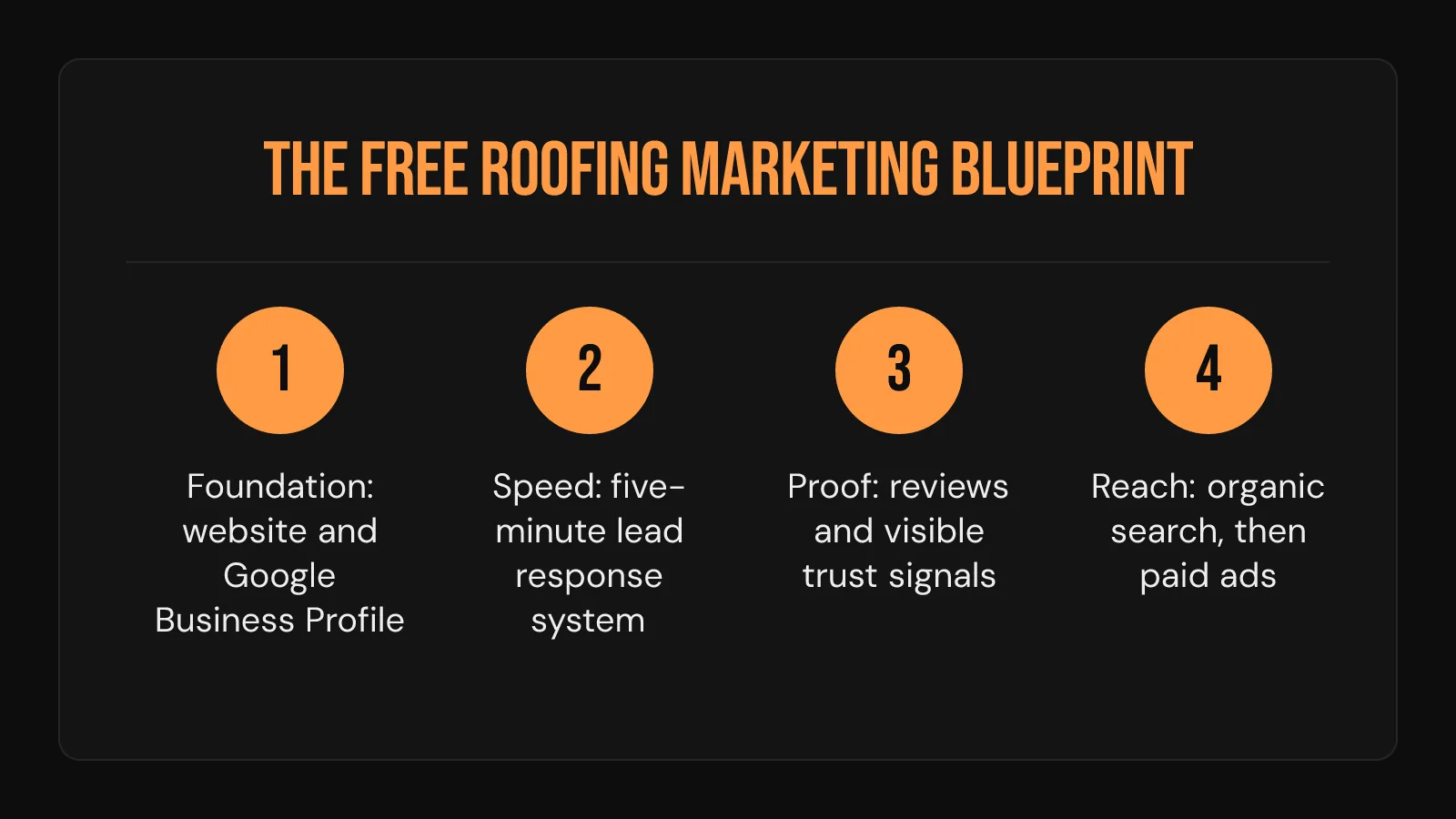
The Free Roofing Marketing Blueprint: Four Stages, In Order
Here is the order, and why it runs this way.
| Stage | What It Fixes | Why This Order |
|---|---|---|
| 1. Foundation | The website and the Google Business Profile | Every later stage sends people through this door first |
| 2. Speed | How fast a new lead gets a real response | The cheapest fix on this list, and the fastest to run |
| 3. Proof | Reviews and visible trust signals | A stranger needs a reason to trust before she calls |
| 4. Reach | Organic search, then paid ads | Reach only pays off once the first three stages can convert what it sends |
Skip a stage and the ones after it work harder for less. A roofing company that buys ads before fixing Stage 1 is paying to send strangers to a door that will not open. The whole point of running these stages in order is roofing leads that actually close instead of names on a spreadsheet nobody calls back.
Stage 1: Fix the Foundation Before Spending on Anything Else
94% of homeowners start their contractor search online. That number alone should settle where the budget goes first: the website and the Google Business Profile are the front door every other stage sends people through. And more than half the field never even gets that door open. 56% of local businesses have never claimed their Google Business Profile at all, which means over half the competition is invisible before the first ad ever runs. These numbers sit inside a wider set of roofing industry marketing statistics and the challenges behind them.
- Claim the Google Business Profile and fill in every field: hours, service area, categories, photos.
- Put a working, click-to-call phone number at the top of every page.
- Add real job photos: before-and-after shots of actual roofs the crew has done.
- List the specific service areas by city or zip code, spelled out in full.
Spend a dollar on ads before this stage is done, and that dollar is buying a click to a door that will not open.
Stage 2: Build the Speed System That Converts What You Already Get
Stage 2 is the cheapest fix on the whole list, and the fastest to run, which is exactly why it comes second. Call a lead inside five minutes and a roofing company is 100 times more likely to reach that homeowner, and 21 times more likely to qualify her, compared with waiting half an hour.
That is a real edge. It is the difference between owning the job and finding out later who did.
- The lead comes in, by form, call, or text.
- Someone on the crew gets notified the moment the lead comes in.
- That person calls back inside five minutes, whenever it is possible.
- If the call goes unanswered, a text follows inside the same five minutes.
- A scheduled follow-up goes out the next day for anyone still undecided.
Stage 3: Stack Proof So Strangers Trust You Before You Call
By Stage 3, the foundation is solid and the speed system is running. Now a homeowner who found the business fast and got a fast callback still needs a reason to trust a stranger on her roof. Going from zero reviews to five can lift conversion by up to 270%, which makes review count one of the most valuable numbers a roofing company can move without spending a cent on ads.
- Ask for the review the day the job finishes, while the work is still fresh in her mind.
- Text a direct link to the review page instead of asking her to search for the business.
- Respond to every review, good or bad, so the next reader sees an owner who is present.
Stage 4: Layer In Organic Reach, Then Paid
Reach comes last on purpose. It is the stage every vendor pitches first, and it is the one that wastes the most money when the first three stages are not ready to catch what it sends. Organic channels, local SEO for roofers chief among them, build slower than paid but keep working long after the spend stops. Paid ads and pay-per-click work fast but stop producing the moment the budget does.
| Channel | Cost | Speed to First Lead | Durability |
|---|---|---|---|
| Organic (local SEO, content) | Mostly time | Weeks to months | Keeps working after the work stops |
| Paid (search ads, Local Service Ads) | Ongoing spend | Days | Stops the day the spend stops |
Add paid spend once these three are already true:
- Stage 1 through 3 are already running day to day, in real practice.
- The website converts the traffic it already gets from organic and referrals.
- There is a real answer for what happens the moment the phone rings.
Both channels amplify whatever the first three stages can already convert, which is the entire point of running this blueprint in order instead of starting here.
Once every stage is running, the conversation shifts from tactics to what actually produces jobs.
From there, the real question is how much of the budget each stage should actually get. The marketing budget percentage that actually fits your stage is a separate number, but it only makes sense once this order is already in place.
Run the free roofing marketing blueprint out of order, and every stage after the skipped one works harder for less. Run it in order, and each stage earns the next one its budget.
Frequently Asked Questions
Do I need to run every stage of the free roofing marketing blueprint, or can I skip to the fast ones?
No skipping past Stage 1 and Stage 2. They are what make Stage 3 and Stage 4 worth running at all, and jumping straight to reach or reviews just means paying more to convert less.
Does this blueprint still apply if I already pay someone for roofing marketing?
Yes. Use it as an audit instead of a to-do list: check what the current vendor is actually covering against these four stages, and see which one is quietly getting skipped. If the audit points toward replacing that vendor, what actually makes a roofing marketing agency worth hiring is the next read.
Why would this blueprint work when roofing marketing has not worked before?
Most failed attempts start at Stage 4, ads or content, while Stage 1 and Stage 2 are still broken underneath. Fix the foundation and the speed system first, and the same channels that failed before usually start working.
What does this blueprint cost to run?
Stages 1 through 3 cost mostly time. Claiming a profile, calling faster, and asking for reviews take attention more than money. Stage 4 is the only stage with a real ongoing dollar cost, which is another reason it runs last.
How long before Stage 1 and Stage 2 actually produce a booked job?
Stage 1 can be done in an afternoon. Stage 2 shows up in the very next lead that comes in, since a five-minute callback either happens or it does not. Stage 3 and Stage 4 take longer to compound.
What is the single biggest mistake roofing companies make with this blueprint?
Starting at Stage 4. Running ads or chasing reach before the foundation and the speed system are solid just sends more strangers to a business that is not ready to convert them.