Roofing Industry Marketing Statistics Challenges and the Fix
Roofing industry marketing statistics challenges show up the same way in almost every shop: leads come in, then quietly stop turning into booked jobs. The numbers below are real, sourced, and current. What most roundups skip is why the numbers land where they do. Content gets published and never gets read. A homeowner finds the business and leaves before deciding anything. A call rings twice and goes to voicemail while a competitor picks up first. This piece pairs each statistic with the obstacle behind it, then closes with what to fix first.
Roofing Industry Marketing Statistics Challenges: The Numbers Behind Them
There are 101,679 roofing contractors in the United States, and most run crews of 20 or fewer. That is the market this data describes: small, busy, and competing for the same local searches every week. Four numbers set up everything else in this piece.
| Stat | What It Means |
|---|---|
| 101,679 roofing contractors nationwide | Most run crews of 20 people or fewer |
| 98% of roofing website content gets zero traffic | Publishing a page is not the same as getting found |
| 62% of consumers skip a business they cannot find online | A weak web presence costs jobs before the phone rings |
| 100x more likely to reach a lead inside 5 minutes vs. 30 | Speed to the phone outperforms extra ad spend |
Why Most Roofing Marketing Content Never Gets Seen
98% of the content on roofing websites gets zero traffic. That number has little to do with effort. Most shops publish a handful of posts, add a location page or two, and stop. Google has nothing to reward because there is nothing built around what a real search actually asks.
A few reasons content goes unseen, in the order we see them most often:
- No page exists for the specific city or suburb a homeowner is searching
- The page exists but never answers the question in the first two sentences
- Nothing on the page signals that this crew specifically handles that job, that material, that neighborhood
- Posting stops after a few months, so the site stops looking active to Google and to a homeowner comparing options
Roofing SEO services fix the mechanics behind this list: pages built around real searches, structured so both Google and the homeowner find the answer fast. For the channel-by-channel version of the same problem, the roofing contractor marketing guide walks through the full sequence.
The Web-Presence Gap Nobody Budgets For
62% of consumers skip a business they cannot find online. That number does its damage early: before the phone rings, before a form gets filled out. A homeowner searches, does not find a real, current business behind the name, and moves on to whoever shows up next.
A web presence usually looks abandoned for a few plain reasons:
- No recent reviews or job photos, so the last update looks like it happened years ago
- Contact information that does not match what shows up in search results
- A site that is slow or broken on a phone, which is where most of this searching actually happens
The gap is a trust problem stacked on top of a visibility problem, and design is the smaller half of it. A missing or abandoned-looking web presence reads as risk to a homeowner sizing up a $10,000 to $30,000 decision she cannot easily verify herself.
Why Fast Lead Response Beats a Bigger Ad Budget
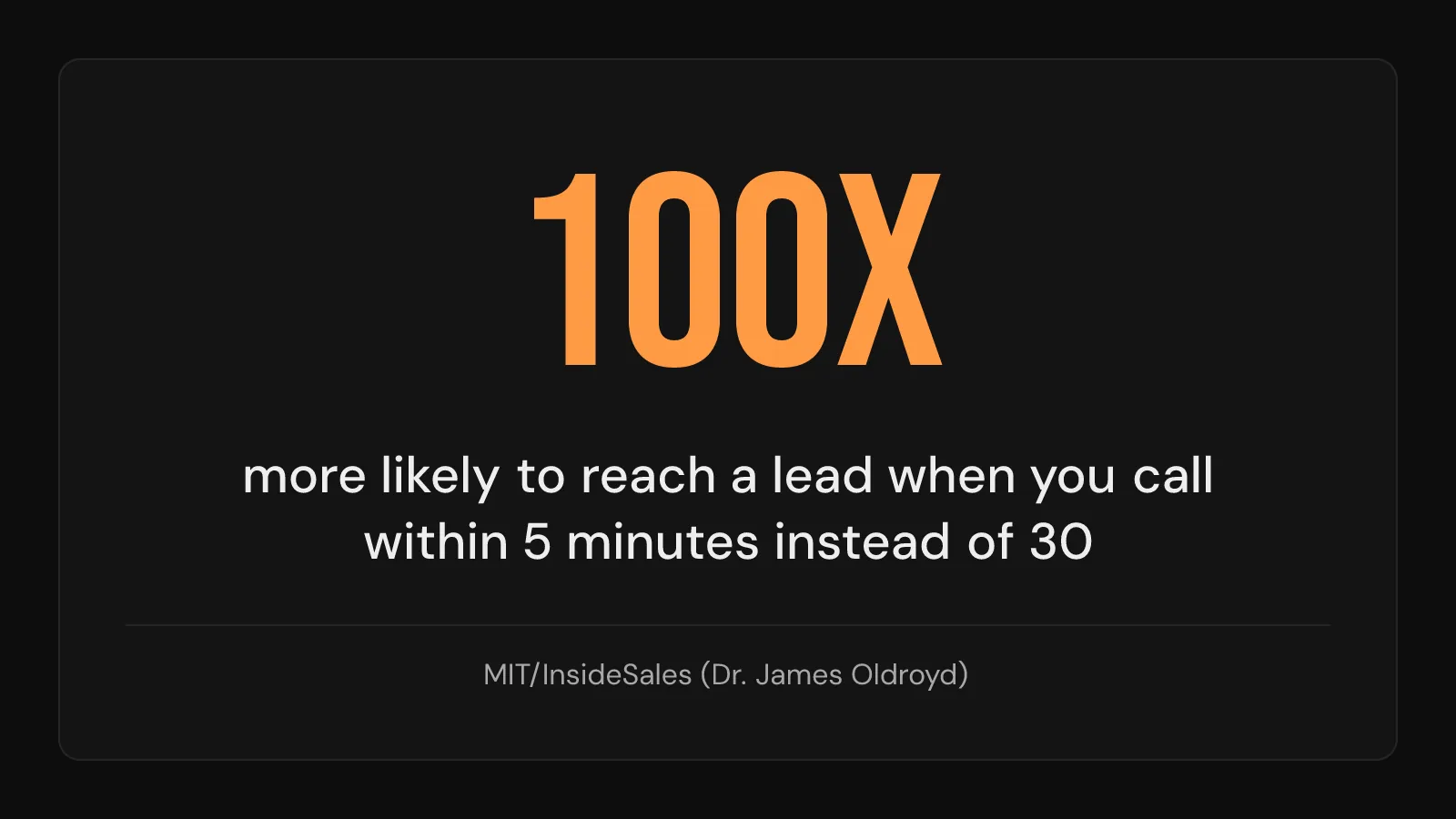
Call a lead inside five minutes and you are 100x more likely to reach them and 21x more likely to qualify them than if you wait half an hour. That gap decides more jobs than the ad platform, the creative, or the offer ever does.
| Response Time | What Happens |
|---|---|
| Within 5 minutes | Up to 100x more likely to reach the lead, 21x more likely to qualify them |
| Within 30 minutes | The baseline these multipliers are measured against |
| A few hours later | The lead has usually already booked with someone else |
Homeowners decide who they trust inside a five-minute window after submitting a form. A missed call during that window hands the job to whichever roofer picked up first. Roofing digital marketing experts check response speed before they touch ad spend, because fixing it costs nothing extra to run and moves the number that actually decides the job.
What These Numbers Mean for Your Next Move
Roofing industry statistics marketing challenges compound each other: a form nobody answers, a page nobody finds, a call that rings too long, each one making the next more expensive to fix. Each of the four numbers earlier in this piece maps to a specific point where a real job gets booked or gets lost.
Roofing industry marketing statistics challenges rarely get solved by spending more before fixing what is already broken. Fix these in order of impact:
- Confirm the site is actually visible for the real local searches homeowners run
- Make the web presence look active, current, and staffed by real people
- Fix speed to the phone before adding a single dollar of ad spend
- Only then treat roofing leads that actually close as a channel worth adding on top
For where the industry is headed next, rather than where it gets stuck today, roofing marketing statistics and trends for 2026 covers the forward-looking numbers.
Frequently Asked Questions
What do roofing industry marketing statistics actually show about lead conversion?
They show a mismatch between effort and results. Most roofing companies publish content, run some ads, and still lose bookable jobs to slow response and weak web presence, which is why the numbers above focus on conversion moments rather than raw traffic.
Do roofing industry marketing statistics point to one advertising channel as the best option?
Channel choice matters less than what happens after the lead arrives. A fast response and a credible web presence make every channel, paid or organic, perform better than it would on its own. The best advertising for roofing breaks down what paid search, social ads, direct mail, radio, and referrals are each actually built to do before any of these statistics get applied to a real budget decision.
Why does most roofing marketing content fail to generate leads?
Most roofing content gets published without being built around a real search a homeowner actually runs, so Google has nothing specific to rank it for. A generic blog post rarely outperforms a page built for one city, one service, and one clear answer.
Why do roofing companies lose leads even when their marketing is working?
Marketing can fill the pipeline and still lose the job at the phone. A lead that waits 30 minutes for a callback is dramatically less likely to become a booked job than one called back in five, regardless of how the lead arrived.
What makes roofing marketing harder than marketing for other home service businesses?
Roofing sells a $10,000 to $30,000 decision a homeowner usually cannot verify herself, tied to weather-driven demand and a crowded field of contractors chasing the same storm cycle. That combination raises the trust bar higher than most home service categories. That storm cycle is exactly the timing challenge covered in storm season marketing for roofing companies.