Storm Season Marketing Roofing Companies Need This Year
Storm season marketing roofing companies run in the weeks before a hailstorm decides who gets paid this year. Most contractors wait until damage reports start showing up online, then scramble. Ad accounts sit paused. The phone system routes calls the same way it does in a slow February. That gap between when the storm hits and when the marketing catches up is where the year's best jobs go to whichever competitor was already set up. This piece breaks down what needs to be staged before the sky turns green, what to run in the first 72 hours after, and how to compete with the crews who show up from three states away chasing the same roofs.
The Storm Season Marketing Roofing Companies Run Before the Sky Turns Green
Most of what gets called storm season marketing roofing companies actually run once the wind has already died down. That is backward. The contractors who win the season set up three things before the first radar warning:
- An advertising budget that can flip on the same day.
- A website that loads fast enough to hold a homeowner's attention on a cracked phone screen.
- A call-answering system that does not care what time the phone rings.
The work that wins the job happens before the job exists. None of this is complicated. It is mostly discipline: keeping the Google Business Profile current in the off-season, keeping review requests going out every month instead of only after a good one, and treating the slow months as the staging ground for the fast ones. Storm season marketing works best as part of a complete roofing marketing plan rather than a separate emergency system bolted on once the wind picks up.
Before the Storm: Staging Your Storm Damage Roofing Marketing Strategies
The storm damage roofing marketing strategies that actually work get built during the calm months. Waiting until a warning is on the news means competing against contractors who staged everything back in March.
- Google Business Profile. Photos updated monthly, hours accurate, service area matching where the crew actually works.
- Ad budget on standby. A budget that can go live the same day a storm makes landfall instead of sitting in someone's inbox for a week.
- A landing page built for one job, separate from the homepage. A page that answers whether the crew can come look at the roof, in one scroll, on a phone, with a form that takes under a minute.
- Review requests on a schedule. Every closed job gets asked for a review, every month, including the slow ones.
- A content system already stocked with real job photos. Before-and-after shots from the last storm season, ready to post the moment the new one starts.
Skip any one of these and the marketing spend that follows the storm has nowhere solid to land. Each item on that list is an asset the business keeps after the season ends, and roofing marketing leads produced by those assets keep arriving long after the storm traffic fades.
Speed to Lead: Why the First Call Back Wins the Storm Season Race
Homeowners decide in minutes, yet the industry average response time is still 42 hours. That gap is where storm season gets won or lost. A homeowner with a tarp on her roof and three roofing trucks already parked on her street is not waiting around for a callback the next morning.
78% of homeowners go with the first company that responds. Call a lead inside five minutes and you are 100x more likely to reach them and 21x more likely to qualify them than if you wait half an hour. During a normal week, a slow callback costs one job. During storm season, when every contractor in three counties is knocking on the same street, it costs the whole block.
| Response time | What it typically means |
|---|---|
| Under 5 minutes | Contact and qualify rates both highest on record |
| Under 30 minutes | Contact odds already falling fast |
| Same day | Competing against a name the homeowner already forgot |
| Next day | The job is gone |
A five-minute response system built before the surge hits is worth more than any single ad dollar spent after it.
After the Storm: Roofing Storm Damage Marketing Strategies for the First 72 Hours
The roofing storm damage marketing strategies that matter most in the first three days look different from anything staged beforehand, because this phase is pure execution.
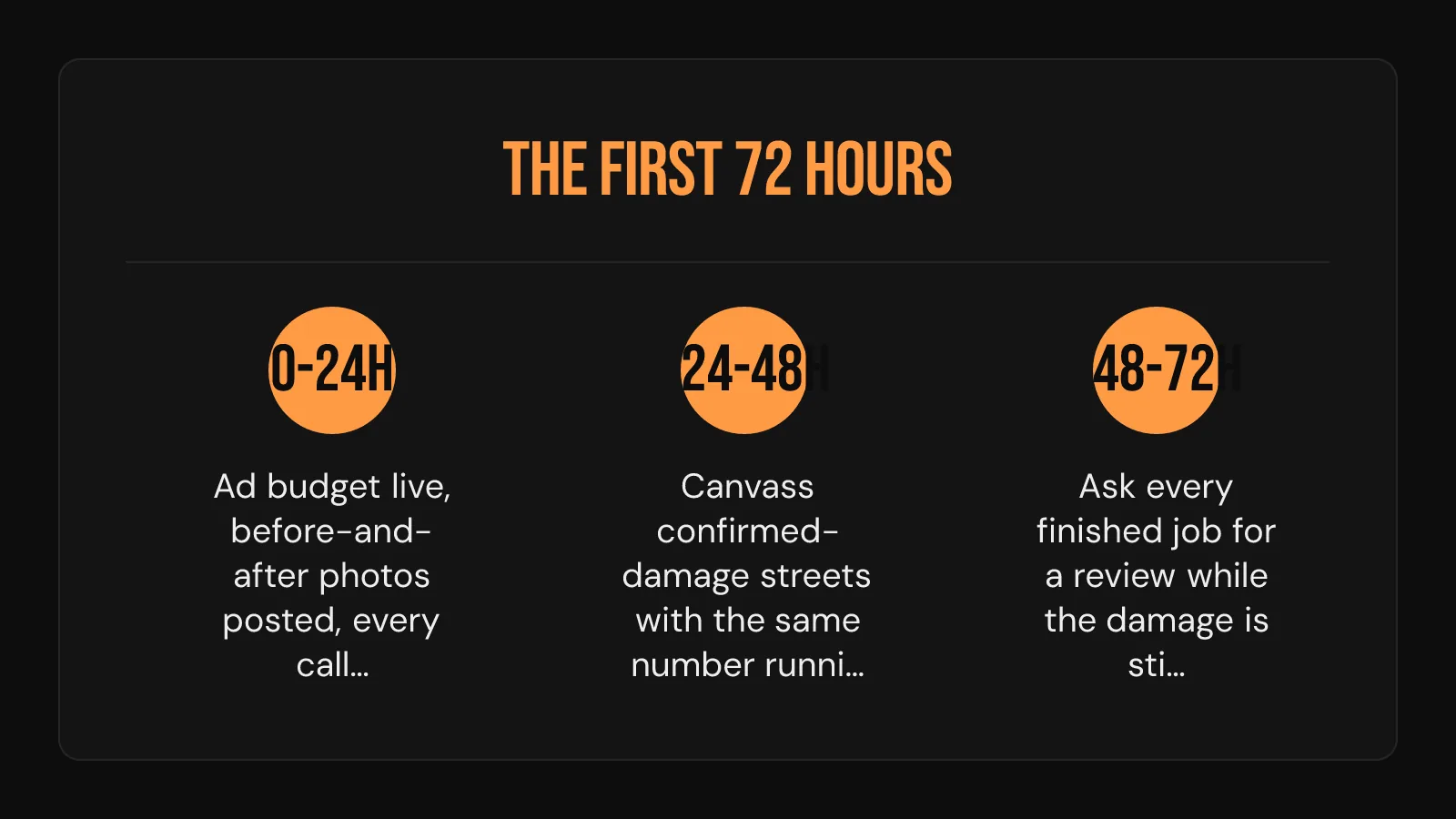
- Hours 0 to 24. Flip the paused ad budget live. Post before-and-after photos from the first jobs as soon as they exist. Answer every call live. Do not let voicemail take the first wave.
- Hours 24 to 48. Canvass the streets closest to confirmed damage, in person, with the same phone number that is answering the ads. A doorknock and a website that match build more trust than either alone. A tightly targeted mailing to the same confirmed-damage streets reinforces the same name; see what actually goes on a storm-triggered roofing advertising postcard for how to time and target one.
- Hours 48 to 72. Start asking finished jobs for reviews immediately, while the tarp is still fresh in the homeowner's memory. A review posted this week carries more weight with the next homeowner scrolling through options than one posted last year.
One missed call costs the average roofing contractor over $2,500. Miss 10 in a month and that is $25,000 gone. Storm season is exactly when a normal month's worth of missed calls can happen in a single week.
How Storm-Chasing Crews Market, and How to Compete With Them
Every hail season, out-of-state crews roll into the hardest-hit neighborhoods and start knocking doors. Most of what passes for storm chasing roofing marketing tips online is written for those crews: hit a market hard, close fast, move to the next county before the first punch list comes due. A local contractor runs on a longer clock than a storm-chasing crew does: a shop, a crew, and a reputation to protect for the next 10 years. The advantage that builds is the one thing a storm chaser cannot fake: a name people in town already trust or already know how to check. In a hail-alley metro that gets hit every spring, roofing SEO in Colorado Springs shows what that durable local search presence looks like in practice.
| Storm-chasing crew | Local roofing company | |
|---|---|---|
| Licensing / local address | Often neither | Verifiable, on file |
| Still answering calls in month six | Rarely | The job is to be there |
| Review history | Thin or none | Years of history to point to |
| Familiar with local adjusters | Variable | Knows them by name |
Most of the storm chasing marketing roofing contractors tips floating around online focus on speed alone and stop there. Speed matters. Everything in this piece says so. But a local contractor competing on speed alone is fighting on the chaser's home turf. Compete on speed for the same lead a storm-chasing crew is also bidding on, and let the review history and the local address do the rest of the work.
The contractors who treat storm season as routine business keep the roofing leads pipeline full in October the same way it was full in June.
Frequently Asked Questions
What's the best advertising for a roofing company during storm season?
Paid search and Google Business Profile visibility both outperform other channels once a storm has already hit, because that is where a homeowner who just Googled "roofer near me" actually looks first. The advertising only works if the answering system behind it can handle the volume, and an ad that generates calls nobody picks up is money spent on somebody else's job. Outside storm season, the best advertising for roofing ranks all six channels a roofing company actually uses side by side, including the two that spike hardest once a storm hits.
How much can a roofing company make in one storm season with the right marketing in place?
The ceiling depends more on response capacity than ad spend. A contractor who can answer, quote, and close within the first call has a real shot at making most of a slow season's revenue in the weeks right after a storm. A contractor who leaves the same after-hours answering gap open that exists every other month leaves most of that upside on the table.
Is storm season marketing worth the cost if a storm might not even hit our area?
Most of what this piece describes helps every month of the year, storm or not: a current Google Business Profile, a steady review cadence, a landing page that loads fast. The two pieces that are storm-specific, a standby ad budget and a canvassing plan, cost almost nothing to keep staged and ready even in a quiet season.
Why would a roofing company that already pays a marketing company need something different for storm season?
The question worth asking the marketing company already on retainer is whether the budget can flip on the same day a storm makes landfall, or whether it takes a week of back-and-forth first. A lot of standing marketing arrangements are built for steady, month-to-month demand and were never tested against a real surge.
What makes storm season marketing different for a roofing company that got burned by an agency before?
Most bad experiences with storm season marketing come from an agency that ran ads without fixing what happened after the click, so the leads showed up and then went cold in a slow follow-up queue. Fixing the response system first, then adding ad spend on top of it, is the part that usually gets skipped.