Why Is Marketing Important for Roofing Companies?
Why is marketing important for roofing companies? Because 101,679 roofing contractors compete for the same jobs nationwide, and a homeowner only calls the ones she can actually find. Marketing is what gets a crew's work in front of that search. That matters even for a company that already gets steady work from referrals, because that pipeline runs dry the moment a slow season hits or a sharper competitor starts showing up first online. This article covers what marketing actually buys a roofing company: the competitive math, the cost of skipping it, and why a bad experience with one vendor is not a reason to give up on it.
Why Is Marketing Important for Roofing Companies? The Short Answer
Marketing decides which roofing company gets the call when a homeowner has three tabs open and 30 seconds to pick one. There are 101,679 roofing contractors in the United States, and most run crews of 20 or fewer. Every one of those companies is real competition for a search a homeowner runs from her couch, and marketing is what puts a company in front of that search regardless of crew quality.
The payoff shows up in real numbers. Small businesses with websites are 2.8x more likely to grow revenue. A homeowner comparing roofers in her area picks from whoever she can actually find and trust in the few minutes she gives the decision. Marketing is what earns a company a spot on that shortlist.
What Happens to a Roofing Company That Skips Marketing
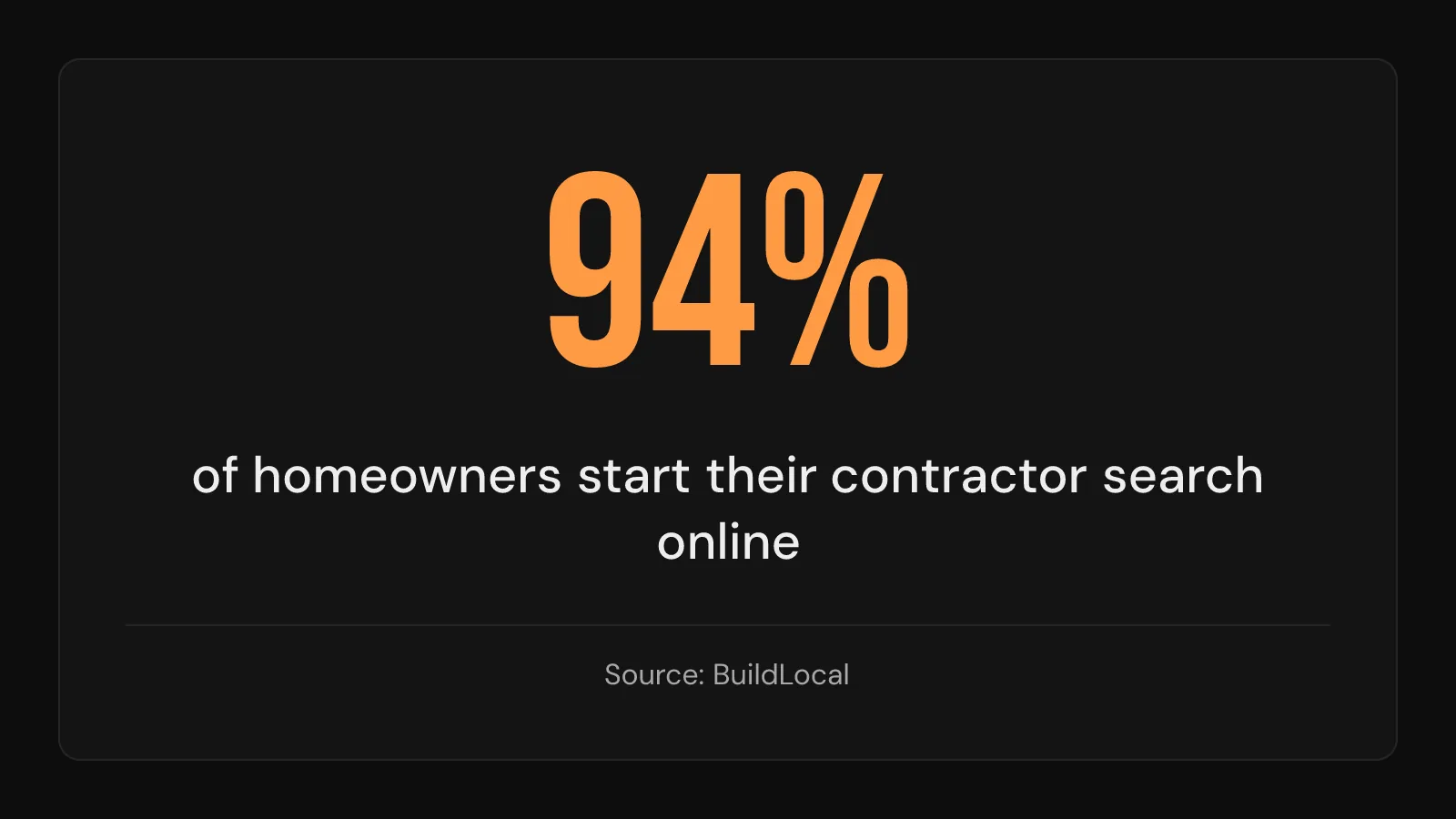
A roofing company that skips marketing keeps losing ground to whichever competitor shows up first, season after season. 94% of homeowners start their contractor search online before they call anyone, so a roofing company that is hard to find loses jobs it never even knew it was competing for.
Here is what that costs a roofing company over a full season:
- A homeowner searches the company's name after a referral, finds an outdated site or no listing at all, and calls a competitor instead.
- A slower, more expensive crew wins the job simply because it showed up first in the search.
- Word-of-mouth leads that used to close on trust alone now stall while the homeowner checks a few more options online.
- Storm season traffic goes to whichever roofer already ranks, regardless of which crew would have done the better job.
Why local SEO matters for roofers covers the search-ranking mechanics behind that first bullet in full. The pattern holds across every channel: invisible companies lose jobs they were qualified to win. The flip side is measurable too, because a company can treat roofing marketing leads as the output of the assets it owns and trace a thin week back to the one asset causing it.
The Channels That Actually Count as Marketing
Marketing covers everything that puts a roofing company in front of the next homeowner before a competitor gets there, across several different channels at once. Four channels carry almost all of it for a roofing business:
| Channel | Why it counts as marketing |
|---|---|
| Word of mouth | The highest-trust channel, but it only reaches people already inside someone's network. |
| Google Business Profile | The listing most homeowners check first, before they ever visit a website. |
| Organic search (SEO) | Earns the click from homeowners who are already searching on their own. |
| Paid ads | Buys visibility immediately, at a real cost per lead, while the other channels build. |
Ranking these four channels in depth is its own subject. Best marketing for roofing companies ranks all four by what actually closes the job, and marketing for roofing contractors covers how they work together as one system. What matters here is scope: a roofing company that only counts word of mouth as "marketing" is missing three of the four channels a homeowner might use to find it.
Why Some Roofing Companies Give Up on Marketing (and Why That Is the Wrong Read)
Some roofing company owners already tried marketing once. They paid a vendor, got a batch of calls that mostly did not convert, and decided marketing does not work for a business like theirs. 70% of roofing companies do not trust the marketing provider they already pay, so that reaction is common and it makes sense.
Most of those failures trace back to the same root cause: nobody could tell which channel actually produced the job that closed, so the entire marketing spend got blamed for the parts that were not working. That is why is marketing important for roofing companies to get right, no matter how the last vendor performed. A system that tracks which lead came from where turns marketing into a number a company can actually manage.
A roofing company burned once needs one thing: a system that can tell a channel that is quietly working apart from one that never was. Before putting money into any channel again, an honest breakdown of how to advertise a roofing business lays out what each option costs and the order to try them in. A crowded market like Orange County makes that distinction worth real money, where roofing marketing in Orange County has to compete against dozens of local roofers chasing the same searches.
Frequently Asked Questions
What is the best way to advertise a roofing business?
It depends on the company's stage. A brand-new roofing business usually needs paid ads or aggressive local SEO to build initial visibility fast, while an established company already earning referrals gets more value from organic search and Google Business Profile work. Best marketing for roofing companies ranks all four channels by what actually closes jobs, and the best advertising for roofing goes deeper on the paid and offline side of that same comparison, paid search, direct mail, radio, and Local Services Ads included.
Do Google Ads work for roofing companies, or is organic search the better bet?
Google Ads can work, but the cost per lead is real and ongoing, and the visibility stops the moment a company stops paying for it. Organic search takes longer to build but keeps producing calls without a per-click bill once it ranks. Most roofing companies get the strongest long-term return from a mix of both. That compounding return across search, content, and the Google Business Profile is the exact focus of inbound marketing for roofing companies.
Does a roofing company that already gets referrals still need marketing?
Yes, because referrals depend on a network that already trusts the company, and that network is finite. Marketing extends reach beyond it, to homeowners who have never heard the company's name and are searching cold. Word of mouth alone caps growth at the size of that existing network.
How can a roofing company tell if its marketing is actually working?
Track each booked job all the way back to the channel that actually produced it, since a trail that stops at wherever the phone call landed hides where the lead really started. A missed-call log, a source tag on every lead, or a simple system that ties a booked job to its channel all work as a starting point. Without that tracking, a company cannot separate a channel that is quietly working from one that is wasting its money.
Why did my last roofing marketing effort not produce jobs?
A missing way to tell which lead came from where, combined with slow follow-up on the leads that did arrive, sinks most marketing efforts before the channel itself gets a fair test. A vendor who reports on activity, like call volume, without ever reporting on outcomes, like booked jobs, can look productive while producing very little.