What Influences Local SEO for Roofers, in Order of Weight
What influences local SEO for roofers is a shorter list than most advice suggests, and the items on it pull with very different force. A roofing company can spend a whole quarter on the wrong one and watch nothing move. One of these signals sits outside anyone's control. Two of them are free. The rest cost a habit. This page puts the factor groups in order of weight and marks which ones a crew can actually change.
What influences local SEO for roofers, ranked by weight
The map pack reads a business the way a neighbor would: where is it, what does it say it does, and does anyone vouch for it. Every signal below answers one of those three questions, and they carry uneven weight.
| Factor group | How much it moves local rankings | How much a roofer controls it |
|---|---|---|
| Proximity to the searcher | Heaviest single influence | None |
| Google Business Profile category accuracy | High, and it gates the rest | Full, and free |
| Google Business Profile completeness | High | Full, and free |
| Review volume, velocity, and recency | High | High, through one habit |
| Location pages, service pages, consistent details | Moderate | Full |
| Engagement signals: clicks, calls, direction requests | Moderate, and compounding | Indirect |
| Citations and directory listings | Low once the basics match | Full, and cheap |
| Backlinks and domain authority | Low for the map pack | Slow |

The control column decides where the week goes. A heavy factor with no control is context worth understanding once. A moderate factor with full control is work worth scheduling.
Proximity is the factor you cannot change
Proximity gets measured from wherever the homeowner stands when she searches, against the address Google has on file. It is why the same search run a few miles apart returns two different sets of results. Distance is rarely the thing profile work moves, and no realistic amount of it reliably overrides distance on a near-me search. What that means for a service-area business:
- Rankings sit strongest in a tight ring around the address and fall off from there.
- One office cannot hold the map pack across a whole metro, however complete the profile is.
- A town well outside that radius behaves like a separate market with a separate set of competitors.
- A second yard with a real, staffed address is a different ranking position, and Google treats it that way.
Proximity is why service-area planning is an address-and-pages question long before it is a keyword question.
Category accuracy pulls harder than profile effort
Two profiles can be equally complete and eligible for completely different searches. The primary category is what the listing gets sorted by, so it gates every other signal attached to it. Completeness is the tiebreaker after that gate opens. The category alone decides:
- Which searches the profile is eligible to appear for at all.
- Which secondary services Google associates with the listing.
- Which competitor set the profile gets measured against in the pack.
This is the split most owners miss. A profile filled out perfectly under a general contractor category will lose roofing searches to a thinner profile filed under roofing contractor. Category accuracy is binary and free, which makes it the highest-return hour available to most roofing companies. The field-by-field work sits one level down, and how to work the Google Business Profile fields in order covers it.
Reviews do three jobs, and volume is the weakest of them
Reviews behave as three separate signals: how many there are, how fast they arrive, and how recent the newest ones are. Each one carries a different weight.
| Review signal | What it appears to influence in search | What a homeowner reads from it |
|---|---|---|
| Total count | Prominence, slowly, with diminishing returns | Whether the company is established |
| Velocity | Prominence, faster than raw count does | Whether the company is busy right now |
| Recency | Freshness, which the map pack rewards | Whether the last few jobs went well |
| Owner responses | Profile activity | Whether anyone is running the business |
Recency is the one that gets underplayed. 27% of consumers now put the most weight on reviews from the past two weeks. A long wall of reviews with nothing new since spring reads as a business that used to be busy.
Velocity does double duty. Every 10 new reviews add about 2.8% to conversion. Every tenth of a star adds 4.4%. That second job is a conversion effect, which is why a review habit pays back before any ranking moves. A weekly review routine a crew can actually keep is the whole mechanism.
Site-side signals widen what the profile can reach
The website is the second surface Google reads, and its job in local search is narrower than most roofing sites assume. Pages widen the set of searches a business is relevant for. Consistent details keep Google confident that every listing points at the same company.
- Location pages earn relevance for towns the address alone would never reach.
- Service pages earn relevance for the job type, which matters when a homeowner searches by the damage she has.
- Name, address, and phone consistency protects what the first two earn. It is a floor: clearing it lifts nothing on its own, and failing it drags everything down.
The layers underneath that are ordinary site work, and the site-side roofing SEO checklist in build order walks them in sequence.
Citations carry less weight than the advice claims
Directory listings were a heavier signal when Google had fewer ways to confirm a business was real. Mapped addresses, phone verification, and years of review history now do most of that confirming. Citations still work as a consistency check, and a consistency check has a low ceiling by design. A citation set only has to do three things:
- Match the profile exactly on name, address, and phone.
- Sit on the handful of directories homeowners in your market actually open.
- Stay free of the duplicate listings an old office address leaves behind.
The mass-directory submission package sold to contractors mostly buys duplicates, which is the exact thing citations exist to rule out. Treat the citation audit as a fix-once job with an annual recheck, then spend the recovered hours on reviews. The step-by-step local SEO checklist for roofing companies has the audit itself.
Engagement signals, and why two crews on the same street rank differently
Two roofing companies can share a street, a category, and a similar review count, and still hold different positions. The difference usually sits in what homeowners do once both profiles appear. Clicks to the website, taps on the call button, and direction requests all tell Google that a listing answered the search.
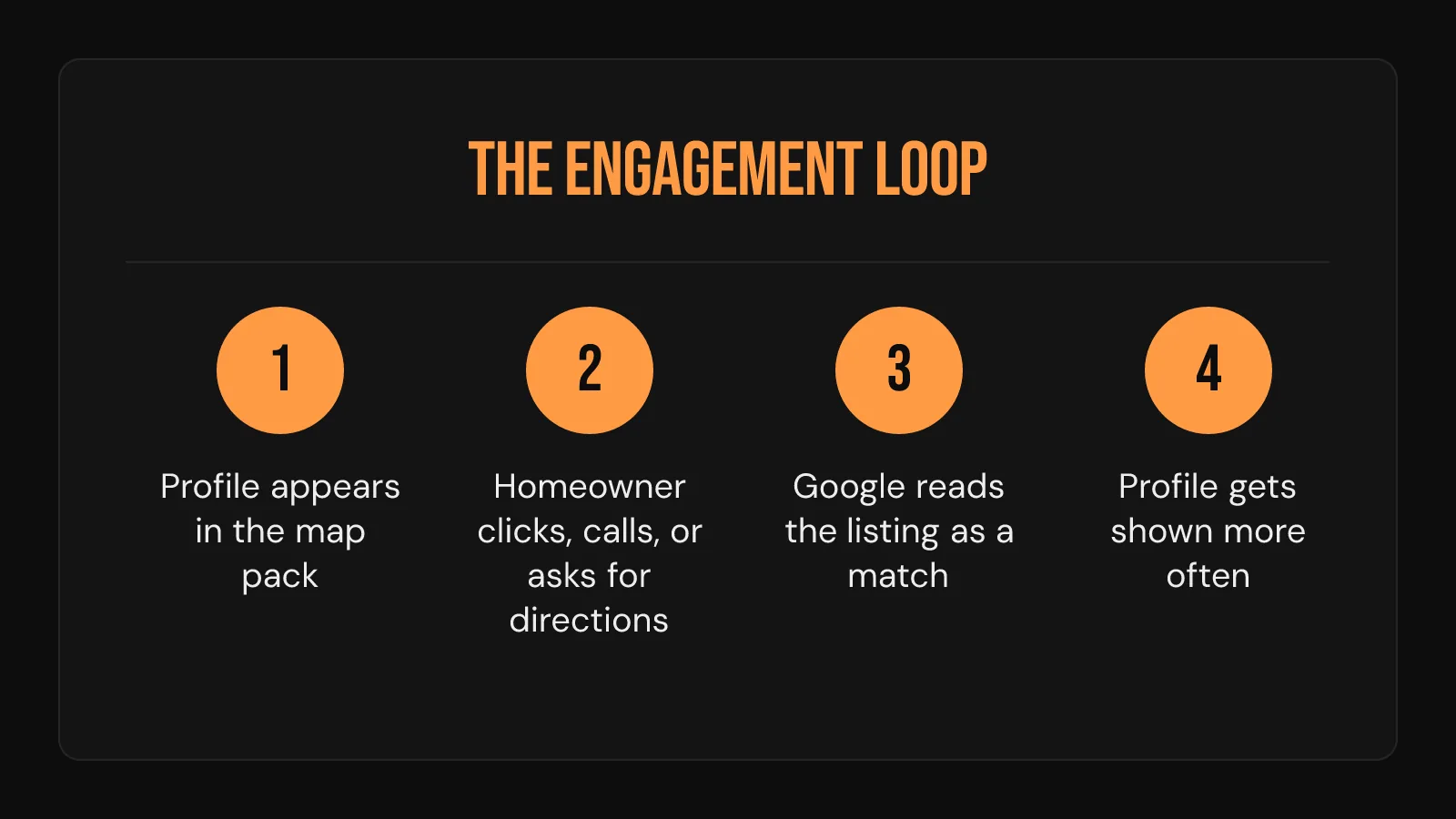
Photos are the cheapest input to that loop. Google's own numbers: profiles with photos get 42% more direction requests and 35% more website clicks.
The profile chosen more often gets shown more often, and that loop is the real reason two crews doing identical work sit in different positions. It is also why the ROI case for local search keeps compounding well after the first ranking moves.
Where a small crew gets the most movement first
Ordered by weight, with the free ones first:
- Check the primary category. One field, no cost, and a wrong value quietly disqualifies the profile from the searches that matter most.
- Start a review habit with a steady monthly flow. A text the day the crew signs off, every job, no exceptions. Recency and velocity both come out of that habit.
- Build one real page for each town you actually work. Real content about that market, one town per page, since proximity will never stretch an address that far.
- Make the listings match. One evening of cleanup, then an annual recheck.
Everything past those four is a long tail worth doing after them. That is the short answer to what influences local SEO for roofers: three groups you can work, and one you cannot.
One honest caveat sits underneath all of it. A ranking produces a call, and a call the office never answers ends right there. A local SEO program run for roofing companies earns its keep only when the phone side holds up its end.
Frequently Asked Questions
What are the three primary ranking factors for local SEO in a roofing market?
Google sorts local results by proximity, relevance, and prominence. Proximity is the distance between the searcher and the business address, relevance is how well the profile and site match the search, and prominence is how established the business looks across reviews and mentions. Only the last two are workable for a roofing company.
Which handful of factors carries most of the movement for a roofing company?
Category accuracy, a live review flow, and real pages for the towns you work. Those three account for most of the movement a roofing company will ever see, and the long tail of smaller tweaks produces very little on its own. The catch is that proximity sits outside all of it and cannot be worked at all.
Which factor did we miss if the profile is finished and rankings barely moved?
Usually one of three. The primary category is wrong or too general, the review flow never actually started, or the address sits far enough from the searches that proximity is capping the result. Check them in that order, since the first two cost nothing to fix.
Why are we behind in the map pack when our SEO vendor reports rankings climbing?
Organic position and map pack position are separate results running on different factor groups. A report tracking organic keyword positions can be accurate and still say nothing about the box that produces most of the phone calls. Ask for map pack position on your money terms, measured from inside your service area.
Which local SEO factor gives a small roofing crew the most movement for the least money?
Category accuracy, because it is a single field and it costs nothing. After that, the review habit, which costs one text message per completed job. Both outrank every paid option on return for a crew running two or three trucks.