Roofing SEO Checklist: The Site-Side Work, in Build Order
A roofing SEO checklist is only as useful as the order it is worked in, because each layer of the site depends on the one underneath it. A page title cannot rank a page Google never crawled. A city page cannot convert a visitor who left during the load. This list covers the website itself, layer by layer: the technical base, the on-page fixes, the pages worth having, and the monthly loop that tells you whether any of it moved. The Google Business Profile side has its own list. The local SEO checklist for roofing companies handles that layer, and the two lists together cover the whole search picture.
The roofing SEO checklist at a glance
Four layers, in the sequence they should be built. Skipping ahead is the most common way a roofing site ends up with content that ranks nowhere.
| Layer | What it fixes | When to work it |
|---|---|---|
| Technical foundation | Whether Google and homeowners can reach the site at all | First, before any content work |
| On-page basics | Whether each page tells search engines what it is | Second, on every existing page |
| Content architecture | Whether the right pages exist for the right searches | Third, one page at a time |
| Measurement | Whether the first three layers are actually moving | Monthly, forever |
Each layer gets its own checklist below.
Layer one: the technical foundation
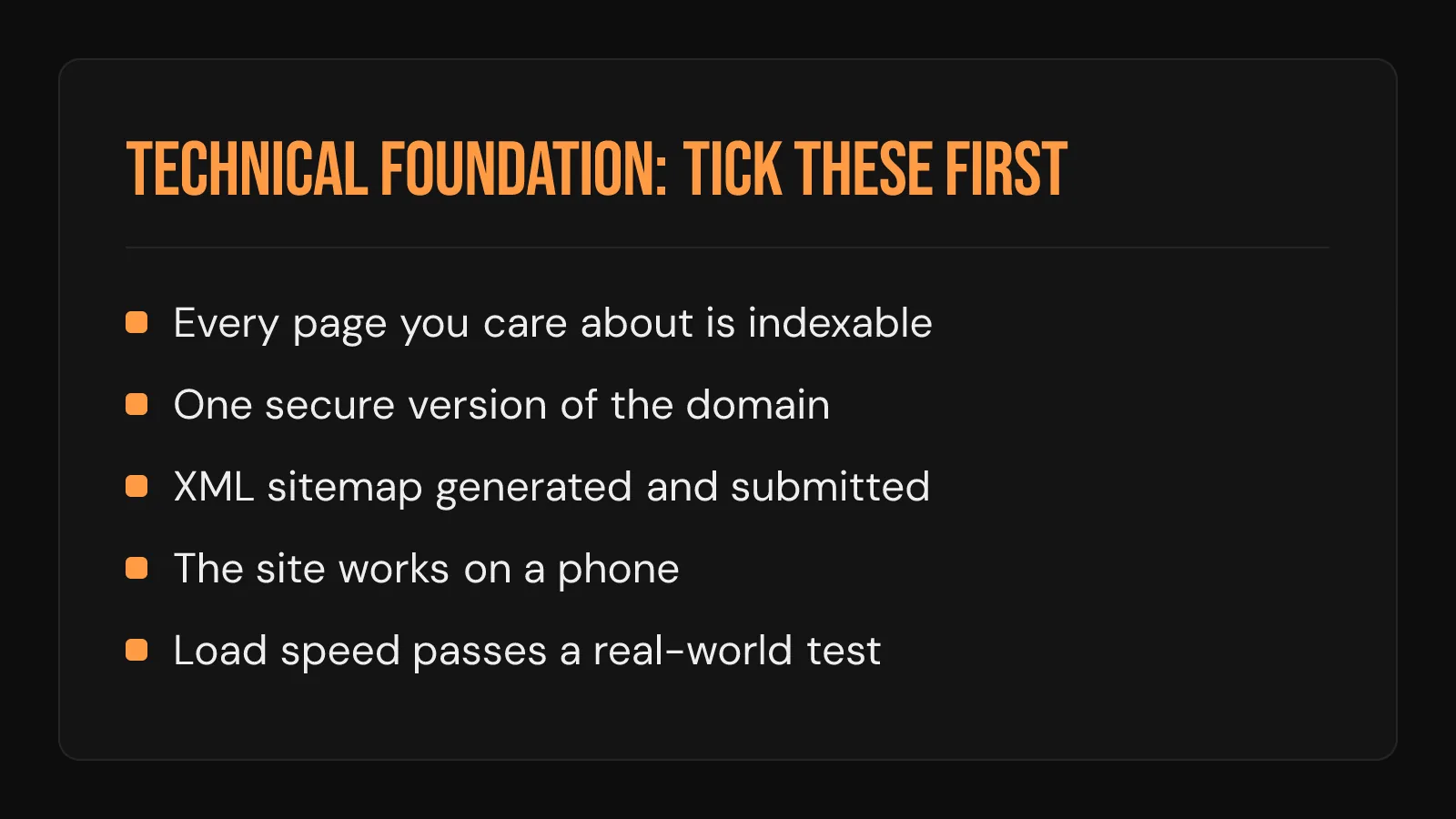
Nothing else on this page matters if the site fails here. 62% of consumers skip a business they cannot find online, and a crawl-blocked or half-indexed roofing site is invisible in exactly that way. Tick these first:
- Every page you care about is indexable. Search
site:yourdomain.comand count what comes back. Missing service pages usually trace to a stray robots rule or a noindex tag left over from the site launch. - One version of the domain. The www and non-www versions, and the http and https versions, should all land on a single secure address. Four addresses splitting one site's authority is a silent tax.
- An XML sitemap exists and is submitted. Most site platforms generate one automatically. Submitting it in Search Console is the step owners skip.
- The site works on a phone. Text readable without pinching, buttons a thumb can hit, the phone number tappable on the first try.
- Load speed passes a real-world test. A site that loads in one second converts at three times the rate of one that takes five. Check it on a phone over a mobile connection, since that is how homeowners will meet it.
Layer two: the on-page basics
With the foundation solid, each page needs to say plainly what it is. This layer is mechanical work an owner or an office manager can run through page by page:
- Title tags lead with the service and the area. The browser-tab title is still the heaviest on-page signal a page has.
- A meta description exists for every page. Written by a person, describing that page. It sways the click even where it does not sway the rank.
- One H1 per page. The visible headline should name the page's job in plain words.
- Service pages and city pages link to each other. Those internal paths are how authority travels through the site and how Google confirms you serve where you claim.
- Every image has alt text. Real descriptions of real job photos. The quick-fix guide to alt tags roofing images actually need covers the pattern in five minutes.
- URLs read like labels.
/roof-repair-planotells everyone more than/page-id-2847.
Plain, mechanical work, and every item of it compounds.
Layer three: the content architecture
This layer decides which pages exist. Most roofing sites fail it by making one homepage do every job. The split that works divides the searches three ways:
| Page type | The job it does | The search it answers |
|---|---|---|
| Service page | Sells one service in plain terms | "roof replacement," "hail damage repair" |
| Location page | Proves you work a specific market | "roofers in Plano," "roofing company near me" |
| Blog post | Answers a question and builds topical depth | "how long does a roof last in Texas" |
Build in that order. A service page for each core service comes first, because those searches carry job intent. Location pages come second, a real page for each market where your crews actually work. What those pages need to say varies with the climate they serve, which is why roofing SEO across Montana is built around snow load west of the divide and hail on the eastern plains. Blog posts come last; their payoff builds over quarters. The site-level half of this work is exactly what website SEO for roofing company engagements are built around, and the wider roofing SEO picture shows how the pages and the profile reinforce each other.
Layer four: the measurement loop
The first three layers are a build. This one is a habit. Set it up once:
- Verify the site in Google Search Console. The domain-level property covers every version at once.
- Confirm the sitemap shows as processed. Submitted back in the first layer, confirmed here.
- Write down the five searches that matter most to your business. Those become your fixed benchmark.
Then run this loop every month:
- Open the Search Console performance report and note which queries and pages earned clicks.
- Check the indexing report for new pages that have not been picked up yet.
- Run your five key searches in a private browser window and note where you sit.
- Compare calls and form fills against last month, because rankings that never become calls are the earliest warning the site itself is the leak.
A checklist worked once is a snapshot. Worked monthly, it becomes a system. For the reasoning behind each layer, the full guide to roofing SEO walks the same ground in prose.
Frequently Asked Questions
What should a roofing SEO checklist include?
A complete list includes the four site-side layers on this page: technical foundation, on-page basics, content architecture, and a monthly measurement loop. It also has a fifth layer that lives off the website: the Google Business Profile, reviews, and citations. That layer has its own dedicated checklist linked above.
How is this different from a local SEO checklist for roofing companies?
The local checklist covers everything attached to the map pack: the Business Profile, review velocity, and directory consistency. This one covers the website underneath it. The two share zero items by design, and a roofing company competing seriously in local search works both.
Does finishing the checklist mean a roofing company can skip paid ads?
Finishing the checklist means organic search can carry a growing share of your calls. Ads remain a separate decision about speed and budget. The Trust Process does not run ads or manage ad spend, so this list is written purely for the visibility you own.
How long does the checklist take for one roofing site?
The technical layer is usually an afternoon with whoever manages your site, and the on-page layer takes an hour or two per existing page. Content architecture is the slow part, measured in months because real pages take real writing. The monthly loop takes about 30 minutes once it is set up.
Why do rankings stay flat when every checklist item looks done?
Flat rankings after a finished checklist usually mean one of three things: the layers were worked out of order, the content layer is technically complete but thin, or measurement was never set up and the movement is invisible. Most owners who feel burned by past SEO work find the problem in the second item. Real pages for real searches move; filler holds still.
The first two boxes to tick
Start with the site: search tonight and the title tags this week. Those two items alone put you ahead of most of the roofing sites in your market. To weigh this list against the map-pack side before deciding where the month goes, which signals carry the most weight in local search ranks them in order.