SEO Optimized Alt Tags Roofing Images: A Quick-Fix Guide
SEO optimized alt tags roofing images need are short, specific, and written for a person first. 98% of the content on roofing websites gets zero traffic, and a big, boring chunk of that failure sits in the images nobody bothered to describe. Every job photo, before-and-after shot, and completed-roof picture a contractor uploads carries an alt attribute, the short line of text search engines and screen readers use to understand what's actually in the photo. Most roofing sites either leave it blank or stuff it with the same phrase on every single image. Fixing that is one box on the wider roofing SEO checklist, inside its on-page layer. This is the actual formula, the mistakes to skip, and where else on a roofing site the same rule applies.
The SEO Optimized Alt Tags Roofing Images Actually Rank For
A strong alt tag describes what's actually in the photo, in plain language, the way you'd describe it out loud to someone who can't see it. That's the whole standard: no slogan, no business name stuffed in, no identical five words copied onto every image in the gallery.
Real project photos convert 37% better than stock photography on a roofing site, and the same logic carries into the words describing them: specific beats generic every time. A photo of a stripped tear-off deck reads nothing like a stock image of a generic shingle roof, and the alt tag should make that difference obvious.
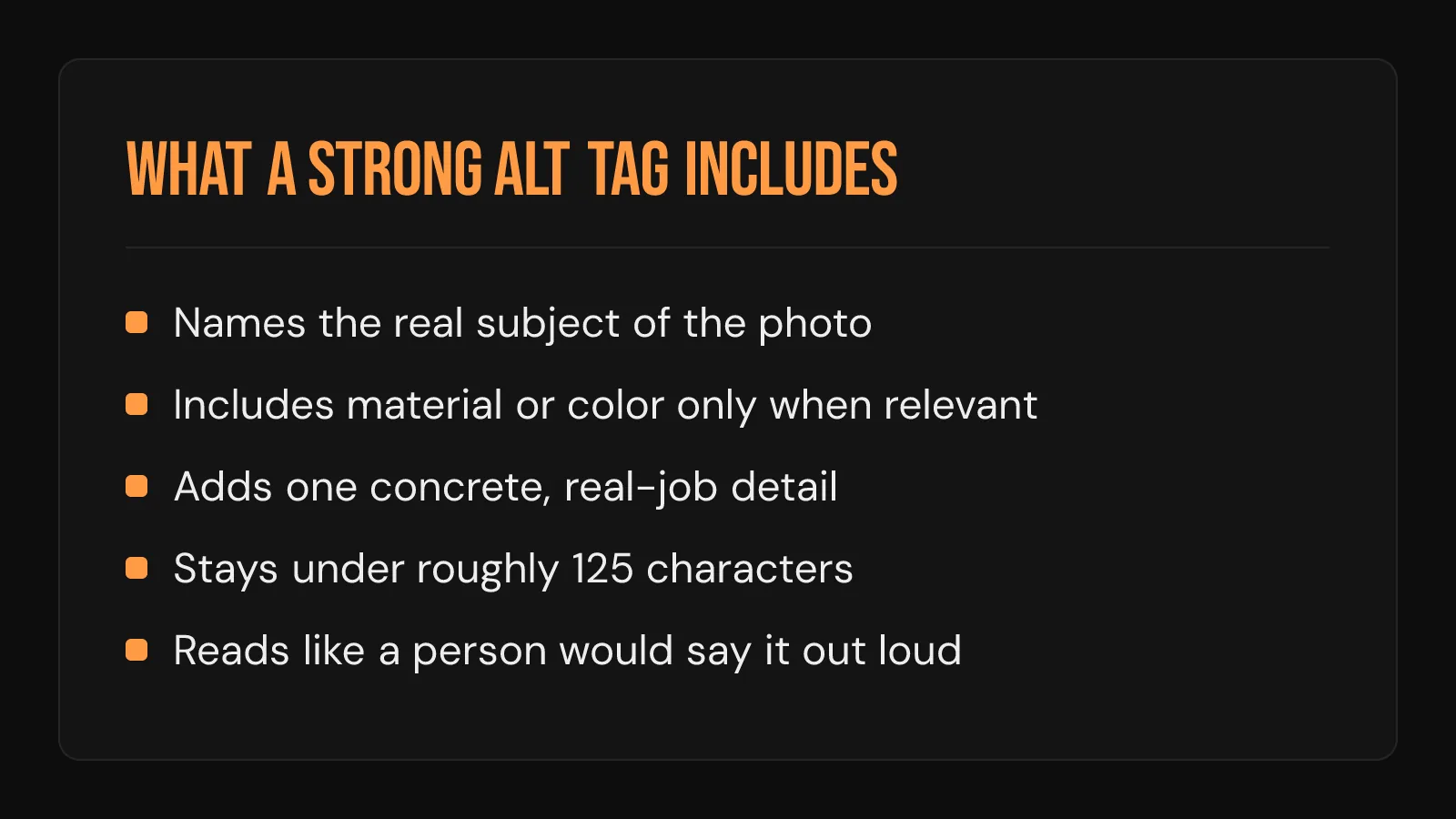
Here's what a strong alt tag actually includes:
- The real subject of the photo (a finished roof, a crew member on a ladder, a stack of shingles ready to go up)
- The material or color, when it's genuinely relevant to the shot
- One concrete, specific detail that makes the photo unmistakably real, taken on an actual job
- A length that stays under roughly 125 characters
- A sentence that reads the way a person would actually say it, plain and short
Everything else is dead weight. A business name jammed into every alt tag adds nothing a search engine or a screen reader needs. The single biggest mistake, and the easiest one to fix, is this: never reuse the exact same alt text on more than one photo.
This is a task most owners can knock out themselves in an afternoon. Whether it makes sense to hand off instead depends on how big the rest of the list is:
| Situation | DIY or hire it out |
|---|---|
| A handful of photos need fixing on an otherwise solid site | DIY, in an afternoon |
| Alt text is one symptom of a much bigger technical SEO backlog | Hire it out, this is a small piece of a larger fix |
Either way, alt text is one small piece of a broader roofing SEO strategy. It won't carry the whole job on its own.
Weak Alt Text vs. Strong Alt Text, Roofing Examples
Most of this is easier to see side by side than to explain in the abstract. The photo types below are what every roofing site publishes constantly, and the weak column is the real, common default:
- A blank alt field
- The camera's raw file name, something like IMG_4821
- The business name pasted into every single image on the page
| Photo Type | Weak Alt Text | Strong Alt Text |
|---|---|---|
| Before-and-after roof replacement | (left blank) | Torn-off shingle roof next to the same house with a new architectural shingle roof installed |
| Completed job photo | "roofing company name" | Finished gray asphalt shingle roof on a two-story home, ridge vents visible |
| Close-up material photo | "IMG_4821" | Close-up of architectural shingles in a weathered wood color stacked before installation |
| Crew or team photo | "our team" | Two-person roofing crew nailing down shingles on a steep pitch during a tear-off |
| Storm damage photo | "storm damage roof" | Hail damage on asphalt shingles showing cracked mat and exposed granules after a spring storm |
Every row above is doing the same job: turning a photo into one of the SEO optimized alt tags roofing images need to actually get found. The pattern holds regardless of the photo type. Name what's really there, skip what a person wouldn't say out loud, and move to the next image.
SEO Optimized Alt Tags Roofing Services Pages Need Too
None of this stops at the blog. The same discipline applies anywhere a roofing company publishes photos:
- Service page before-and-after galleries
- Completed-job portfolio pages
- Photos uploaded to the Google Business Profile
Each one carries the exact same kind of images, and needs the exact same kind of description behind them.
Indiana roofers run into this across a state split between Indianapolis, Fort Wayne, and half a dozen smaller metros. A roofing SEO strategy built for Indiana's metros needs the same alt-tag discipline behind it, gallery by gallery, city by city.
Google's own numbers: profiles with photos get 42% more direction requests and 35% more website clicks. Those photos only pull their full weight when someone actually writes the file name and the alt text by hand. A camera's default file name and a blank alt field both waste the exact same opportunity.
A short sequence covers most of it before a single photo goes live:
- Rename the file to something descriptive before uploading it, for example completed-shingle-roof-dallas.jpg
- Write the alt text to match exactly what the photo shows, using the same plain language from the checklist above
- Compress the file size so the page carrying it still loads fast on a phone
Three steps, done once per photo, and the same discipline that works on a blog post carries straight over to a service page or a Google Business Profile listing, which is really just local SEO for roofing companies showing up in a different form.
This one fix is a small piece of a much longer list. For the rest of it, a full DIY roofing SEO walkthrough covers what to tackle next.
Frequently Asked Questions
Do I need to hire an SEO company just to fix alt tags on my roofing photos?
No. Alt text is one of the few SEO tasks a busy owner can genuinely knock out in an afternoon: open the media library, describe each photo in plain words, save. Hiring help makes more sense for ongoing technical work across a whole site; a one-time pass on existing images is a good DIY job.
Where do alt tags rank among the best ways to improve a roofing website's SEO?
Alt tags sit closer to a maintenance task than a growth lever. They matter for image search, accessibility, and giving Google full context on a page, but they won't fix a site with weak content, no reviews, or a broken Google Business Profile on their own. Whether it makes sense to invest in the rest of that work, and what it actually takes to get there, is worth a straight answer; see what roofing SEO costs and whether it pays off.
Are alt tags a high-impact SEO fix for a roofing site, or a minor detail?
Both, depending on what's already in place. On a site with strong content and a solid local presence, cleaning up alt text is a small, fast win. On a site with bigger structural problems, it's a detail worth fixing but nowhere near the top of the list.
How long should an alt tag be for a roofing photo?
Roughly 125 characters or less is the practical target most screen readers and search engines handle well. A single clear sentence describing the photo almost always lands well under that limit anyway.
Should every roofing photo's alt tag include the same target keyword?
No. Repeating one keyword across every image on a page reads as spam to both search engines and actual readers, and each alt tag should describe that specific photo on its own. The keyword itself already has a home in the page's title, heading, and body copy without needing to repeat inside every image tag too, and the full roofing SEO and PPC keyword list covers how to choose which ones earn that spot in the first place.
Do alt tags actually help a roofing photo show up in Google image search?
Yes, alt text is one of the main signals Google uses to understand and rank an image. It won't guarantee a top spot in image search on its own, but a photo with no description at all has almost no chance of showing up there.