Roofing Reputation Management: A Practical Guide
Roofing reputation management is the ongoing work of asking every customer for a review, answering whatever comes back, and keeping the Google Business Profile accurate week after week. Most roofing companies treat it like a task to finish once, then forget about. A homeowner comparing three roofers before she calls sees only whatever the profile shows this week. This page covers what the practice actually involves, why it decides which contractor gets the call, the weekly rhythm that keeps a profile current, how to answer a bad review without breaking Google's rules, and where a busy crew can hand the whole thing off.
What Roofing Reputation Management Actually Involves
Roofing reputation management means three things happening on a real schedule: a review request every time a job wraps, a reply to every review that posts, and someone actually watching the profile so nothing sits unanswered for weeks. None of the three works alone. A steady flow of five-star reviews with no replies reads as an abandoned account. A fast reply habit on a profile nobody ever asks to grow stays thin no matter how well it is run. The practice only works with all three running together, every week, the same way a crew schedule gets checked every week.
Why the Profile Gets Read Before the Phone Ever Rings
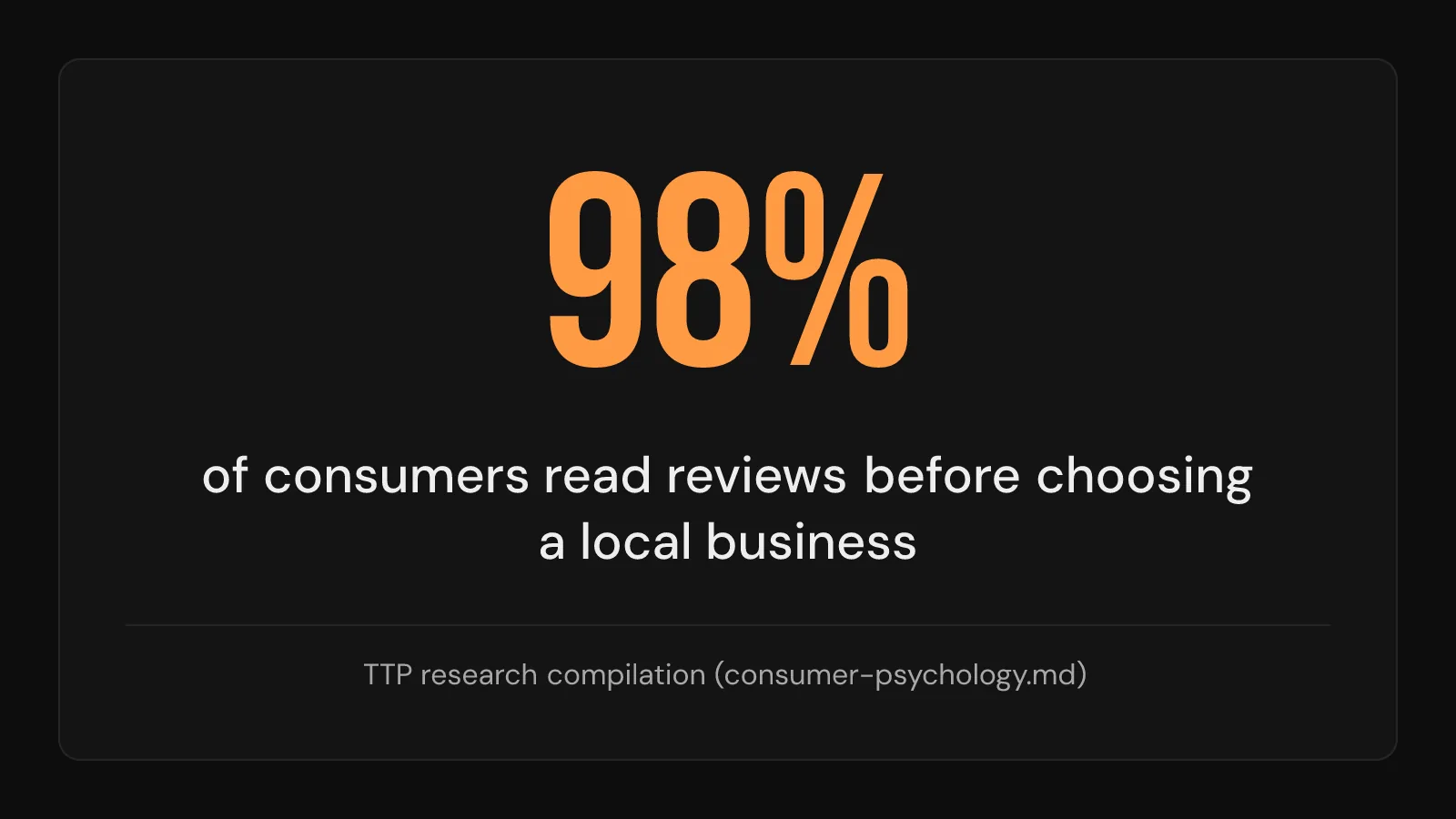
98% of consumers read reviews before choosing a local business. A roofing decision is exactly the kind that sends someone to check. Texas requires no state roofing license. Anyone can call themselves a roofer, which is exactly why homeowners lean so hard on trust signals. Those are the same signals behind why local visibility depends on the same profile:
- The review count, and whether it looks current or frozen
- How recent the most recent reviews actually are
- Whether anyone from the company ever replies to what gets posted
A homeowner three tabs deep, comparing bids from three trucks that all showed up after the same storm, is reading whatever the profile shows this week. In a hail market like Tulsa, where one cell can put every crew in the metro in front of the same homeowner on the same afternoon, that week-old profile often decides the job, which is why roofing leads in the Tulsa metro turn on review recency as much as on years in business.
Claim and Complete the Google Business Profile
A reputation only has a profile to attach to once it is claimed and filled in. The name and logo on that profile should also match what shows up on the truck and the website, since consistent branding shapes how credible a listing looks. Before the weekly habits below start paying off, get the basics locked down:
- Business name written exactly as it appears on the invoice and the truck
- The phone number the office actually answers, checked against what shows on the listing
- Hours kept current for real storm-season changes, checked at least once a season
- A primary category set to "Roofing contractor," matched to how the business is actually run
- At least one photo of finished work, uploaded the same week the job wraps
These same fields also feed the ranking-lever checklist for the same profile.
The Weekly Rhythm: Ask, Answer, Watch
The habit that actually moves a profile is short and repeats every week. Roofing reputation management holds together only when these three steps run in order, without skipping one because the schedule got busy:
- Ask the day the crew leaves, while the yard is still clean and the work is still fresh in her mind.
- Answer every review that posts within a few days, the five-star ones and the one-star ones both.
- Watch the profile at least once a week for anything that slipped through unanswered.
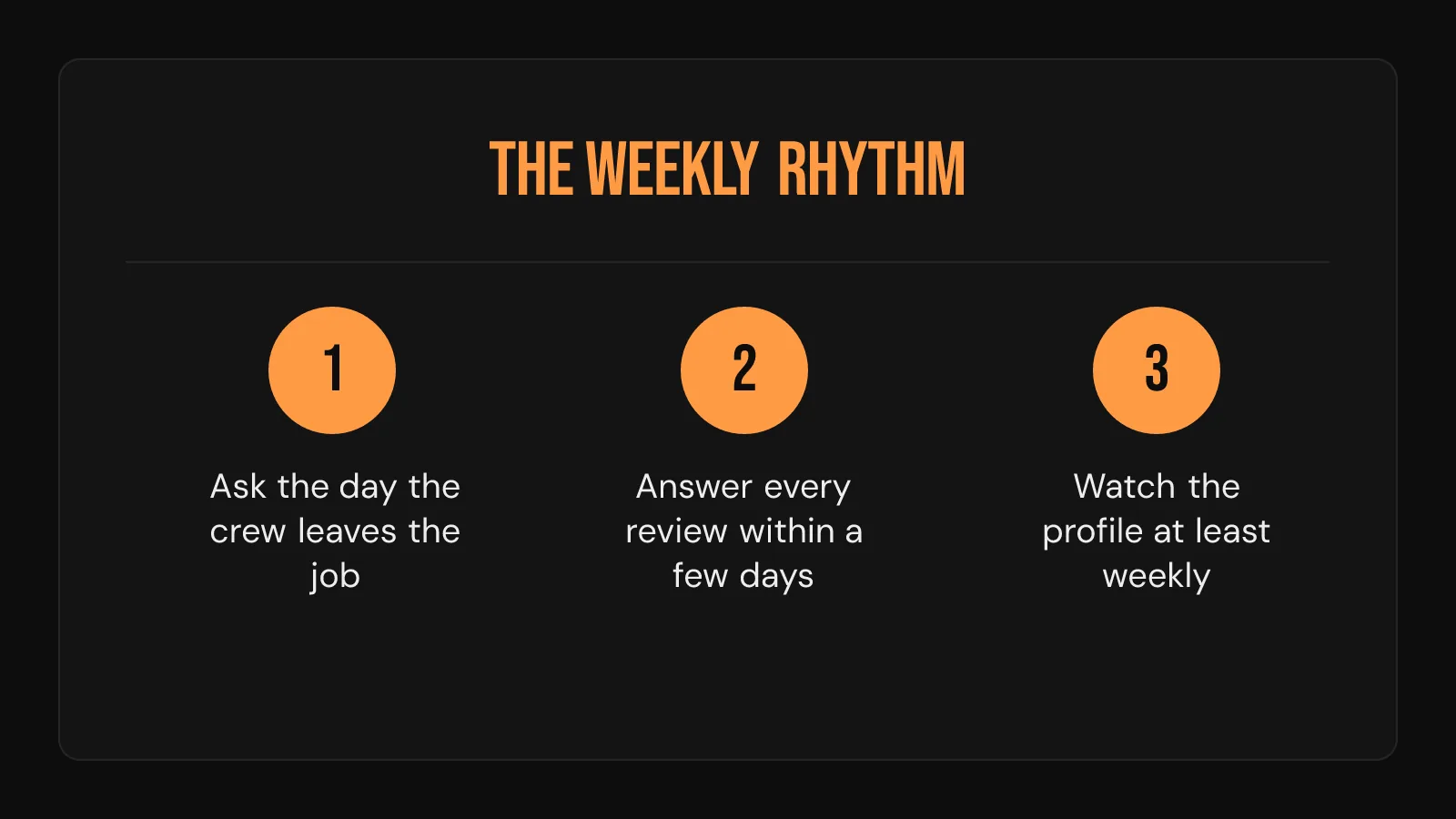
Skip the ask and the review count stalls. Skip the answer and a single bad week sits public for a month. Skip the watch and both problems go unnoticed until a slow month finally forces someone to open the app.
How to Answer a Bad Review Without Breaking Google's Rules
A one-star review is a chance to show the next reader how the company handles a real problem. The reply that works stays specific, stays calm, and moves toward a phone call or an email, away from a back-and-forth in the public comments.
| What a Compliant Reply Does | What It Skips |
|---|---|
| Names the actual job or issue the reviewer raised | Generic "sorry you feel that way" language |
| Offers a phone number or email to resolve it directly | Arguing the reviewer's account of events in public |
| Stays factual about what happened and what happens next | A defensive tone, even when the review reads unfair |
None of this includes gating, incentivizing, or manufacturing reviews. Google's policies flatly ban all three of the following:
- Asking a customer to leave a review only if it will be positive
- Offering a discount or gift in exchange for a review
- Posting or paying for fake reviews
Any of the three risks the whole profile getting suspended, erasing years of real review history in one enforcement action.
Recency and Volume Beat a Perfect Average
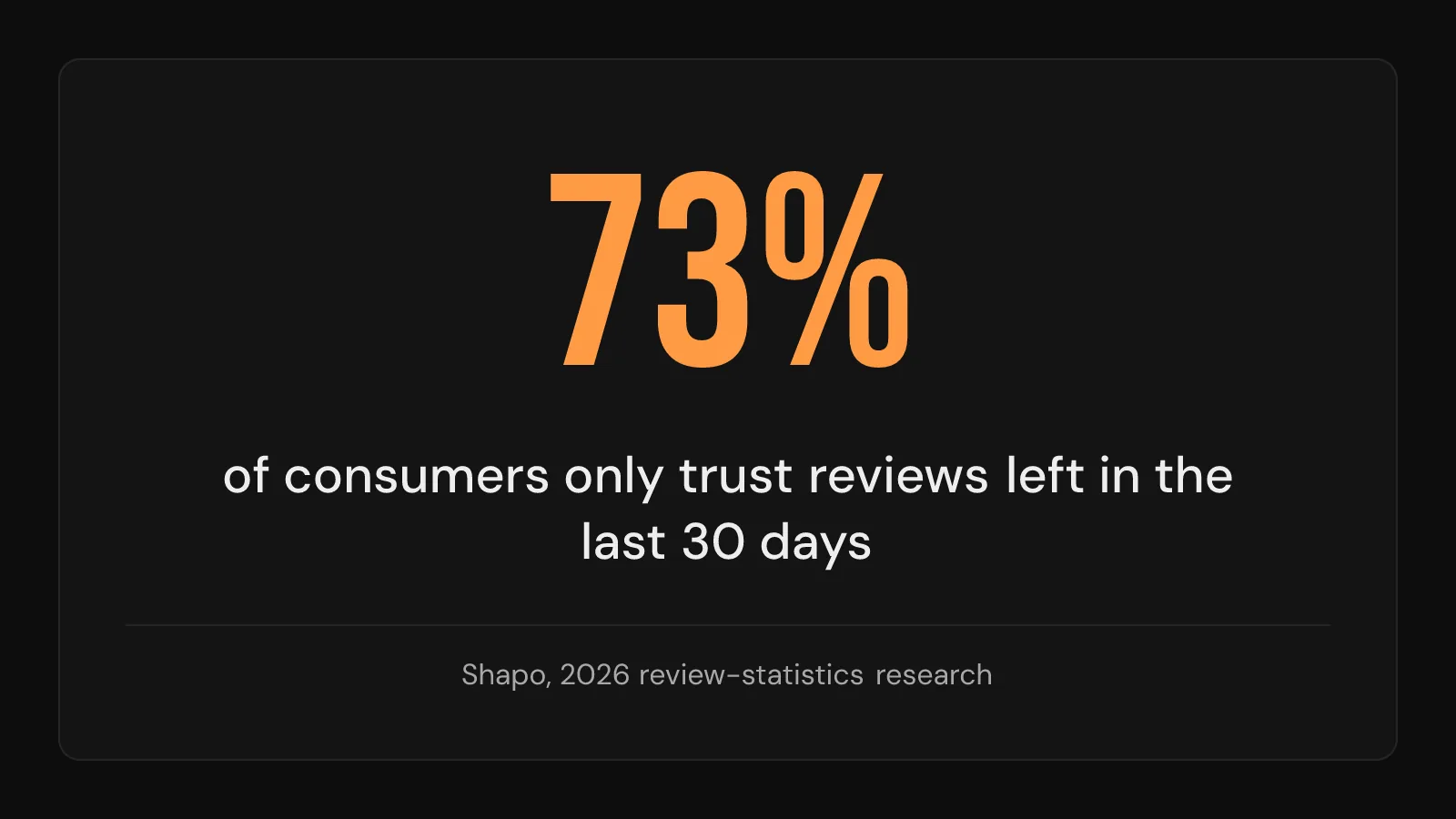
A five-star average from two years ago carries less weight than most contractors assume. 73% of consumers only trust reviews left in the last 30 days, and 27% now put the most weight on reviews from the past two weeks. A profile that stopped growing in 2024 reads as stale even when every review on it is glowing.
Volume matters just as much as freshness. 55% of consumers pick the company with many solid reviews over the one with a handful of perfect ones. Every 10 new reviews add about 2.8% to conversion. Every tenth of a star adds 4.4%. A steady flow of honest four- and five-star reviews, added every week, outperforms a stalled profile sitting at a perfect score from a year ago. Where reviews sit among the local ranking factors is worth knowing first.
| Review Signal | What It Tells a Homeowner |
|---|---|
| Left in the last 30 days | The company is still active and still doing the work |
| Left in the last two weeks | The freshest, highest-weighted signal a homeowner checks |
| Volume of 20+ recent reviews | More trustworthy than a handful of perfect, older ones |
| A reply on nearly every review | Someone is actually running the account |
The full local SEO checklist for roofing companies covers the other fields worth tracking on the same profile.
Where This Leaves You If You'd Rather Not Run It Yourself
Running this every week is realistic for a company with someone whose job includes it, and much harder once that person also has three roofs to inspect the same day. Reputation and review management is genuinely one of the pieces The Trust Process builds: a weekly system that asks, answers, and watches the profile on schedule. It ships standalone or as part of the full engagement, always disclosed up front with no surprise bundling.
Reviews are one layer of a longer decision. The walkthrough below covers the whole path a homeowner takes before she calls: what she searches, what the site has to do when she lands, how fast the follow-up reaches her, and where reviews sit inside that.
Frequently Asked Questions
What counts as roofing reputation management?
It is the ongoing practice of asking for a review after every job, answering every review that posts, and keeping the Google Business Profile accurate and current, run every week on a standing schedule. A one-time cleanup does not count once the account goes untouched again.
How often should a roofing company ask for a review?
The same day the crew leaves the job site, while the work is still visible and fresh in the homeowner's mind. Waiting a week, or batching requests at month's end, produces a noticeably lower response rate.
Should a roofing company respond to negative reviews, or leave them alone?
Respond to every review, including the negative ones. A specific, calm reply that names the actual issue and offers a direct way to resolve it does real work for the next reader; an unanswered one-star review sitting for weeks reads as a company that stopped paying attention.
Can a roofing company offer a discount or incentive in exchange for a review?
No. Google's policies prohibit asking for a review only if it will be positive, offering an incentive tied to leaving one, and posting or paying for fake reviews. A profile caught violating any of these can be suspended, wiping out real review history built over years.
Does a roofing company's Google profile need daily attention, or is a monthly check enough?
A weekly check catches most of what matters: new reviews to answer, photos to add, and anything on the listing that has drifted from reality. A monthly check leaves a bad review sitting in public for weeks before anyone even sees it, long enough to shape what the next several homeowners think.
How many reviews does a roofing company actually need before it stops mattering?
There is no fixed number where reviews stop mattering. 55% of consumers pick the company with many solid reviews over the one with a handful of perfect ones. Volume and recency keep paying off well past the point most owners assume they can stop asking.