Types of Roofing Leads Emergency vs Planned, Side by Side
The two types of roofing leads emergency vs planned demand produces arrive on the same phone line and need two different businesses standing behind it. One is a homeowner with water coming through a bedroom ceiling at nine at night. The other has three years left on her roof and sat down on a Sunday afternoon to start reading. Both are worth having. A system built around one of them handles the other badly. This piece covers how to spot which mode a call belongs to, why a single funnel starves one side, what changes in the site, the profile, and the follow-up for each, and how the mix moves through the year.
The Two Types of Roofing Leads Emergency vs Planned Demand Creates
Emergency demand starts with damage the homeowner can see or hear. An active leak. Shingles in the yard after a hailstorm. A tarp that is already lifting. She wants the water to stop and will hire whoever picks up and can get a truck there. Price comes up late, because the alternative to paying is a ruined ceiling.
Planned demand starts with a decision she made on her own schedule. The roof is 18 years old. The house goes on the market in spring. She opens three tabs, reads reviews, and calls back whoever answered her questions best. An emergency call that lands in voicemail is usually the end of it. 85% of callers who reach voicemail never try again. A planned inquiry will try a second company, then a third.
| Emergency demand | Planned demand | |
|---|---|---|
| What triggers it | Visible damage: a leak, hail, a failed tarp | A decision: an aging roof, a remodel, a listing date |
| How she searches | Urgent and local | Comparative and slow |
| Decision window | Minutes to hours | Two weeks to six months |
| What decides it | Who answers, and how fast a truck arrives | Proof, reviews, financing, who kept in touch |
| What she needs first | When you can get there | What the job involves and what happens next |
Both modes feed the same pipeline, and both are worth having. They are two jobs the same company does. Sorting them is how a roofing leads pipeline you own stops leaking at both ends.

How to Tell Them Apart Before You Quote
The tells show up in two places: the words that brought her to you, and the first 20 seconds of the call.
What the search tells you:
- Time words. Now, today, tonight, emergency, 24 hour. Almost always urgent.
- Damage words. Leak, leaking, hail, storm damage, missing shingles.
- Comparison words. Cost, price range, best, reviews, financing. The slow side, every time.
- Lifespan words. How long a roof lasts, metal against asphalt, warranty terms.
What the call tells you:
- Where she is calling from. Standing under the drip sounds different from a kitchen table.
- Whether a date already exists. A closing date or a remodel start means planned.
- Whether an adjuster has come up. Damage is already in play.
- How soon she asks you to get there. That question is most of the diagnosis.
The tell is time pressure, and it is audible inside the first 20 seconds of the call. This is a different cut than customer type. Segmenting roofing clients by job type sorts by who is buying. This sorts the same list by how fast they need you.
Why One Funnel Cannot Serve Both
Telling the two types of roofing leads emergency vs planned work apart matters only if something downstream changes. A funnel is a set of defaults: how fast the phone gets picked up, what the auto reply says, how many attempts happen before a file goes quiet. Most companies run one set for every call.
Tuned for urgency, the system is front loaded. Somebody answers day and night, the reply is immediate, and the file closes after two attempts. Point that at a planned inquiry and you drop a homeowner who was six weeks from signing.
Tuned for planned work, the system is patient. A form lands in an inbox, somebody reads it in the morning, and a sequence runs for weeks. Point that at a leak call and the job is gone before anyone opens the inbox. While a slow contractor waits until morning, 64% of homeowners are already browsing competitors in the same session. Answering inside five minutes, after hours included, keeps the urgent side alive.
The two misses cost different money at different speeds:
- The urgent miss is loud. It happens inside an hour and you hear about it.
- The planned miss is quiet. Over a year it is the bigger number, because those files were warm when they went cold.
The 8% who keep following up past the fifth touch end up with 80% of the business. Very few roofing companies run a fifth touch on anything, and almost none run one on a repair-sized inquiry.
What Changes in the Site, the Profile, and the Follow-Up
Each mode asks something different of the same four assets. Repair-sized work is where this gets expensive quietly, since repair inquiries that go cold rarely announce themselves the way a lost replacement job does.
| Asset | Emergency demand | Planned demand |
|---|---|---|
| The website | Tappable number above the fold, a plain answer on how fast you come out | Job galleries, the process, financing, warranty terms |
| The Google Business Profile | Accurate hours, service area, photos proving you work her zip code | Review volume and recency, answered questions, finished-work posts |
| The phone | Live answer day and night, or an automated answer that books a slot | A callback inside the hour, as long as it happens |
| The follow-up | Two attempts in the first hour, then let it go | Weeks of sequence, checking back on the date she named |
Reviews do the heaviest lifting on the planned side. 92% of homeowners read your reviews before they ever dial your number. On the urgent side those same reviews matter less than whether the profile says you are open right now.
One scope note. The Trust Process does not sell, broker, or guarantee leads. The work here is the website, SEO, CRO, content, the Google Business Profile, an automated SMS follow-up and nurturing system, and an inbound voice agent. The last two earn their keep across both modes: the voice agent picks up the leak call at nine at night and books a slot, and the SMS system keeps a planned inquiry alive into week three. A market hit hard enough tips almost entirely urgent for a stretch, which is what turning storm damage demand into booked jobs has to be built for.
The Seasonal Mix Shift
The balance moves through the year. Storm season, roughly March through June across most of the country, tips it toward urgent work. The quiet months run on planned jobs.
- Late winter. Planned inquiries build as homeowners price spring work.
- Spring into early summer. Storm activity spikes urgent volume, and the pipeline built in February gets neglected while everyone chases the phone.
- Late summer. Urgent volume falls off and those neglected files are two months cold.
- Autumn into early winter. Roof replacement leads from homeowners who want the job finished before the first freeze carry the schedule.
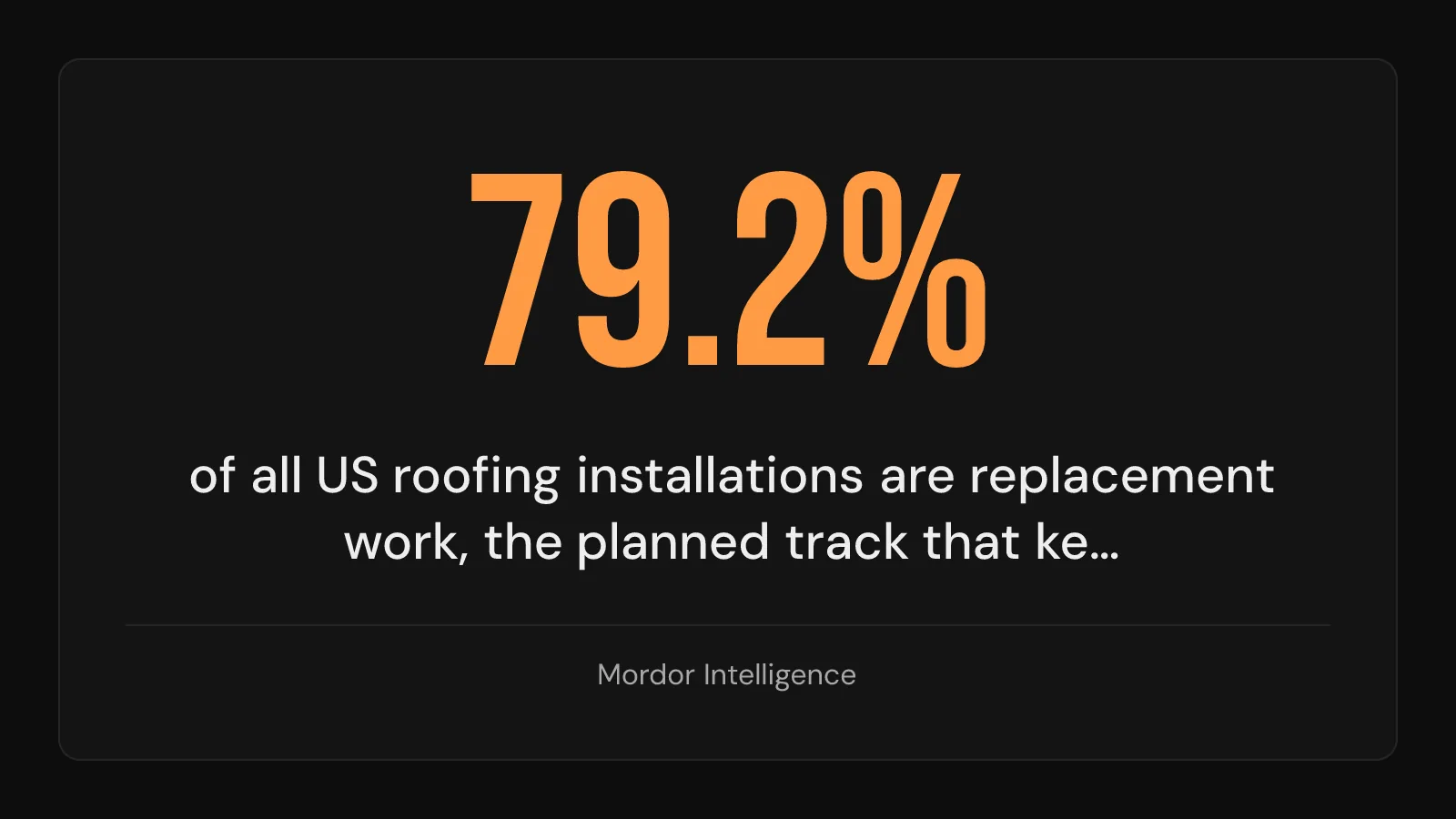
Replacement work makes up 79.2% of all roofing installations. Over a full year the planned track is the larger business even in a hail market, so letting it starve every spring costs more than the storm weeks give back.
Two traps sit inside that cycle:
- Staffing only for the spike. The phone rings out in May.
- Staffing only for the steady months. The patient sequence goes dark when urgent volume makes it hardest to run by hand.
The timing question is a subject of its own: what to have ready before storm season starts covers the calendar side. Local rules move the mix as well, and roofing leads in Nashville show what a permit threshold and two license tiers do to both tracks at once.
Frequently Asked Questions
What is the 25% rule for roofing, and does it turn a repair call into a replacement job?
The 25% rule refers to a code provision many jurisdictions have adopted: once repairs in a 12-month window pass roughly a quarter of a roof section, that section has to come up to current code. It varies by jurisdiction, and the local building department is the only authority on a given address. It matters here because an urgent repair call can become a replacement job during the inspection, which is why the two tracks have to hand off cleanly.
What is the best way for a roofing company to generate both emergency and planned work?
The best way to generate both is one front door and two back ends. Local search presence catches both types of roofing leads emergency vs planned demand produces, since both start on the same results page. After the click they split: answering speed and after-hours coverage on one side, proof depth and a long follow-up sequence on the other.
Is it worth running two follow-up tracks when we only close a handful of planned jobs a month?
It is worth it because the second track is a sequence, and a sequence costs setup hours once. The jobs it catches are already in your pipeline going quiet, which is cheaper work than finding fresh inquiries. A handful of planned jobs a month at replacement size usually separates a thin quarter from a good one.
Our marketing company already answers our phones, so why would lead type change anything?
Lead type changes what good answering means. Ask whoever handles the phones two things: who picks up a leak call at nine on a Sunday night, and what a form that arrived 14 days ago is getting today. Plenty of arrangements handle one of those well and were never set up for the other.
We tried separating repair calls from replacement calls before and it fell apart, so what was missing?
Most splits fall apart at the handoff, because the rule lived in one person's head. It holds when the intake step records which mode the call is in and the follow-up sequence reads that field on its own. Anything depending on a person remembering to move a file survives about three busy weeks.