Roofing Marketing News: What Actually Matters This Year
Roofing marketing news moves fast, and most of it repeats the same platform-of-the-month advice every few months. A few real shifts sit underneath the noise this year, and they are worth a contractor's actual attention. Private equity firms are buying up roofing marketing platforms at a pace that changes who owns the tools crews already use. Homeowners are starting to find contractors through channels that did not exist two years ago. And a majority of roofing companies still do not trust the vendor they are already paying. This roundup skips the hype: what is actually moving, why it matters for a small roofing company, and how to spot the next real change.

The Roofing Marketing News That Actually Matters This Year
Most roofing marketing news falls into one of two buckets: a platform update dressed up as a trend, or a genuine shift in how homeowners find and vet a contractor. The second bucket is small. Three shifts this year belong in it:
- Where homeowners start their search
- Who owns the marketing platforms roofing companies already pay for
- How little of the published content on roofing sites actually gets read
Each one changes something real about how a five-to-20-person roofing company gets found and gets hired, and none of them require chasing a new platform every quarter. The shift worth tracking is who controls the tool, and whether the work behind it actually reaches a homeowner.
This is the ground floor of marketing for roofing contractors right now, and it is worth understanding before the next headline arrives.
AI Is Already Changing Where Homeowners Find Roofers
Homeowners used to run the same basic search every time: a city name plus a generic roofer query into Google. That is changing, and the shift is happening on both sides of the transaction: how homeowners search, and how contractors work.
| Where the Shift Shows Up | Current Number | Trend |
|---|---|---|
| Homeowners who now find a contractor through emerging answer engines, tools that summarize an answer instead of returning ten blue links | 11% | Growing more than 150% a year |
| Roofing contractors who already use AI somewhere in the business | 40% | Double the number from 2023 |
Both figures are still small relative to the whole market, and both are moving fast enough that the tools already feel ordinary. Most contractors call the shift an efficiency gain rather than a gimmick. What still separates one roofing company's marketing from another's is whether a real homeowner search actually surfaces the business at the moment she is deciding who to call. Showing up in an answer engine's summary runs on the same site, profile, and review signals that decide the map pack, which is the whole premise behind AI SEO for roofing companies.
Private Equity Is Buying Up Roofing Marketing Platforms
This consolidation reaches past roofing companies and into the software crews use every day. Private equity firms are acquiring a roofing platform, on average, every 48 hours. That pace touches tools already sitting on a roofing company's desktop:
- Scheduling software
- Review platforms
- Lead-routing systems
- The agencies running ads on top of them
A platform changing hands often means a pricing change, a support-quality shift, or a feature roadmap decided somewhere far from the crews actually using the product. A five-to-20-person roofing company rarely gets a say in any of it. The practical move is knowing which vendors have changed hands in the last year, and asking directly whether that changed how the account gets serviced. Lead-routing systems are worth the closest look, since the mechanics behind a vendor lead program decide what an owner is actually buying once the ownership changes.
Why So Many Roofing Companies Don't Trust Their Marketing Provider
70% of roofing companies do not trust the marketing provider they already pay. That number holds up against a second one: 98% of the content published on roofing websites gets zero traffic. A lot of roofing companies are paying every month for work that is not reaching anyone, and most of them already suspect it.
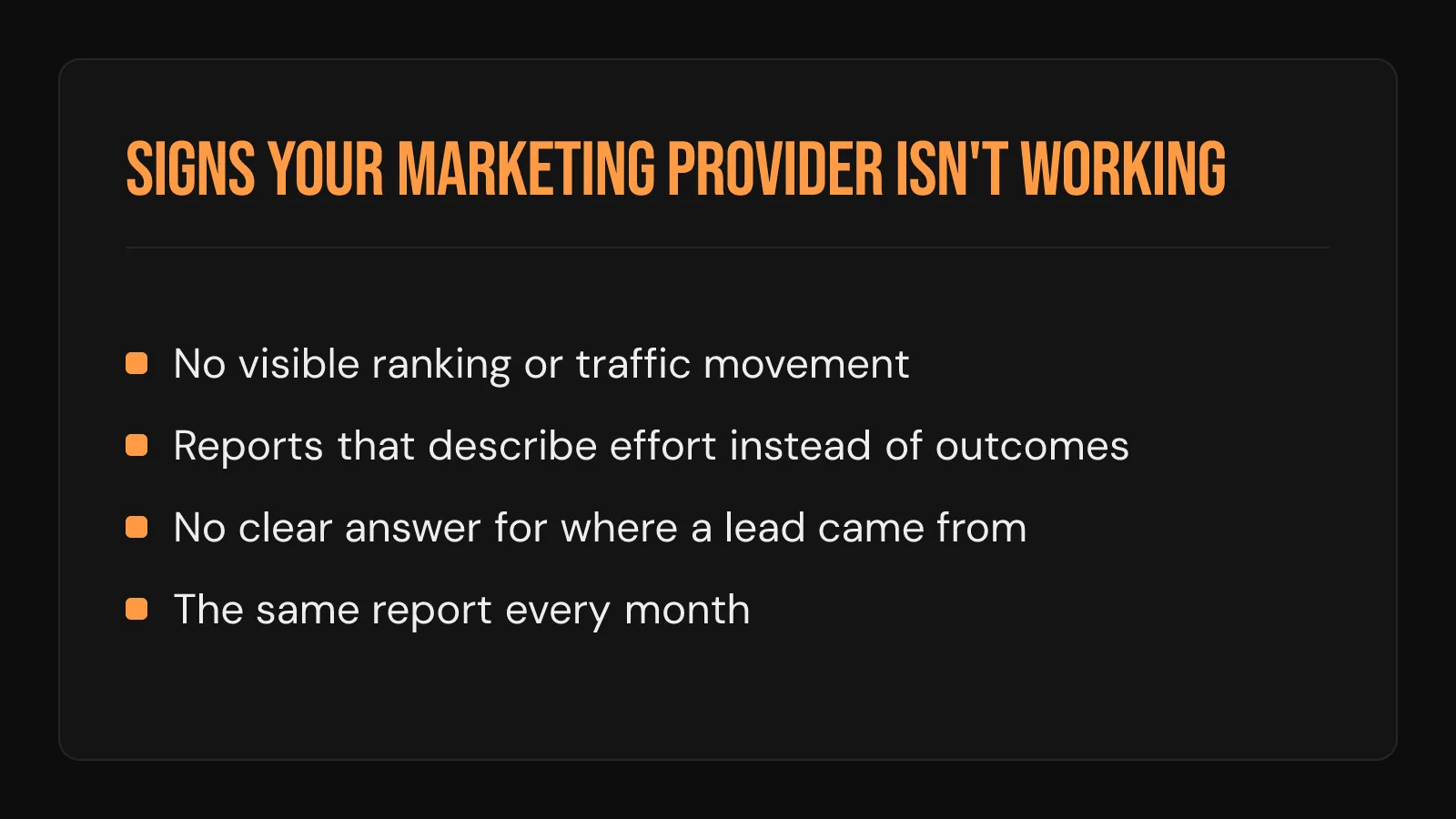
This distrust follows a pattern: it shows up whenever a vendor's reporting does not match what the roofing company actually sees on its own calendar. A few signs are worth checking before the next invoice:
- No visible ranking or traffic movement. A vendor should be able to point to real numbers on request.
- Reports that describe effort instead of outcomes. A useful monthly report ties a specific blog post, ad, or social update to a booked job by name.
- No clear answer for where a lead came from. A booked job should trace back to a specific page, ad, or call source.
- The same report every month. Real work changes the numbers over time.
None of this requires firing anyone on the spot. It is a short list to check, and most roofing companies have never actually asked. How to vet a roofing marketing agency before signing covers what to ask before the first invoice arrives.
Roofing Marketing News at a Glance
Four shifts, one table. This is the short version of everything above, useful for skimming back to later or forwarding to a partner who has not read the whole piece.
| Shift | What It Means for Your Business |
|---|---|
| Emerging answer engines | A small but fast-growing share of homeowners now find a contractor through a summarized answer instead of a search results page. |
| Private equity consolidation | Vendors and platforms change ownership often. Pricing and support can shift without warning. |
| Provider distrust | Most roofing companies pay a vendor they do not fully trust, usually because reporting does not match results. |
| Content that doesn't rank | Nearly all roofing website content gets zero traffic, which means most "marketing" activity produces nothing measurable. |
For the longer-running data behind these numbers, see our roofing marketing statistics and trends roundup. The current roofing leads news tracks lead costs and close rates by source.
How to Tell Real Roofing Marketing News From Noise
Not every headline deserves a strategy change. Before acting on the next piece of roofing marketing news, run it through four questions in order:
- Does it change what a homeowner actually sees today? A shift in search behavior or platform ownership matters. A new buzzword usually does not.
- Is there a verifiable number behind it? A single agency's blog post carries far less weight than an independent study or a platform's own reported data.
- Would a business built on fundamentals already be doing this? Fast response, real reviews, a site that loads and earns trust on a phone. Most "new" advice is really a reminder to fix an old leak.
- What does it actually cost to test? A small, reversible test beats a full strategy rebuild every time.
Most roofing marketing news is a distraction from four things that already work: answering fast, following up, earning reviews, and having a site a homeowner trusts on her phone. The companies that keep winning jobs answer fast, follow up, and earn reviews. A homeowner can actually find them, and actually trusts them once she lands on the page.
For the leads all of this is ultimately about, see roofing leads that actually close.
Frequently Asked Questions
What's actually changing in roofing marketing right now?
A small number of real shifts are happening under a lot of recycled advice: emerging answer engines are starting to send homeowner searches to a contractor, private equity is buying up the platforms roofing companies already use, and most published roofing content still is not reaching anyone. Everything else making the rounds is usually a repackaged version of the same three ideas.
What's the best way to advertise for roofing given how fast the landscape is changing?
The best-performing move even with the landscape changing this fast is making an existing channel actually work: a site that loads fast and earns trust on a phone, a Google profile that matches what the crew actually does, and follow-up that starts inside minutes rather than hours. New channels are worth testing in small amounts once those three are solid.
What roofing marketing news should contractors actually pay attention to?
Contractors should pay attention to news that changes where a homeowner actually looks or who controls a tool they already pay for, and skip coverage that is only a new name for an old tactic. The four questions in this piece's last section are a fast filter for telling the two apart.
How do I know if my roofing marketing provider is actually working?
Ask for three things: current ranking or traffic movement, a clear source for the last five leads, and a report that changes month to month instead of repeating the same numbers. A provider who cannot produce any of the three is a real signal, whatever the relationship has been so far.
Should I change my marketing budget every time a new trend shows up?
Marketing budgets should not swing every time a new trend shows up. A new trend deserves a small, reversible test before it earns a real budget line, and most roofing marketing news never clears that bar. Save the bigger moves for shifts with a verifiable number behind them, like the ones covered above.