How Does a Roofing Leads Program Work? A Mechanics Breakdown
How does a roofing leads program work? Underneath the login screen and the monthly invoice, every one of them runs the same four-part chain: somebody creates the demand, somebody routes it to a contractor, a billing trigger fires, and a contract decides what happens when a record turns out to be junk. Vendors dress that chain up differently. Some sell names. Some sell connected calls. Some sell booked appointments. The machinery underneath barely moves. This piece walks the chain end to end, so the next vendor call reads as a set of settings you can ask about.
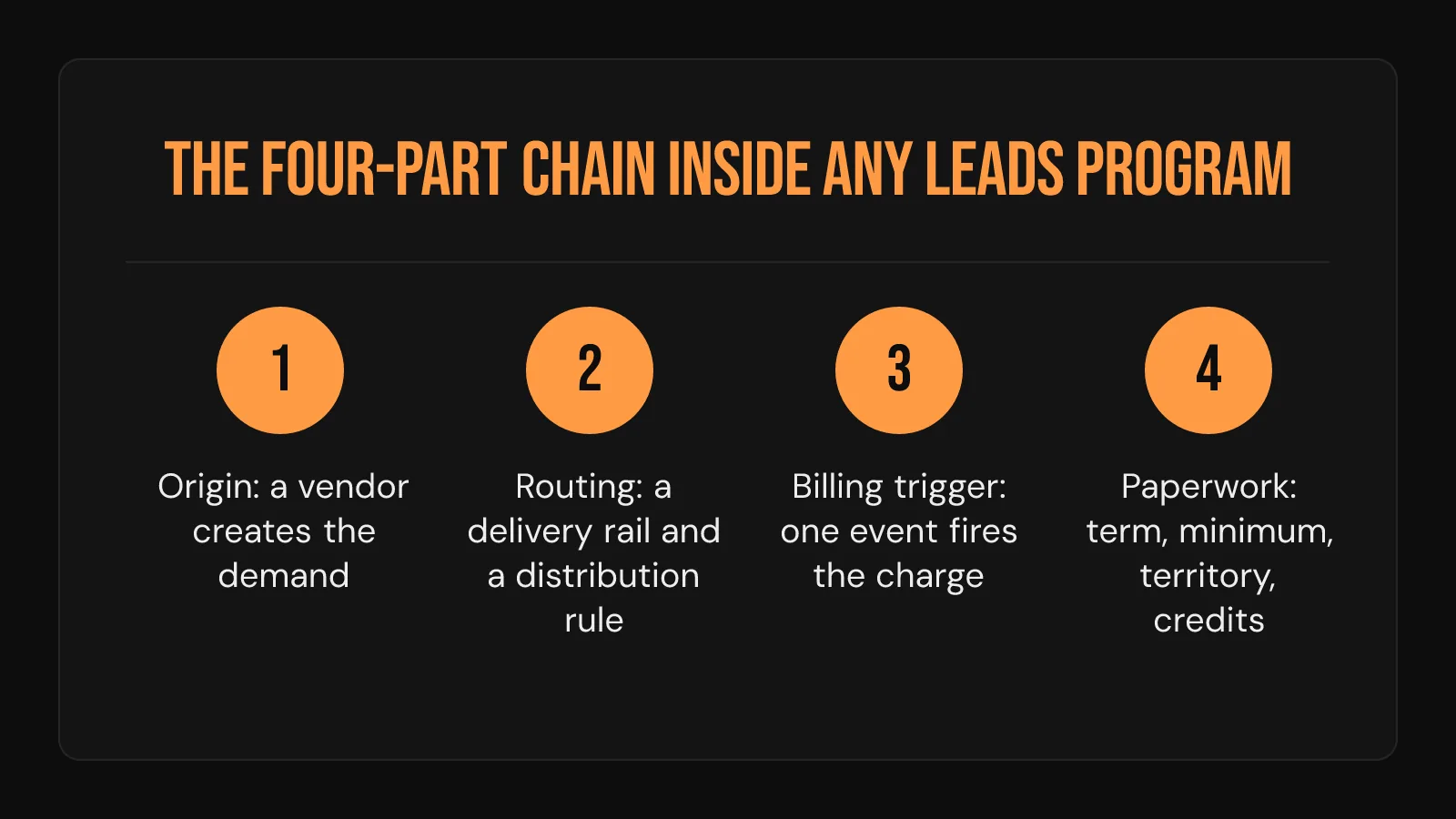
How does a roofing leads program work? The four-part chain
Whatever the invoice calls it, a program moves a homeowner's contact information along the same path:
- Origin. Somebody upstream spends money or labor to get a homeowner to raise her hand.
- Routing. That record travels down a delivery rail, under a distribution rule that decides who else receives it.
- Billing trigger. One defined event fires the charge. Everything before it is the vendor's cost. Everything after it is yours.
- The paperwork. A contract sets the term, the minimum, the territory, and the rules for disputing a record that never had a chance.
Every real difference between two vendors sits inside one of those four boxes. It is also why a lead pipeline the business owns sits in a category of its own.
Where the leads actually originate
A program cannot sell a homeowner it never found. Somebody spent money or hours producing that record first, and the method sets the intent behind it:
- Vendor-owned ad accounts. Paid search, Local Services Ads, or paid social run under the vendor's own brand. Usually the freshest records in the market, and your company name never appeared in the ad she clicked.
- Vendor-owned content and directory sites. The vendor ranks a site, puts a quote form on it, and sells what the form catches. She did research before submitting, and she believes she contacted the site.
- Outbound teams. Call centers, canvassers, and appointment setters working a list. She did not start the conversation, which changes how the first exchange opens.
- Aggregator and affiliate networks. A form filled on some other property, passed along a chain, sometimes more than once. Freshness and intent both swing hard here.
Those four supply lines are the entire upstream. A record from a vendor's ad account and one resold out of an affiliate network land in the same portal, on the same invoice line. Most vendors run more than one and report the result as one product. Judging what arrives is a separate skill, covered in judging a lead source on quality.
How a lead reaches your phone
Delivery has two settings stacked on each other. The rail is the pipe the record travels down. The distribution rule is who else stands at the far end of it. The rails, by how much time each costs you:
- Portal or dashboard. You log in and work a queue. Nothing tells you a record arrived, so the clock runs while your laptop is closed.
- Email or SMS alert. A push the moment the record lands, and only as fast as whoever is holding the phone.
- CRM push or webhook. The record drops into your own system and can fire your own automated follow-up on arrival.
- Live call transfer. She is already on the line when your phone rings. No delivery lag at all.
The distribution rule then sets the competitive shape. Simultaneous blast sends one record to every contractor holding that territory at once. Round-robin rotates it down a list, one contractor at a time. First-accept posts it and awards it to whoever claims it fastest. A blast turns delivery into a footrace before anybody says a word to her. While a slow contractor waits until morning, 64% of homeowners are already browsing competitors in the same session.
The delivery models, side by side
Four billing models cover almost everything sold here. Each moves the trigger to a different point on the same chain:
| Model | What fires the bill | What you are buying | Where the risk sits |
|---|---|---|---|
| Pay per lead | A contact record delivered to you | A name and a number | Yours. The record may never pick up. |
| Pay per call | A connected call past a duration threshold | A live conversation | Split. The vendor owns the ring, your office owns the answer. |
| Subscription or retainer | The calendar, monthly | Access for a period, volume rarely promised | Yours. A quiet month still invoices. |
| Pay per appointment | A slot booked on your calendar | A scheduled sit-down | Mostly the vendor's, until the no-show question comes up. |
The billing trigger is the one line that decides what a vendor has to deliver to get paid. How per-call billing is triggered is the cleanest illustration: the charge lands when the call connects, and everything after the hello belongs to your office. What each model costs per signed job is a separate calculation, run in the real cost per booked job.

How lead credits and disputes work
Every program delivers some records that were never going to work. The credit process decides who absorbs them:
- The window. A fixed number of days, sometimes hours, from delivery to filing. Miss it and the charge stands.
- The channel. A dispute button in the portal, a form, or an email to a rep. A button resolves in minutes. An email can sit for a week.
- The evidence. Dial attempts, timestamps, and call recordings. A vendor requiring recordings is requiring you to run call tracking.
- What usually qualifies. A disconnected or wrong number, a duplicate of a record already delivered, an address outside the territory you bought, or a renter with no authority over the roof.
- What usually does not. She did not answer. She answered and said no. She was collecting a third bid. She hired whoever called first.
- How an approved claim pays out. Almost always a credit against future records. A refund to the card is rare, and that matters most on the month you are trying to leave.
The credit rules tell you what the vendor believes it sold you, and the billing trigger tells you what it has to deliver to get paid.
What the contract locks in
The commercial terms live in a separate document from the pitch, and they outlast the enthusiasm. Five clauses carry the weight:
| Clause | What it controls | The setting to get in writing |
|---|---|---|
| Term and renewal | How long you are committed, and how it rolls over | The notice period in days, and the date the clock starts |
| Monthly minimum | The floor you pay whether records arrive or not | Whether an unspent minimum carries forward or expires |
| Territory | The map the vendor sold you | Whether it is drawn by ZIP, county, or radius, and how many maps overlap it |
| Exclusivity clock | How long a record stays yours alone | The number of days before it can be resold |
| Data at termination | What leaves with you | Whether your records export, and in what format |
The exclusivity clock is the clause most owners skim. Exclusivity that runs on a clock ends when the clock does, and the record goes back into circulation. That is the mechanism behind records resold by age after the first buyer.
Volume language lives in the minimum clause: what a volume guarantee actually promises is usually a spend floor with a delivery target beside it.
What to verify before you sign
Six settings describe any program completely. Get each one in writing:
- Which of the four origins produced the records you will actually receive.
- Which rail delivers them, and how many minutes pass between her submit and your notification.
- Which distribution rule applies: blast, round-robin, or first-accept.
- What single event fires the charge.
- How many days the dispute window runs, and which reasons the vendor has actually approved.
- What the notice period is, and what data leaves with you.
How does a roofing leads program work? For the vendor in front of you, it works exactly the way those six answers describe.
The Trust Process does not sell, broker, or guarantee roofing leads. No page here ends at a lead order form. The work is the conversion side: the website, the search visibility, the Google Business Profile, and the automated follow-up that decide what a delivered record turns into.
That matters because every box in the chain closes at delivery. A record arrives, a call connects, an appointment posts, and the vendor's obligation is complete. The next few minutes belong to your office. 95% of home services companies never make it inside the five-minute window. I tested this myself. I called 20 companies pretending to be a homeowner. Only one called me back in under an hour.
Buying or building, the same office picks up the phone. Whether to buy the leads or build the demand is its own decision, and it changes nothing about that part.
Frequently Asked Questions
What am I actually paying a roofing leads program for?
You are paying for a delivery event: a record delivered, a call connected, a period of access, or an appointment booked. The contract defines that event precisely, and the signed job sits outside the definition. Price moves with your market, the model, and how many contractors hold your territory.
Where does a leads program get the leads it sells?
A program draws from four supply lines: ad accounts the vendor owns, sites the vendor ranks, outbound teams working lists, and networks reselling forms filled elsewhere. Most vendors run more than one and report the result as a single product. The mix behind your records is a fair thing to ask for in writing.
Can I get a refund when a lead turns out to be junk?
Most programs answer a valid claim with a credit against future records. A cash refund to the card is uncommon enough to assume it is off the table. The claim also has to land inside the dispute window, measured in days from delivery and easy to miss in a busy week.
What do I check after a leads program has already burned me once?
Start with the three settings that usually caused the damage: the distribution rule, the dispute window, and the notice period. Those decide whether you were racing three other contractors, whether a dead record could be clawed back, and how long you stayed stuck. Read all three before the price.
Does this site run a roofing leads program?
No. The Trust Process does not sell, broker, or guarantee roofing leads, and it never resells a record to anybody. The work here starts after a record lands, on what your site, your profile, and your follow-up do with it.