Roofing Leads Prices: The Real Cost Per Booked Job
Roofing leads prices get quoted one lead at a time, and that is exactly what makes them misleading. A rate card tells you what a name and a phone number will cost. It stays quiet about what a signed job costs, and that second number is the one your margin lives on. What roofing leads cost on paper and what they cost per booked job are two different figures, and the gap between them is where contractors get burned. This page reports the market structure straight, runs the per-job math no vendor page runs, and names the point where renting demand stops making sense.
What roofing leads prices look like right now
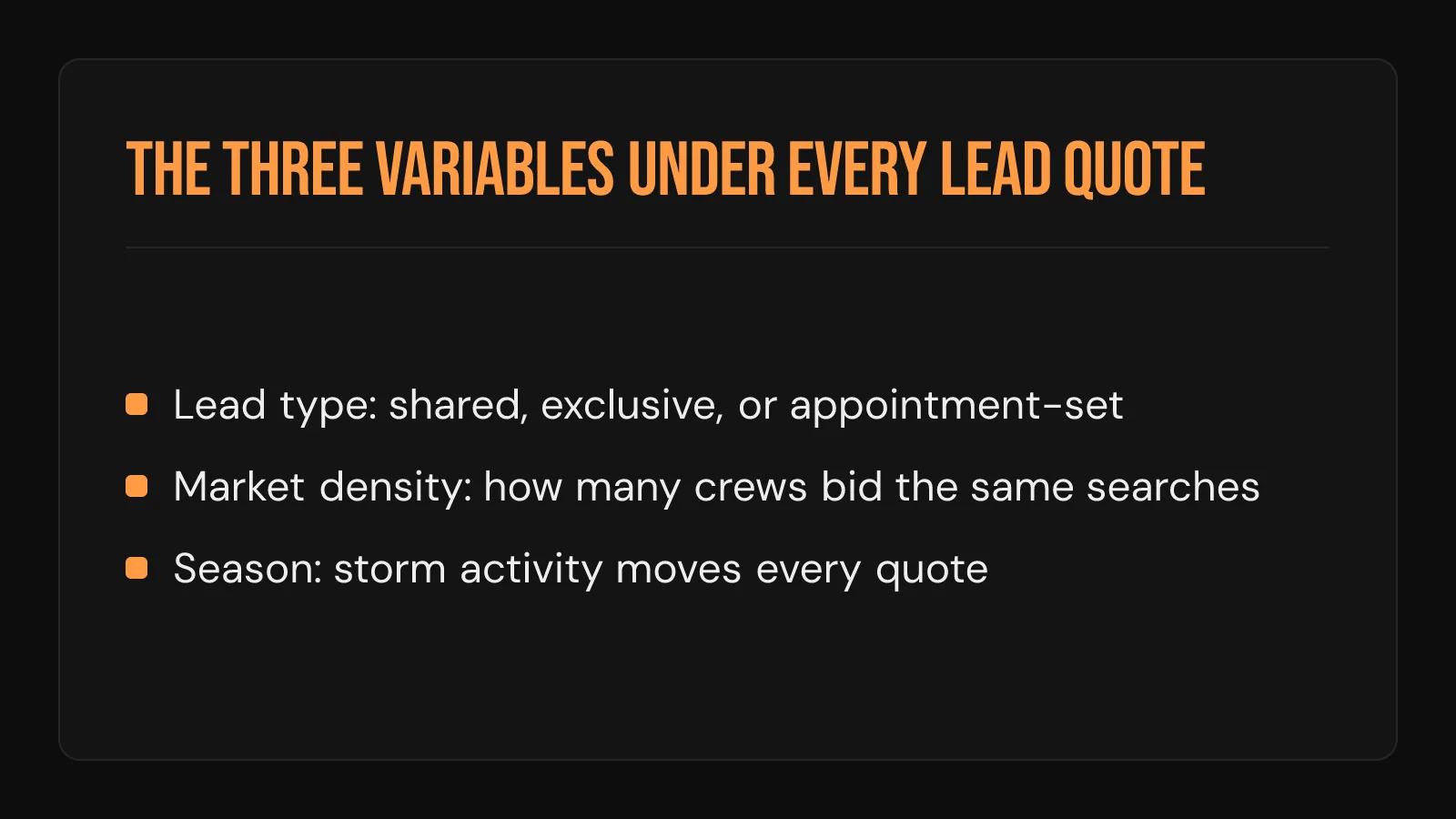
Every vendor call starts with the same question: how much do roofing leads cost? The honest answer is a range, because three variables sit under every quote:
- What kind of lead it is, and how many contractors are buying the same one.
- Where you operate, and how many crews are bidding there.
- What the weather did last month.
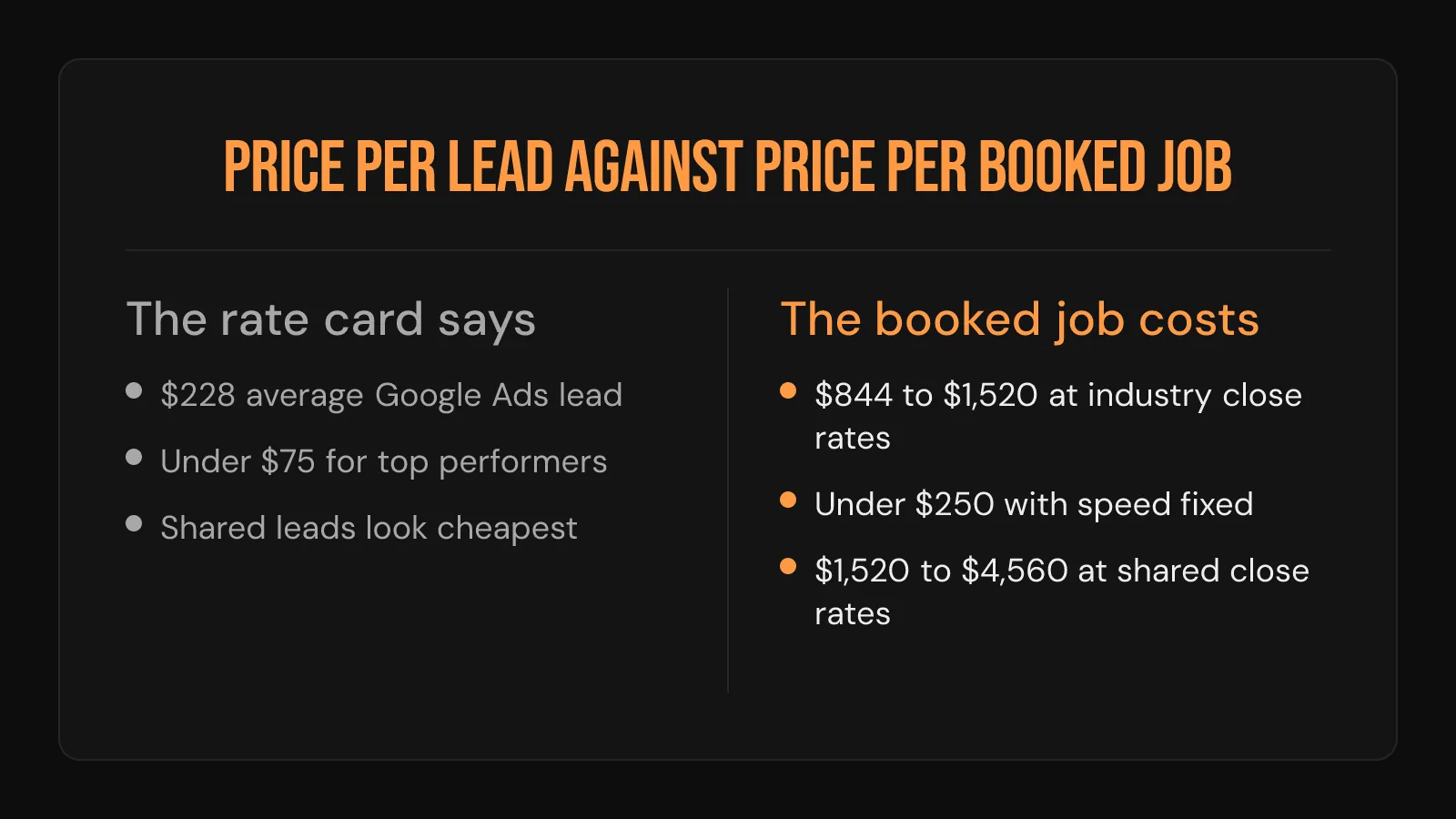
One benchmark is still worth anchoring on. LocaliQ's ad data puts it plainly: a roofing lead from Google Ads averages $228, and top performers still pay under $75.
The structure underneath the quotes looks like this:
| Lead type | What you are paying for | What moves the price |
|---|---|---|
| Shared marketplace lead | One homeowner inquiry sold to you and several competitors at once | How many contractors bought the same inquiry, and how fast each one calls |
| Exclusive lead | The same inquiry, sold to one contractor only | The exclusivity premium itself |
| Appointment-set lead | An inquiry already qualified and booked onto your calendar | The vendor's labor to screen and schedule it |
| Owned demand | Your own site, profile, and follow-up producing the call | A build cost up front instead of a meter that never stops |
A fifth arrangement bills by the ring: pay per call roofing leads charge for each connected call instead of each delivered name.
The price per lead is the wrong number to shop on
Comparing roofing leads cost per lead across vendors tells you who is cheapest to try. It says nothing about who is cheapest to close, and closing is the only part that pays. The close-rate benchmarks make the gap concrete. The industry closes 15 to 27% of its leads. Top crews clear 30%. Shared leads from the big marketplaces close at 5 to 15%.
Simple division on those two benchmarks shows what a booked job actually costs:
| The lead | Cost per lead | Close rate | Cost per booked job |
|---|---|---|---|
| Google Ads, average buyer | $228 | 15 to 27% | $844 to $1,520 |
| Google Ads, top performer | Under $75 | 30% or better | Under $250 |
| Any $228 lead at shared-marketplace close rates | $228 | 5 to 15% | $1,520 to $4,560 |
The table is simple arithmetic on the two cited benchmarks and nothing more. Your own close rate rewrites the right column, which is the only price that belongs in a budget. A cheap lead that never closes is the most expensive lead you can buy.
Most published roofing leads cost per lead 2025 figures trace back to ad-platform data rather than marketplace rate cards, which quote by market and job type. Reading them as one national price is how a contractor ends up budgeting for the left column and paying the right one. That right column is also the number to carry into a marketing plan that budgets around what leads really cost.
What drives the cost of roofing leads up or down
Five variables do most of the moving:
- Exclusivity. Exclusive roofing leads cost more than shared ones because you are the only contractor who gets the call. That premium is usually worth paying, because a shared inquiry turns into a race the moment it is sold.
- Job type. A replacement inquiry carries a bigger job value than repair-sized work, and lead prices follow job value. Repair-sized roofing leads also go cold faster than anything else a vendor sells.
- Storm activity. Demand spikes after a real hail or wind event, and per-lead quotes move with the season. The window is real and checkable, which is exactly why vendors price into it.
- Market density. More contractors bidding on the same searches raises the price of every inquiry in that zip code. A quiet market and a saturated one will never see the same quote.
- Lead age and resale. A fresh inquiry is worth more than one that has been resold for days. Every extra buyer lowers the odds that any single contractor closes it. At the far end of that curve sit aged roofing leads, records old enough to be sold by the batch at a steep discount.
These ranges are structural. The exact quote always depends on your market, and a vendor offering one flat national price is smoothing over all five variables at once.
Why The Trust Process does not sell roofing leads
The Trust Process does not sell, broker, or guarantee leads. There is no rate card behind this page and no per-lead quote coming at the end of it. We publish the market math because contractors ask for it on nearly every call, and because the honest answer sets up a better question: what would it take to stop renting?
That question matters because roofing leads prices never really end. The invoice renews every month you keep buying, and the moment you stop, the phone goes quiet. A lead pipeline you own works the opposite way: it costs the most on day one and gets cheaper with every job it produces.
Speed is the other half of the math, and it is the one variable no vendor controls. Call a lead inside five minutes and you are 100x more likely to reach them and 21x more likely to qualify them than if you wait half an hour. 78% of homeowners go with the first company that responds. A slow follow-up makes an expensive lead worthless and a cheap one worse.
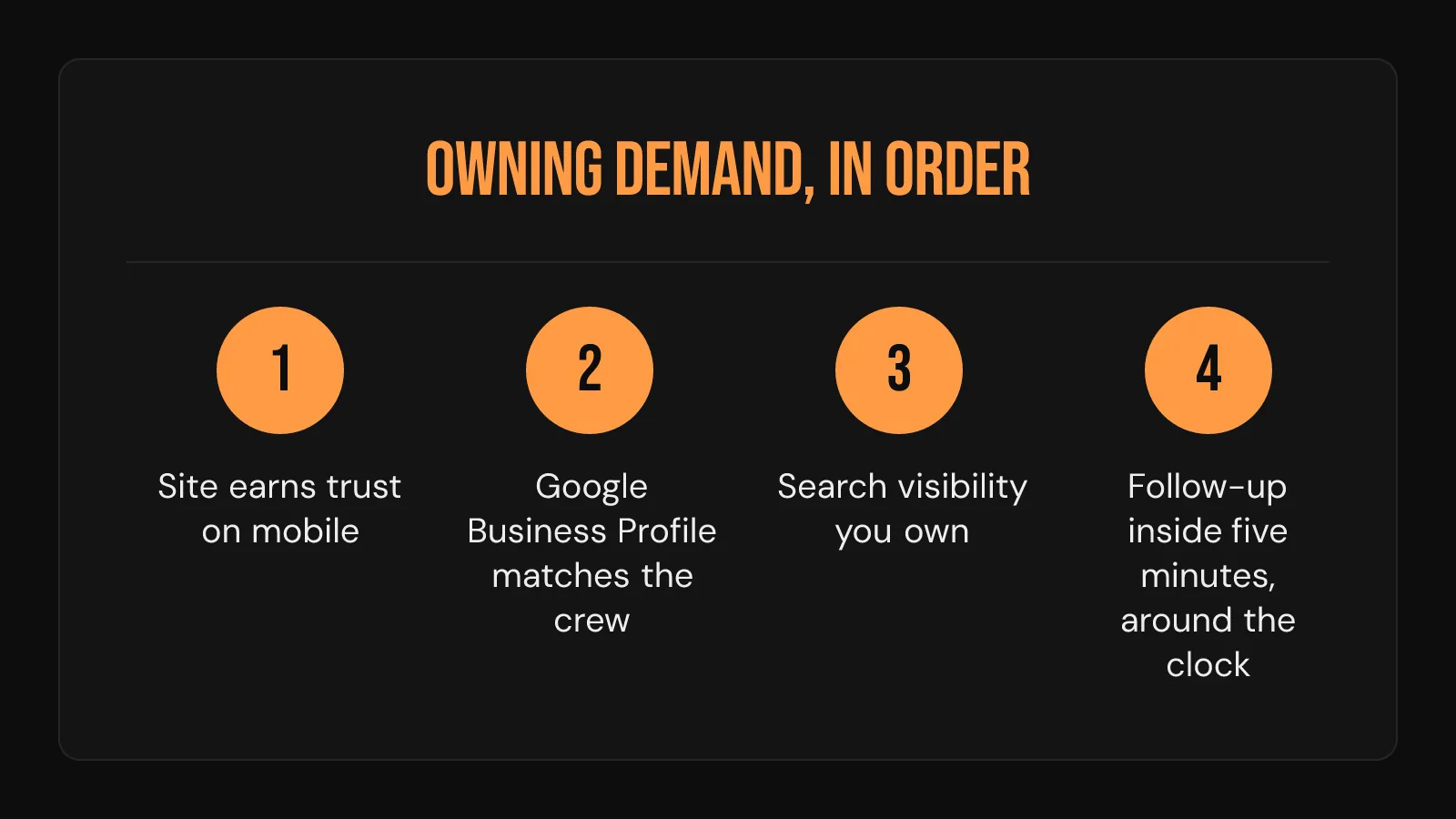
Owning demand is a build with an order to it:
- Make the site earn trust on mobile, because the homeowner judges the company by the page before she ever dials.
- Clean up the Google Business Profile until it reflects what the crew actually does.
- Build search visibility you own, so inquiries arrive without a meter attached.
- Automate the follow-up so every inquiry gets an answer inside the five-minute window, around the clock.
None of that is free, and it is slower than buying a list on Tuesday. Renting demand versus owning it walks the full trade-off, speed against ownership, on both sides of the fence.
How to pressure-test a lead price before you buy
Plenty of contractors will still buy leads next month, and that can be a sane bridge while an owned pipeline gets built. Pressure-test the quote before signing:
- Shared or exclusive, and if shared, how many contractors get the same homeowner?
- What is the repair-versus-replacement mix in the leads that will actually arrive?
- What is the credit policy when a lead turns out to be a wrong number, a renter, or an address outside the service area?
- What close rate do current roofing customers actually see, and does that math clear your average job margin?
Run every answer through the same division as the table above. Then read what lead-volume case studies leave out before a vendor's proof deck closes the argument for them.
Frequently Asked Questions
How much do roofers pay for leads from the big marketplaces?
What roofers pay the big marketplaces is quoted per lead and per market, and it moves with demand, so no single published number covers every vendor honestly. The number that flips the comparison is the close rate. Shared leads from the big marketplaces close at 5 to 15%, so the real cost per job runs several times the rate card.
What is the going price of a roofing lead from Google Ads?
The going price of a roofing lead from Google Ads runs around the $228 LocaliQ average, and disciplined buyers pay far less. The spread exists because market density, job type, and season move every auction. Treat the average as a ceiling to beat rather than a fee to accept.
What is a reasonable cost per lead for a roofing company?
A reasonable cost per lead for a roofing company is whatever your close rate and average job margin can carry. A $200 lead closed one time in ten is $2,000 of acquisition cost per booked job, which a full replacement can absorb and a small repair cannot. Run that division before any vendor conversation, because it is the entire argument of the table above.
Is buying roofing leads worth it at these prices?
Buying roofing leads can be worth it at these prices if the conversion side of the business is fixed first. A bought lead and an owned lead both die in a slow follow-up, and speed is the one variable the rate card never mentions. Fix the response window first, and the same spend closes more jobs at any price point.
Does The Trust Process sell roofing leads?
No, The Trust Process does not sell, broker, or guarantee roofing leads. Roofing leads prices are what you pay to rent demand; what we build is the owned kind. If the real leak is your follow-up or your site rather than lead volume, the walkthrough says so plainly.