Roofing Lead Generation Service: Types, Costs, How to Choose
A roofing lead generation service sells or routes homeowner repair and replacement inquiries to contractors, and the distribution model behind it decides whether that inquiry turns into a signed job or a wasted call. Some services sell the same inquiry to four contractors at once. Others sell it to one. Some charge per delivered name, others per connected call, and a few build search visibility that produces inquiries with no per-lead invoice at all. This page covers the real types on the market, what drives their cost, and a plain checklist for vetting one before a contract gets signed.

What a Roofing Lead Generation Service Actually Sells
Strip away the sales page and the mechanism underneath is simple. A homeowner fills out a form or calls a tracked number, and that request gets sold or routed to one or more roofing contractors. What differs between vendors is everything downstream of that moment:
- How many contractors receive the same request
- How fast it arrives
- What happens if the homeowner turns out to be a renter, a wrong number, or outside the service area
The distinction that matters most is exclusivity. A shared lead goes out to several contractors at the same time. An exclusive lead goes to one. The price, the close rate, and how much follow-up work it takes to win the job all trace back to that single fact.
Types of Roofing Lead Generation Services
Most roofing lead generation companies run one of four models below, and knowing which one is on the table changes what you should ask before signing anything.
| Model | How the Lead Arrives | Typical Exclusivity | Who It Tends to Fit |
|---|---|---|---|
| Shared marketplace | Sold to several contractors from one form submission | Shared, several buyers per inquiry | Crews with a fast, staffed response system already built |
| Exclusive lead service | Sold to one contractor only | Exclusive | Crews that can absorb a higher per-lead cost for a better close rate |
| Pay-per-call | Billed per connected phone call rather than per delivered name | Varies by vendor | Crews that want to pay only for a real conversation |
| Content or SEO-built pipeline | Homeowner finds the contractor directly through search, with no per-lead invoice | Exclusive by nature, one search result | Crews willing to trade a slower ramp for demand nobody else is bidding on |
The first model is the one behind the four-way race most contractors do not realize they have entered.
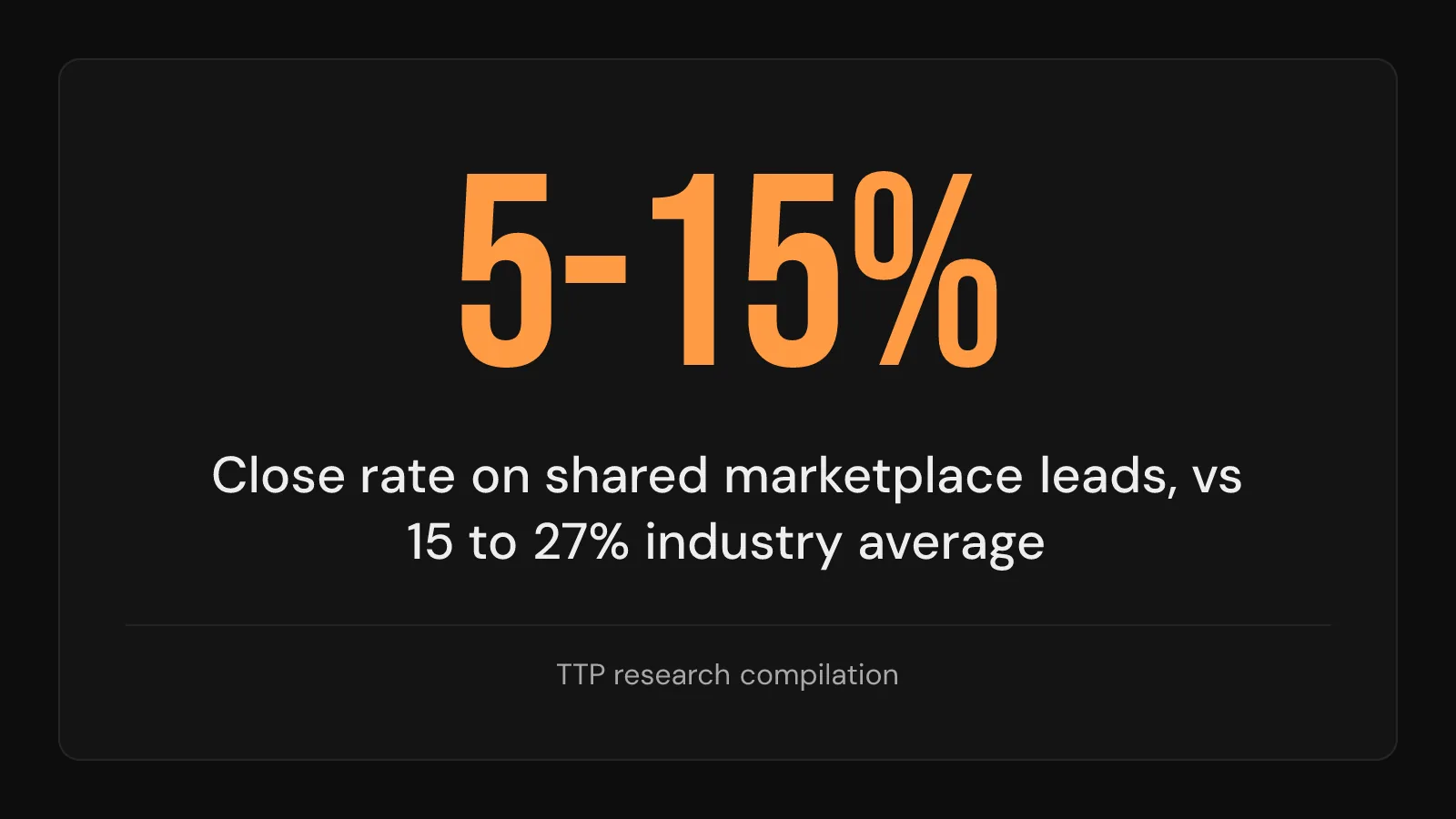
Exclusivity usually earns its premium. The industry closes 15 to 27% of its leads. Top crews clear 30%. Shared leads from the big marketplaces close at 5 to 15%. Every contractor on that list is racing the same clock for the same homeowner, and that race is what the extra cost is actually paying to avoid.
None of these models are priced the same, and comparing vendors on sticker price alone misses the number that actually decides whether a vendor is worth using: cost per booked job. See the full cost-per-job math for the complete breakdown.
How to Vet a Lead Vendor Before You Sign
Before you compare the top roofing lead generation services on your shortlist, run each candidate through this list. The contract terms below apply just as much to a full-service roofing lead generation agency, where exclusivity, ownership, and reporting matter even more once a whole engagement is on the line rather than a single delivered name.
- Ask for three sample leads from the last two weeks and check whether they read like real, current requests or recycled records.
- Read the exclusivity clause line by line. A promise on a sales page and a promise inside the contract can read very differently.
- Ask what happens when a delivered lead turns out to be a wrong number, a renter, or outside the service area, and get the credit policy in writing.
| Criterion | Why It Matters | Red Flag |
|---|---|---|
| Response-time SLA | A fresh request that is not delivered in real time has usually already been called by someone else | Vendor cannot say how fast a lead reaches you after the homeowner submits |
| Geographic overlap | Dense overlap turns an "exclusive" lead into a shared-marketplace race in practice | Vendor will not disclose how many other contractors buy from the same territory |
| Minimum contract term | A long lock-in costs the most once lead quality drops after the first month | Multi-month commitment with no early cancellation path |
| Sample transparency | Real, recent samples show what actually gets delivered rather than what the sales page promises | Vendor stalls or refuses to share sample leads before a contract gets signed |
Response time deserves its own line, because it is the one variable that decides whether a good lead survives contact with reality. Call a lead inside five minutes and you are 100x more likely to reach them and 21x more likely to qualify them than if you wait half an hour. That statistic usually gets used to explain why a contractor should answer fast. A lead that sits in a vendor's queue for hours before it ever reaches you has already cooled past the point that stat describes, no matter how fast you call it once it lands.
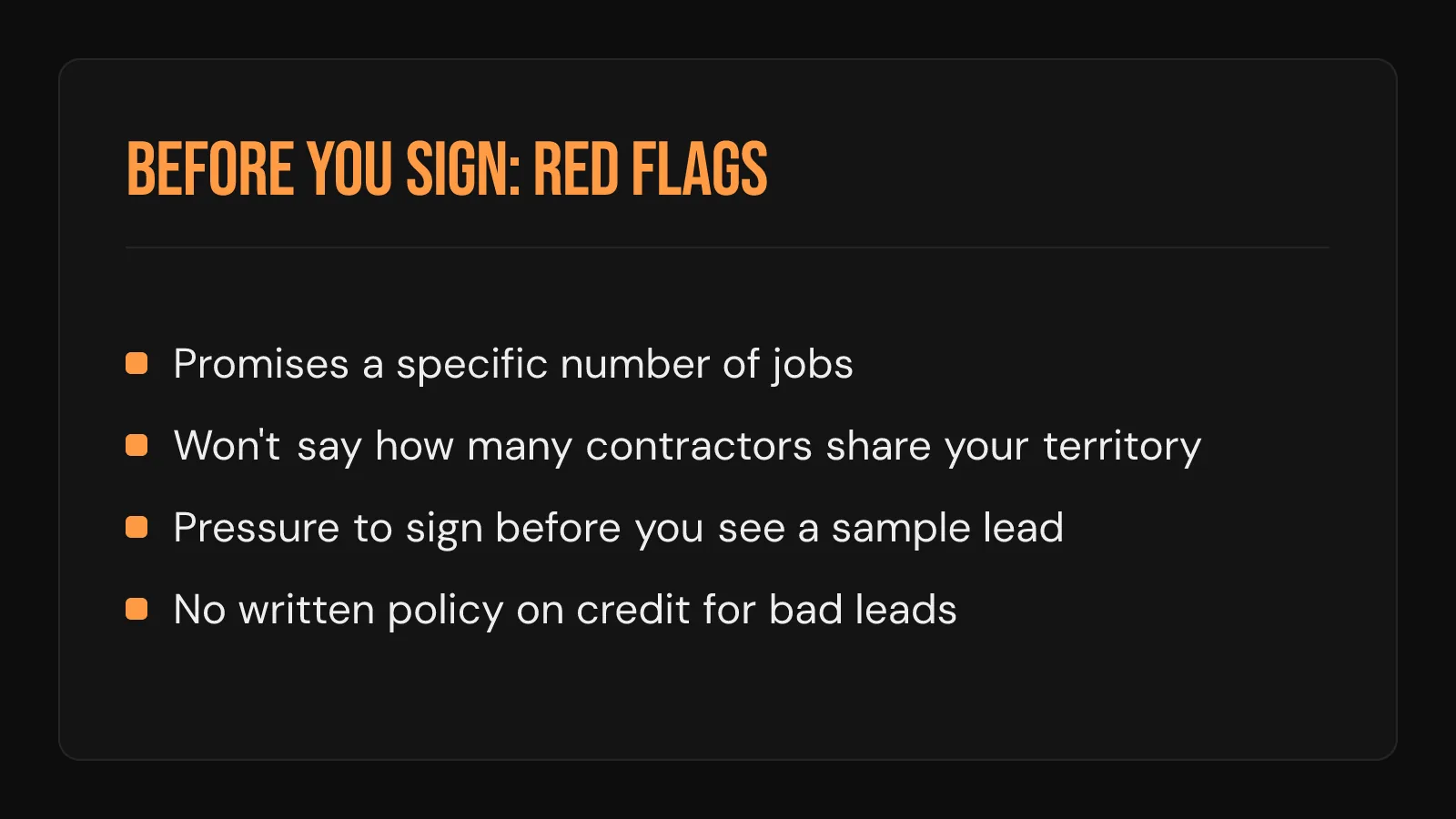
Walk away if any of the following show up during the sales conversation:
- A guarantee tied to booked jobs rather than delivered leads. What a guarantee like that actually means is worth reading before signing anything with that word in it.
- Refusal to say how many other contractors buy from the same territory
- Pressure to sign before a sample lead has been reviewed
- No written policy on credit for bad or duplicate leads
Where This Leaves You If You're Already Getting Leads
Buying leads still makes sense for plenty of roofing companies, especially early on or during a slow month, as a real part of the plan. The Trust Process does not sell or broker roofing leads. The work here is the system underneath any lead source, bought or organic: response speed, follow-up that does not die after day two, and a Google profile that earns the call before a lead is ever purchased. Buying roofing leads versus owning the demand yourself walks through that full trade-off in more depth. Tracking those leads costs nothing to start: what a free roofing CRM actually covers lays out the no-cost tier's real limits before a crew commits a year of job history to it.
Once a lead is actually inside your pipeline, moving it through stages, from first contact to a signed job is its own discipline, separate from which vendor or channel it came from.
Frequently Asked Questions
What is a roofing lead generation service?
It is a company that collects homeowner roofing inquiries, through ads, a directory listing, or its own site, and sells or routes those inquiries to contractors, either to one buyer or to several at once. The Trust Process does not sell or broker roofing leads. Its work is the conversion system underneath the leads a contractor already has.
How much does a roofing lead vendor charge?
Cost varies by model and market, but one benchmark from LocaliQ helps anchor it. A roofing lead from Google Ads averages $228, and top performers still pay under $75. Exclusive leads generally cost more per lead than shared ones, and the number that actually matters is cost per booked job.
What is the difference between exclusive and shared roofing leads?
An exclusive lead is sold to one contractor only. A shared lead is sold to several contractors from the same form submission, and the homeowner usually hears from all of them within minutes of each other. Shared leads cost less per lead and close at a noticeably lower rate, which is why the sticker price rarely tells the whole story.
Is buying leads worth it for a company that already gets calls?
It depends on what is actually broken. A company that already gets calls and still has open schedule gaps often has a conversion problem, a slow follow-up or a Google profile that undersells the work, and buying more leads adds volume without addressing that gap. A company with genuinely open capacity and no pipeline yet is a different case, where buying leads can bridge the gap while other channels build.
Do I still need a lead vendor if I already work with a marketing company?
Not automatically. Stacking a paid lead vendor on top of an existing marketing relationship can work, but only if the two do not compete for the same homeowner in the same territory. Check the exclusivity and geographic-overlap terms before adding a second source, or the new vendor may just be racing the marketing you are already paying for.
What should I check before signing a contract with a lead vendor?
Start with the three items in the checklist above: real sample leads, the exact exclusivity language in the contract, and a written credit policy for bad leads. 70% of roofing companies do not trust the marketing provider they already pay, so treat a new contract with the same scrutiny you would want applied to the one you already have.