Percentage of Roofing Leads From Google: The Real Data
Every roofing contractor asking about the percentage of roofing leads from Google is really asking one thing: does a directory listing or a website even still matter. The honest answer starts with a caveat: no agency has a verified, sourced percentage for how many roofing leads trace back to Google versus a referral versus a repeat client. The data below is more useful than a manufactured number. A referral still gets checked on Google before the phone rings, and a thin or unclaimed Google Business Profile quietly costs jobs that never register as lost. This page covers what the verified numbers say, and why measuring by percentage misses the real mechanism.
What Is the Percentage of Roofing Leads From Google?
Search for this exact question and most results either dodge it or invent a number. One roofing-leads guide floats a 30% referral, 20% SEO, 20% paid, 20% outbound, 10% repeat-client split, presented as a general guideline rather than cited statistical data, and that is the pattern across almost every source on this topic.
The table below sticks to what is actually verified, phrase by phrase.

| The question | What the verified data actually shows |
|---|---|
| Percentage of roofing leads from Google search | 94% of homeowners start their contractor search online (BuildLocal), the default starting point for nearly every search, referral or not. |
| Percentage of roofing leads from local SEO | 94% of weekday calls to local businesses start at the Google Business Profile (Figment Agency), exactly what local SEO work controls. |
| Percentage of roofing leads from organic search | No verified split exists for organic search specifically, which is why a page that keeps ranking keeps producing calls no single stat captures. |
| Percentage of roofing leads from online sources | 62% of consumers skip a business they cannot find online, the closest thing to a real "online versus offline" figure that holds up. |
| Percentage of roofing leads from Google Map Pack | No separately verified Map Pack-only split exists, though the Map Pack draws directly from the Google Business Profile above. |
| What percentage of roofing leads come from Google | No single trustworthy figure exists. The more useful number is how many searches touch Google before a call happens, covered in the rows above. |
A roofing leads case study read honestly walks through exactly how a lead-volume number like these hides whether the leads actually became jobs.
Why the Channel Matters Less Than the Search
A neighbor gives a name. That name still gets Googled. The percentage of roofing leads from word of mouth looks high on a job sheet, but almost none of those calls skip a phone-in-hand search first. The same holds for the percentage of roofing leads from referrals broadly: the referral opens the door, and what Google shows decides whether the door stays open.
A homeowner Googles the business name. Three tabs open: the website, the Google Business Profile, and the review sites. She checks in order:
- Does the business name turn up a real, current result instead of a dead link or a Facebook page from three years ago?
- Does the Google Business Profile show recent reviews and a real address?
- Does anything about the listing contradict what the neighbor said?
Skip any of those and the referral quietly dies before the call happens. The percentage of roofing leads from local search matters here for the same reason: even a warm lead from a neighbor runs through a local search before it becomes a phone call.
The Google Map Pack, Near-Me Searches, and Local Search's Real Share
The map pack is the three-listing block above the organic results, drawing straight from the Google Business Profile instead of the website. Most roofing leads from near me searches never reach a website at all; the homeowner calls straight from the listing.
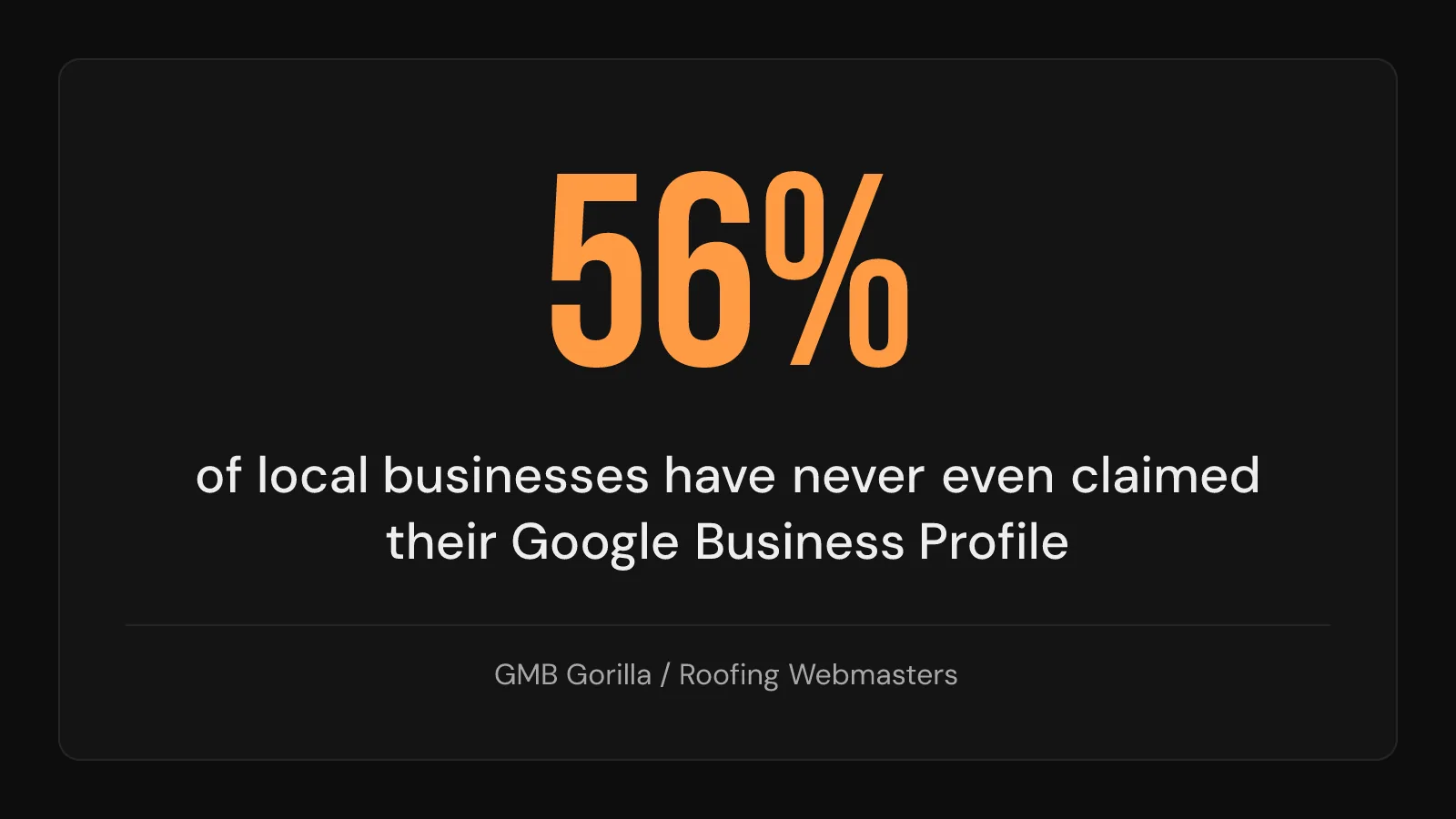
Local search percentage of roofing leads is easiest to picture through the map pack, since that block is the physical evidence of who Google currently trusts most in a given neighborhood. 56% of local businesses have never even claimed their Google Business Profile, meaning over half the competition in most markets has not claimed the listing the map pack surfaces first. The percentage of roofing leads from local searches keeps climbing every year the smartphone habit deepens, and an unclaimed or thin profile is an open door left for whoever fills theirs out. That climb in local search demand is exactly the ground covered in roofing SEO leads.
Claiming and filling out a Google Business Profile takes about an afternoon, and it is the single highest-payoff move most of these numbers point back to.
A map pack listing pulling its weight tends to share a few traits:
- Photos from a real job in the last month instead of a stock roofline
- Reviews that get a real reply instead of a star count alone
- Service areas matching where the crew works
- Contact details matching the website
For a full breakdown of what ranking in the map pack actually takes, see local SEO for roofing companies.
Primary Sources of Leads for Roofing Contractors
There is no single primary source of leads for roofing contractors that dominates every market. Across most local markets, the primary sources of leads for roofing contractors fall into a few repeatable buckets:
- Referral and repeat clients. Free, immediate, and still routed through a Google check before the call, as covered above.
- Organic and local search. The Google Business Profile, the map pack, and a website that actually ranks.
- Paid search. Fast, priced per click, and best used once the free channels above stop being the bottleneck.
- Aggregator and shared leads. Bought from a marketplace, closing at roughly half the rate of an owned pipeline.
Sources of leads for roofing contractors worth tracking all run through the same checkpoint: does the business show up, and does it look credible, the moment someone checks. Paid search inside that bucket often means Google Local Services Ads specifically, the channel covered in LSA marketing for roofing companies. For that fourth bucket specifically, what a roofing lead generation service sells and how to vet one breaks down the models and the contract terms worth checking before paying for any of them.
Clean, sourced roofing marketing statistics leads sources breakdowns stay rare industry-wide, since few shops track which channel a lead came from past the first call. The honest read of sources of roofing leads statistics leans on search behavior data instead of a manufactured split. For the fuller picture, see roofing marketing statistics or trends for 2026.
The most common search terms for roofing leads cluster around a small set of patterns: a service plus "near me," "roof repair" plus a city name, and the business's own name typed in right after a referral.
Google is the checkpoint almost every roofing lead passes through, whether it started as a referral, a repeat client, or a cold search. What actually gets a phone to ring stays simple: a homeowner has to find the business, trust what she sees, and reach a real person fast. Roofing leads that actually close come from treating that checkpoint as the priority, rather than a separate source to chase.
Frequently Asked Questions
Does Google Ads count toward the percentage of roofing leads from Google, or only organic search?
Paid ads sit inside the same Google ecosystem, but they behave differently from the organic and Map Pack traffic covered above. A Google ad click costs money the moment it happens and stops the moment the budget runs out. The organic and local search numbers in this piece are the leads that keep showing up without a fresh dollar spent each month.
If most of my leads already come through Google in some form, is it worth paying to improve where I show up?
Yes, and the return compounds instead of resetting every month like a paid ads budget does. A stronger Google Business Profile and better local search visibility keep working long after the invoice is paid. The upgrade pays for itself the first time it wins a job that would otherwise have gone to whichever competitor showed up first.
If my guy already runs our Google Ads, doesn't that already cover our Google leads?
It covers paid clicks, which is one piece of what shows up under Google. The organic results, the Map Pack, and the Google Business Profile sit outside what an ads-only vendor manages, and the data above says those free channels carry the larger share of the calls. A referral or a "near me" search usually lands on the organic listing or the map pack first, before it ever reaches a paid ad. See how the Google Ads auction actually prices that click if you want the mechanics without an ads-vendor pitch attached.
We already tried cleaning up our Google Business Profile once and our lead count didn't change. Why would this be different?
A one-time cleanup and an actively maintained profile produce different results, because Google weighs recency over a single edit from months ago. Recent photos, reviews answered within a day or two, and accurate service areas all send a stronger signal than one edit made once and left alone. Most competitors have not kept their own profile current, which makes staying consistent a real, ongoing edge.