A One-Page Roofing Marketing Plan Your Crew Can Actually Run
A roofing marketing plan only works if it fits the crew that has to run it. Most owners wear four to six hats, and a plan that assumes a marketing department dies by the second week of March. The fix is a smaller document with harder numbers. This post covers those decisions, the revenue math, the channel ranking, a five-step build order, and a one-page template you can copy this week.
What a Roofing Marketing Plan Has to Decide
Strip away the jargon and a real plan makes four decisions:
- Who you sell to. The homeowner, the neighborhood, the job type you actually want more of.
- What the revenue target implies. Jobs needed, inquiries needed, calls that must get answered.
- Which channels get run. Two, picked on cost and speed. Never six.
- Who answers when it works. An inquiry nobody responds to is a job you paid to lose.
A workable marketing plan for roofing company owners also has to fit inside real hours. If it needs 15 hours a week and you have three, it is fiction. If you are still collecting options for the channel decision, start with roofing marketing ideas grouped by cost and speed, then come back and cut the list to two. That table above assumes the job type you actually want more of is residential; if some of it should be commercial work instead, how to find commercial roofing leads covers the different channel mix that takes.
Anchor the Roofing Business Marketing Plan to a Revenue Number
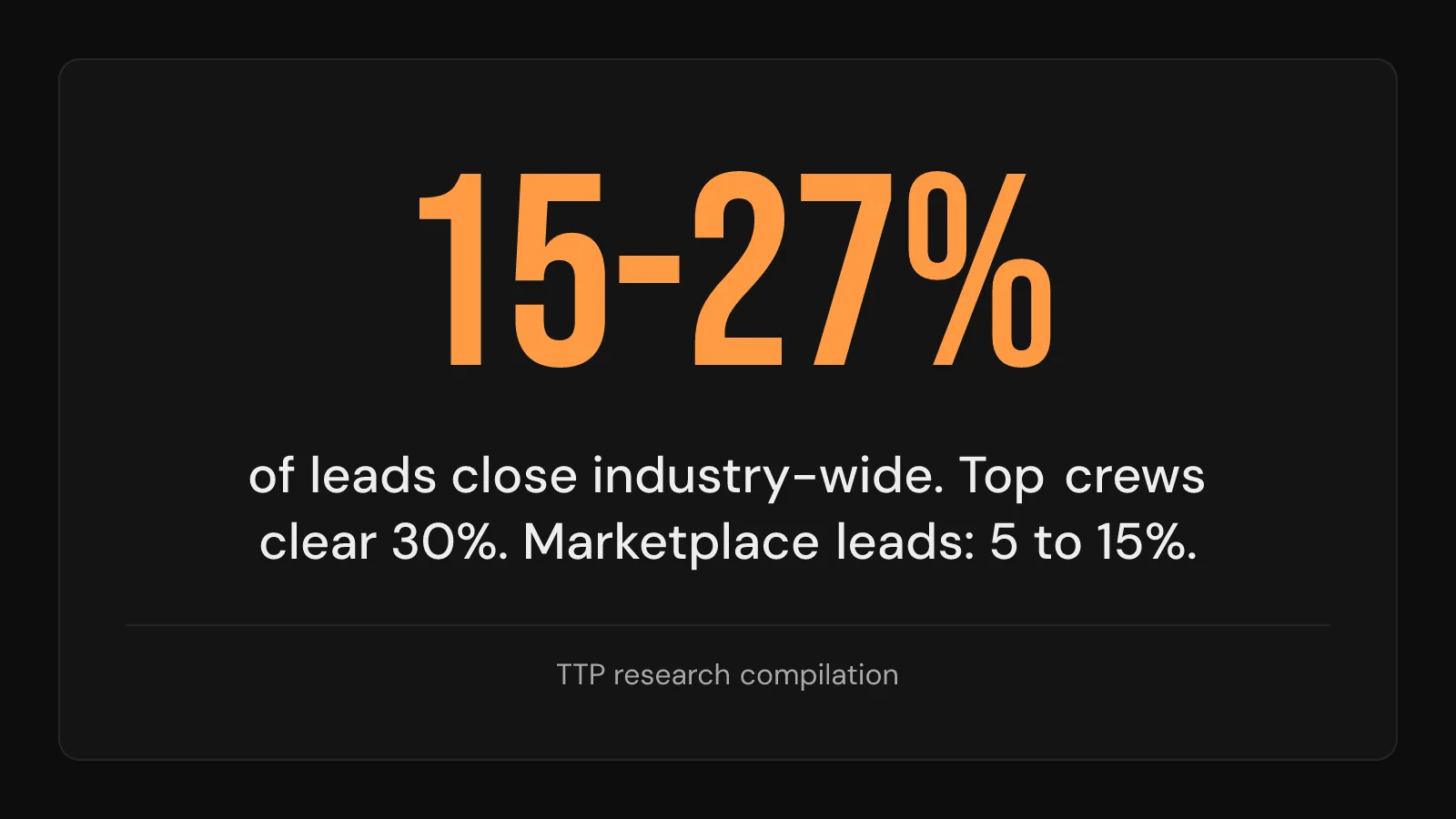
Pick the number first. Say the goal is 40 extra jobs this year. The industry closes 15 to 27% of its leads. Top crews clear 30%. Shared leads from the big marketplaces close at 5 to 15%. At a 25% close rate, 40 jobs means about 160 real inquiries, or three to four a week. Once the year becomes a weekly inquiry target, every channel can be judged against it.
A business marketing plan for roofing crews starts with that math, never with the logo. One caveat: close rates move with response speed, so the same 160 inquiries can produce 30 jobs or 48 depending on who picks up the phone.
The Channels a Roofing Company Marketing Plan Has to Rank
94% of homeowners start their contractor search online. That one number should shape the ranking. Here is how the usual options compare for a small crew:
| Channel | Cost signal | Speed to results | Whose job it is |
|---|---|---|---|
| Paid ads (Google Ads, LSAs) | Paid, per-lead auction | Days | A vendor you hire and watch |
| Social posting | Free, steady time cost | Weeks to months | You or someone on the crew |
| Email to past customers | Low cost, list required | Weeks | You or a vendor |
| Direct mail and yard signs | Low, per-piece cost | Weeks | You |
| Referrals and reviews | Free | Immediate when asked | You and the crew |
| Website, SEO, and Google profile | Investment up front | Weeks to months, then compounds | The foundation everything above lands on |
The direct mail and yard signs row deserves a second look before it gets written off as old-fashioned. Roofing marketing materials breaks down which physical pieces still earn their cost and which ones just look busy.
One honest note before you rank anything: The Trust Process does no ad management, no social posting, and no email campaigns. Those rows are here as education only. The website, SEO, and follow-up rows are where roofing industry marketing actually lives, sold as one piece or several depending on where your plan is thinnest.
The last row is the one most plans skip. Every channel in the table sends people to the same four assets:
- Your website
- Your search visibility
- Your Google profile
- Your follow-up
That foundation is what actually produces jobs for roofing companies when it is built right. It decides how many of the clicks you already earn become booked inspections.
The organic side deserves one warning. 98% of the content on roofing websites gets zero traffic. Publishing without a search target is a hobby. SEO for roofing contractors earns its slot because it compounds, and it only compounds when the pages chase searches homeowners actually make.
The best marketing plan for a roofing company usually runs two channels hard and ignores the rest until those two are boring and reliable.
The Five-Step Build Order
Building a marketing plan for roofing contractors is mostly a matter of sequence. Do these in order:
- Set the revenue number. Jobs this year, then inquiries per week, using the close-rate math above.
- Fix the conversion foundation first. Site loads fast on a phone, Google profile claimed and photographed, follow-up wired so no form sits overnight. Spending on channels before this step is pouring water into a cracked bucket. For the search side of the foundation, run the SEO practices that pay off first in that order.
- Pick two channels. One fast, one compounding. The table above is the shortlist.
- Set the weekly cadence. Two hours, same day every week, on the calendar like a crew dispatch.
- Wire the follow-through. 78% of homeowners go with the first company that responds. Decide who answers inside five minutes and who backs them up. This step is where owning your lead pipeline stops being a slogan and starts being a schedule.
That sequence is the whole roofing marketing plan. Everything past it is decoration.
The Zero-Budget Version
No budget just means the plan spends hours instead of dollars. The best free marketing plan for roofing company owners leans on three moves:
- Claim and work the Google Business Profile. Real job photos every week, every review answered, services and hours current.
- Ask for the review before the truck leaves. The homeowner is never more grateful than in that hour.
- Call every referral back the same day. A referral treated like a sure thing goes to whoever responds first.
Free is a real budget line. It just gets paid in time. For a fuller ranking of paid and free options, see which marketing actually works for roofing companies. For the year-over-year read on which channels are actually gaining ground, see this roundup of roofing marketing statistics and trends.
A Roofing Company Marketing Plan Template You Can Copy
Print this, fill in seven boxes, and put it where the crew can see it:
| Plan box | The question it answers | Example entry |
|---|---|---|
| Revenue target | What does the year have to produce? | 40 replacement jobs |
| Ideal job | Which work do we actually want? | Full replacements in the north suburbs |
| Lead math | How many inquiries does that take? | 160 for the year, three to four a week |
| Channel one | Where does attention come from first? | Google profile and review velocity |
| Channel two | What backs it up? | Referral follow-up on every finished job |
| Weekly cadence | When does the marketing work happen? | Tuesdays, two hours, no exceptions |
| Follow-through owner | Who answers inside five minutes? | Office manager first, owner as backup |
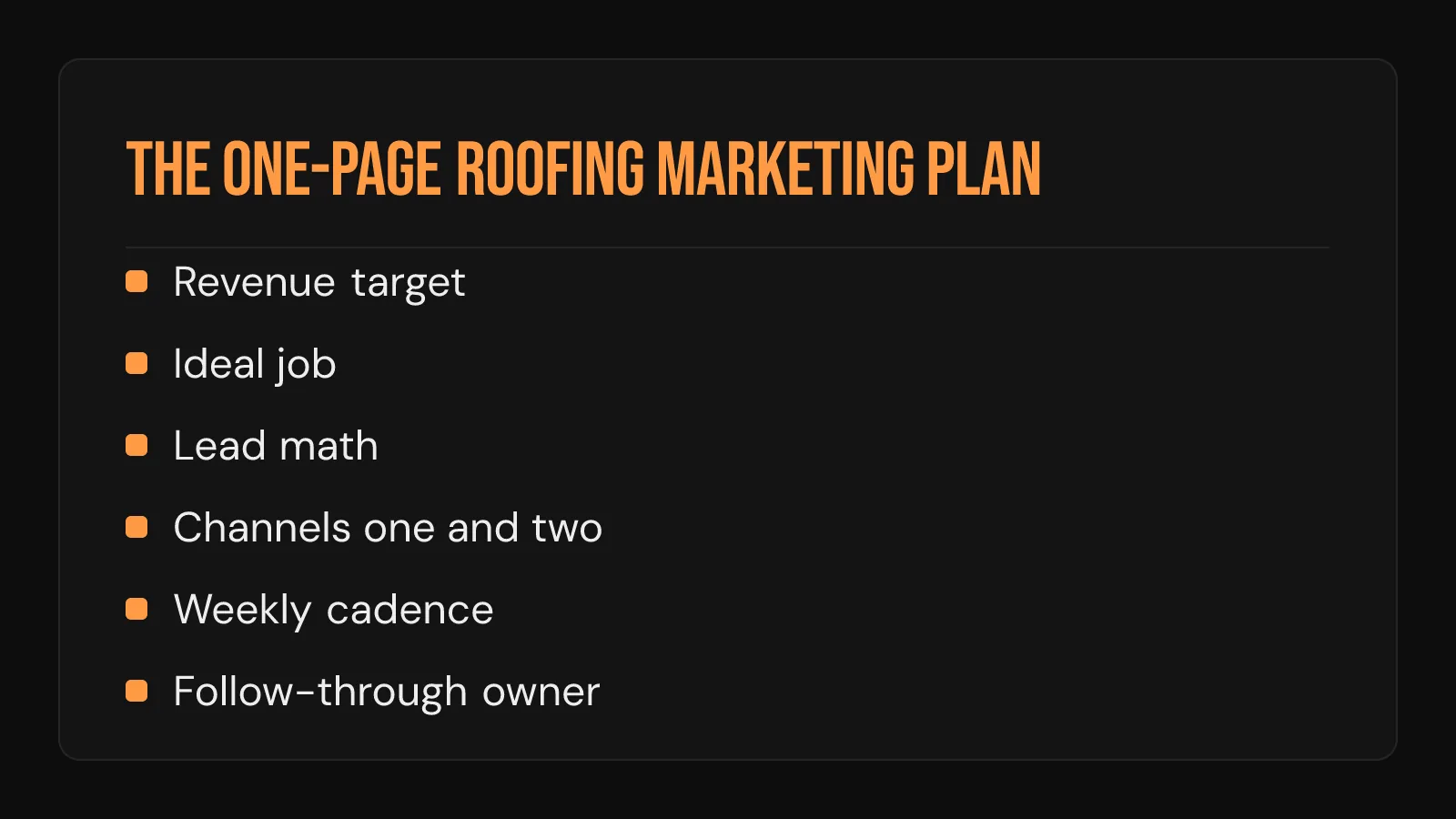
A business marketing plan template for roofing crews needs nothing longer than that. If a box is blank, the plan is not finished. If a box changes, update the paper the same week. A plan the crew can run in two hours a week beats the plan that gets abandoned in March.
Frequently Asked Questions
How do I promote my roofing business if the plan only gets a few hours a week?
Promote your roofing business by putting those few hours into the two channels that compound fastest: the Google profile and review velocity. Two hours every single week beats 10 hours in January and silence until June. The cadence matters more than the total.
What are the five p's of a marketing plan and do they matter for roofing?
The five p's are product, price, place, promotion, and people, and for roofing they matter less than the textbook says. A roofer's product and place are mostly fixed, so the real decisions live in promotion and people. That is why the one-page template above spends most of its boxes there.
Can a marketing plan get a roofing company to $100,000 in sales?
A roofing marketing plan can get a company to $100,000 in sales when it works backward from that number. Break the goal into jobs, break the jobs into weekly inquiries at a real close rate, and the plan becomes a lead target you can check every Friday. The revenue math section above does exactly that.
Do I need a marketing plan if I already have a marketing guy?
You need a marketing plan even with a marketing guy, because the plan is what tells both of you where to aim. Without the revenue math and the channel ranking on paper, you are grading his work on vibes. With it, every invoice can be checked against a weekly inquiry target.
What if the last marketing plan I paid for went nowhere?
A marketing plan that went nowhere usually died at follow-through rather than channel choice. Most owners who got burned bought activity: posts, flyers, a retainer, a report. The fix is a plan where every channel feeds a phone that gets answered, which is the one part you can verify week by week.