Best SEO Practices for Roofing Businesses That Book Jobs
The best SEO practices for roofing businesses are the ones that end in a phone call, and most published lists rank them backwards. They open with blog calendars and keyword tools, then bury the two moves that actually make a phone ring. This list runs in payoff order instead. An owner wearing four hats cannot run every practice at once, so the sequence has to earn its keep from week one. The order is the advice.
The best SEO practices for roofing businesses, ranked by payoff
Five practices carry nearly all of the payoff, and they work best in this order:
- Claim and work the Google Business Profile. The map pack is where local calls start.
- Build review volume and recency. Homeowners scan reviews for safety before they ever dial.
- Give every town you serve its own real page. One page per market, written for that market.
- Make the site fast on a phone. A slow mobile page loses her before it loads.
- Publish content that answers homeowner questions. Last because it compounds slowest.
| Practice | What it moves | When you feel it |
|---|---|---|
| Business Profile | Calls from the map pack | Weeks |
| Reviews | Which roofer she decides to trust | Weeks |
| City pages | Rankings in every town you serve | Months |
| Site speed | How many visitors survive the load | Days after the fix |
| Homeowner content | Question searches that turn into estimates | Months |
Each one gets the short version below. For the method behind the whole system, start with the full roofing SEO picture.
Google Business Profile first: that is where the calls start
94% of weekday calls to local businesses start at the Google Business Profile. Not the website. The profile. That one number should reorder most to-do lists on its own, yet the profile is usually the piece an owner set up once and never opened again. The local SEO for roofers best practices that actually move the map pack start right there. The same profile decides who wins the roofing jobs nearby. A worked profile is also the closest thing this trade has to free roofing leads that arrive without a per-lead bill.
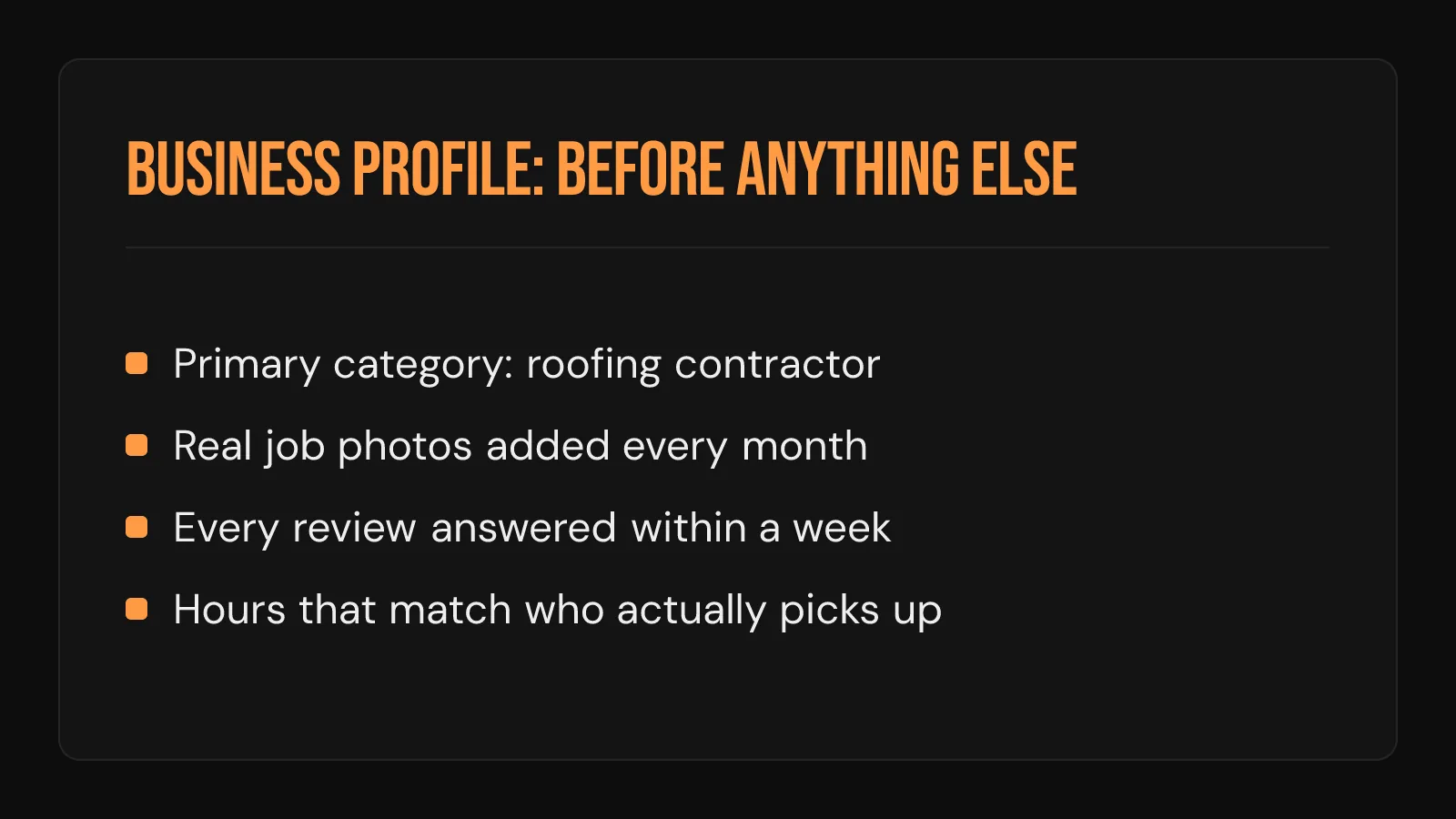
If you were the homeowner, would you call the roofer whose profile shows six photos from 2019 and a review reply from never? Probably not. Four items are worth doing before anything else:
- Set the primary category to roofing contractor and leave it alone.
- Add photos from real jobs every month: crew, tear-off, finished deck. Skip the stock shots.
- Reply to every review, the glowing ones and the angry ones, within a week.
- Match the listed hours to reality, including whether anyone picks up after five.
None of it needs a marketing budget, and all of it feeds earning a spot in the Google Maps three-pack.
Reviews and city pages: proof for her, relevance for Google
Reviews are the trust half of this work. 55% of consumers pick the company with many solid reviews over the one with a handful of perfect ones. Volume and recency beat a spotless score. A homeowner deciding between three tabs reads the newest reviews first, checks how you answered the worst one, and turns what she finds into a character judgment. Review recency is the most skipped item in local SEO for roofing contractors best practices, which makes it cheap ground to take.
City pages are the relevance half. A roofer serving nine towns from one generic service page is invisible in eight of them. Volume alone does nothing either: 98% of the content on roofing websites gets zero traffic, mostly because it was written for a template instead of a search. A roofer operating across many markets hits this same wall at scale, which is the core problem national roofing SEO has to solve.
| A page written from a template | A page written for a real search |
|---|---|
| Same paragraph with the city name swapped | Names the neighborhoods, the storm dates, the permit office |
| Ranks nowhere | Ranks in that one town |
| She bounces in seconds | She recognizes her own street |
City landing pages are also where local SEO for roofing companies best practices most often stall, because writing nine real pages is slow work. Take them one market at a time, starting with the step-by-step local SEO checklist.
Site speed on a phone: the practice nobody sees
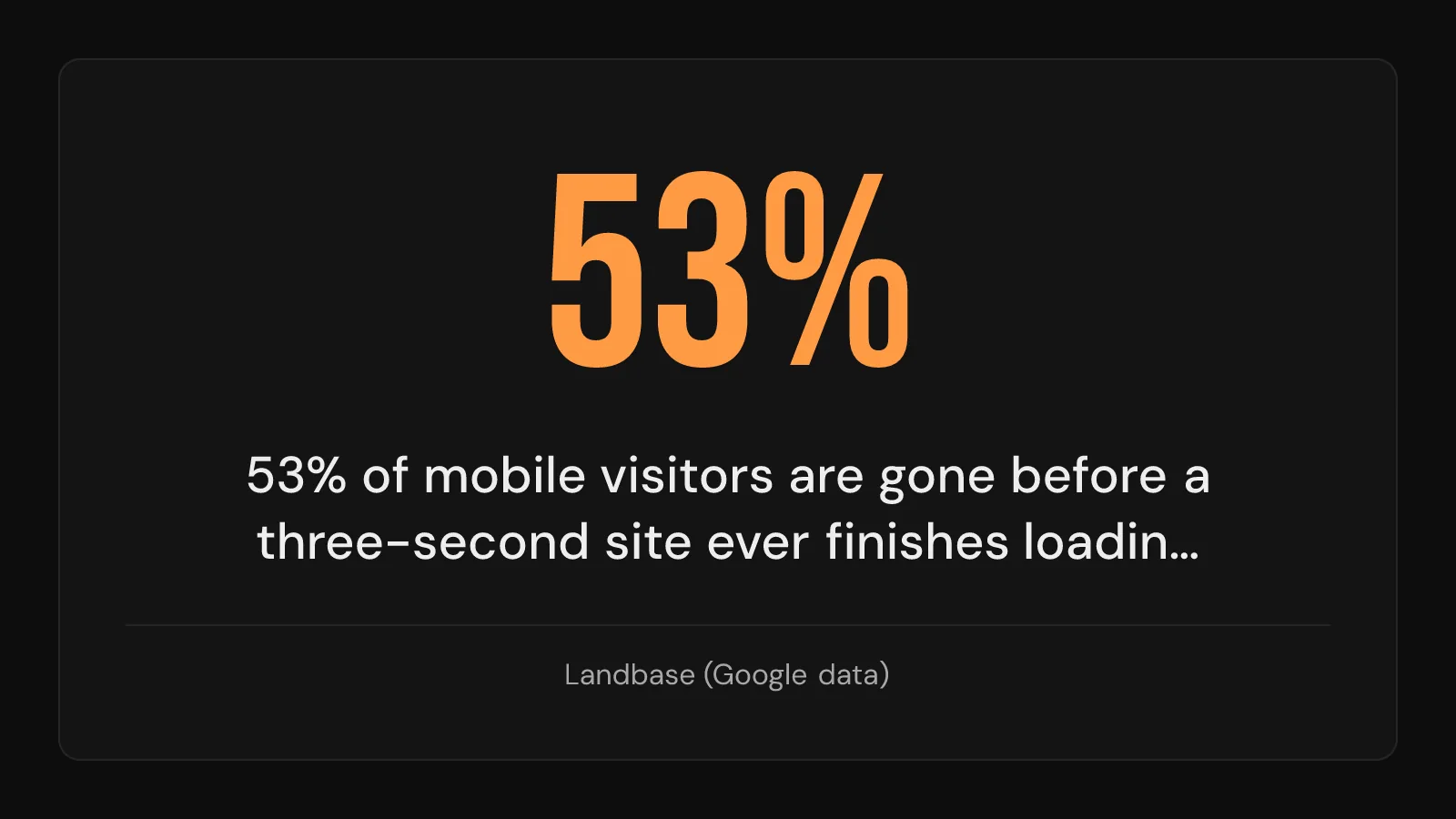
Every practice above dies on a slow site. 53% of mobile visitors are gone before a three-second site ever finishes loading. She reads a slow page the way she reads a crew that shows up late, and she is gone before the hero photo renders. Roofing contractor SEO best practices treat load time as a trust signal because that is exactly how she treats it.
Most slow roofing sites are slow for boring reasons: oversized photos, a decade of stacked plugins, a theme built for desktop screens. Three checks you can run from the truck tonight:
- Load your own site on cell data, away from the office wifi, and count the seconds.
- Tap the phone number with a thumb. It should open the dialer on the first try.
- Find your service area in under 10 seconds. If you cannot, she cannot.
Where the best practices stop: ranking without converting
Run all five practices well and something strange can still happen. Rankings climb, traffic grows, and the phone stays quiet. The best SEO practices for roofing companies still lose money when the site they feed cannot convert the click, because search only delivers her to the door. The door has to work.
A few signs the door is the problem:
- Calls after hours hit voicemail and never come back.
- Form fills sit unanswered past dinner.
- Reviews look strong while the site still looks like a 2014 template.
Search itself keeps shifting, and emerging answer engines reward the same signals of clear structure and direct answers, so none of this work gets wasted. The finish line just has not moved. The list ends at the click. The job is won after it. Connecting the two is the whole point of roofing SEO services built around booked jobs.
Frequently Asked Questions
How long before the best SEO practices for roofing businesses start producing calls?
Profile and review work usually gets felt in weeks, because the map pack reacts faster than organic rankings do. City pages and homeowner content take months to earn their spots. That gap is the reason the order matters more than the effort.
Do the best SEO practices for roofing contractors change during storm season?
The practices hold through storm season, but the tempo changes. Right after a hail event every roofer in town becomes visible at once, so review velocity and fresh job photos matter most in those weeks. The company that kept its profile alive all year wins that surge.
How do I check whether my marketing guy already covers these practices?
Checking takes about 10 minutes and needs nothing beyond a phone. Search your company in incognito mode, count the reviews newer than a month, then load your own site on cell data. What you find in those three checks is what homeowners find every day.
Which practice was missing if I ran SEO for a year and nothing moved?
The order was usually the problem rather than the effort. Content gets written before the profile is claimed and before any city page exists for it to support, which is how a year of work ends up invisible. Restart the list from the top and the same hours produce different results.
Which of these practices can an owner run without hiring anyone?
Profile upkeep, review asks, and the phone tests are owner-runnable between jobs. City page production and technical cleanup are where solo effort usually stalls, because both need sustained hours an owner rarely has. Handle the first group yourself and be honest about the second.
Where to start this week
Claim the profile tonight if you never have. Ask your last three happy customers for a review tomorrow morning. That is two of the five practices moving inside a day, and the two with the fastest payoff. The rest is a build. It goes faster when you trust the order. That same order carries through every other part of roofing SEO, and the full priority order for roofing SEO breaks down exactly where each piece fits.