Roofing Company Marketing Strategies: The Full Channel Guide
Most roofing company marketing strategies fail before a single dollar gets spent, because nobody decided which strategy actually fits the business first. A new company chasing paid ads before it has a single review wastes money the same way an established company still knocking doors leaves growth on the table. This page is the decision underneath both the list of ideas and the one-page plan: how to pick which strategy matches where a roofing company actually sits today, when to change it, and how to tell whether it is even working.
Roofing Company Marketing Strategies: What Actually Counts as One
A tactic is one thing a roofing company tries. A strategy is the reason it tried that thing instead of 10 others, and the plan for what happens next based on what the results show. That distinction separates the best marketing strategies for roofing companies from the long list of tactics that get tried once, produce a mixed result, and get dropped without anyone learning why.
Three things turn a channel choice into an actual strategy:
- A named stage. The company knows whether it is new, growing, established, or riding a storm season, and picks the channel that fits that stage instead of whatever a competitor is doing.
- A defined success number. Cost per booked job, decided before the money goes out. Call volume alone means nothing without it.
- A review point. A date on the calendar to check the number above and either keep going or switch paths.
Most marketing strategies for roofing companies skip straight to the channel: website, ads, social, reviews. The channel matters far less than the sequence a company runs it in, which is exactly why confusing a tactic with a strategy is the single most common way roofing marketing strategies fail before they start. A roofing business marketing strategy built around a channel instead of a stage is really just a tactic wearing a bigger name.
If the goal is a full list of channels to try, our roofing marketing ideas breakdown covers more than a dozen of them by cost and speed. If the channel is already picked and the only need is a document a crew can run this month, the one-page roofing marketing plan is built for exactly that. This page answers the question both of those assume is already settled: which strategy fits first, and how a company knows when it has changed. If the real gap is learning the work rather than picking a channel, digital marketing courses for roofing companies covers when a course earns its price and when to hire it done.

Match a Strategy to Your Business Stage
The table below is a map of the best roofing marketing strategies, showing which one to run first based on where the business actually sits today.
| Business stage | Strategy to run first | Lead channel emphasis | Main risk of picking wrong |
|---|---|---|---|
| New (under two years) | Local presence and reviews first | Google Business Profile, referrals | Paying for ads before there is any trust signal to click on |
| Growing (adding a second or third crew) | Lead-buying to fill capacity fast | Paid search, shared leads | Buying volume with no system to catch or follow up on it |
| Established (steady demand) | Owned organic search and content | SEO, content, referrals | Coasting on reputation while a newer competitor out-ranks them |
| Storm-market (seasonal surge) | Fast-response paid plus profile | Paid ads, Google Business Profile, phone speed | Treating a three-month surge like it will fund the other nine |
Roofing business marketing strategies almost always fail the same way: a company at stage one runs the tactics built for stage three, or the other way around, and blames the channel instead of the mismatch. A roofing company marketing strategy chosen this way holds up year after year, as long as the stage gets re-checked when the crew count or the review count changes.
Nothing about roofing company marketing strategies 2026 changes the four stages above. The stages stay structural regardless of the calendar year. The channels available for roofing marketing strategies 2026 will keep shifting as platforms change. The stage-matching logic behind roofing marketing strategies 2025 stays the same, because the stage is what decides the channel.
The Four Strategy Paths
Every roofing contractor marketing strategies conversation eventually comes down to four real paths instead of 40. None of them are new. What changes is which one fits the stage from the table above, and how much of the budget goes to each.
- Buy volume while capacity is open. This is the fastest of the four, and the one behind most roofing contractor marketing strategies 2024 crews leaned on the moment a second crew needed work. It only pays off if someone answers inside minutes, because a bought lead has already been offered to at least one competitor too.
- Win the local map pack before paying for a single click. Marketing strategies for roofing contractors rarely start here, even though a complete Google Business Profile and a steady flow of reviews cost nothing but time. A company that skipped this path during roofing contractor marketing strategies 2025 planning usually pays for it later with a higher cost per lead everywhere else.
- Build organic search that keeps producing after the writing stops. The best marketing strategies for roofing contractors that compound instead of expiring almost always run through content and search rather than a single paid campaign. This path also carries the most patience requirement of any roofing marketing strategies for contractors decision on this list, since the payoff arrives in months rather than days. Video is one of the highest-trust pieces of content in this lane, and roofing company video marketing covers the clips that actually book jobs.
- Pay for speed when the season will not wait. Commercial roofing marketing strategy work often lives here too, since a commercial buyer's timeline rarely matches a homeowner's. Roofing company advertising through paid search or Local Services Ads earns its cost only inside a season with a real deadline attached to it.
None of these four roofing contractor marketing strategies require picking blind. Roofing digital marketing experts who can run these plays are worth a conversation if narrowing down all four still feels like guessing.
| Path | Fits the stage | Speed to first result |
|---|---|---|
| Buy volume | Growing, needs capacity filled now | Fast, if follow-up already works |
| Win the local map pack | New, no reviews or profile yet | Days to weeks |
| Build organic search | Established, playing the long game | Months |
| Pay for speed | Storm-market, seasonal surge | Same day to same week |
Two of the four rarely combine well. Running roofing contractor marketing strategies 2024 2025 in the lead-buying lane while underfunding the organic lane at the same time is the fastest way to spend twice for one result. The same four paths held for roofing contractor marketing strategies 2026 planning, and they will hold for whatever year follows it, because the stages in the table above do not reset every January. A company running roofing contractors marketing strategies 2024 already learned this the hard way: the path that worked at five employees is rarely the path that still works at 15. Marketing strategies for roofing contractors 2024 looked different from what a company needs today in channel mix. The four paths that actually apply stayed the same.
Common Mistakes When Picking a Roofing Marketing Strategy
Every one of these mistakes shows up more than once in effective roofing marketing strategies research, competitor case studies, and calls with roofing owners who tried something before this.
- Picking the channel before naming the stage. Best marketing tactics for roofing companies get borrowed from a competitor's feed instead of matched to the stage this specific company is actually in.
- Running two paths' tactics at once. Effective roofing marketing tactics from path one and path three pull in opposite directions when both get funded with no priority between them.
- Skipping the roofing contractor marketing best practices that cost nothing. A profile with three reviews and no photos undercuts every paid channel layered on top of it.
- Never defining what "working" means before spending a dollar on it. This single mistake shows up under every other mistake on this list, and fixing it alone would prevent most of the rest.
- Copying last year's channel mix without checking the stage again. Effective roofing marketing strategies 2024 case studies almost all point back to the same root cause: a channel got funded before anyone wrote down what success would look like.
How to Tell Whether the Strategy Is Working
A roofing marketing strategy is only as good as the number attached to it. 94% of homeowners start their contractor search online, so any strategy that skips a real digital presence is already fighting from behind before the first call comes in.
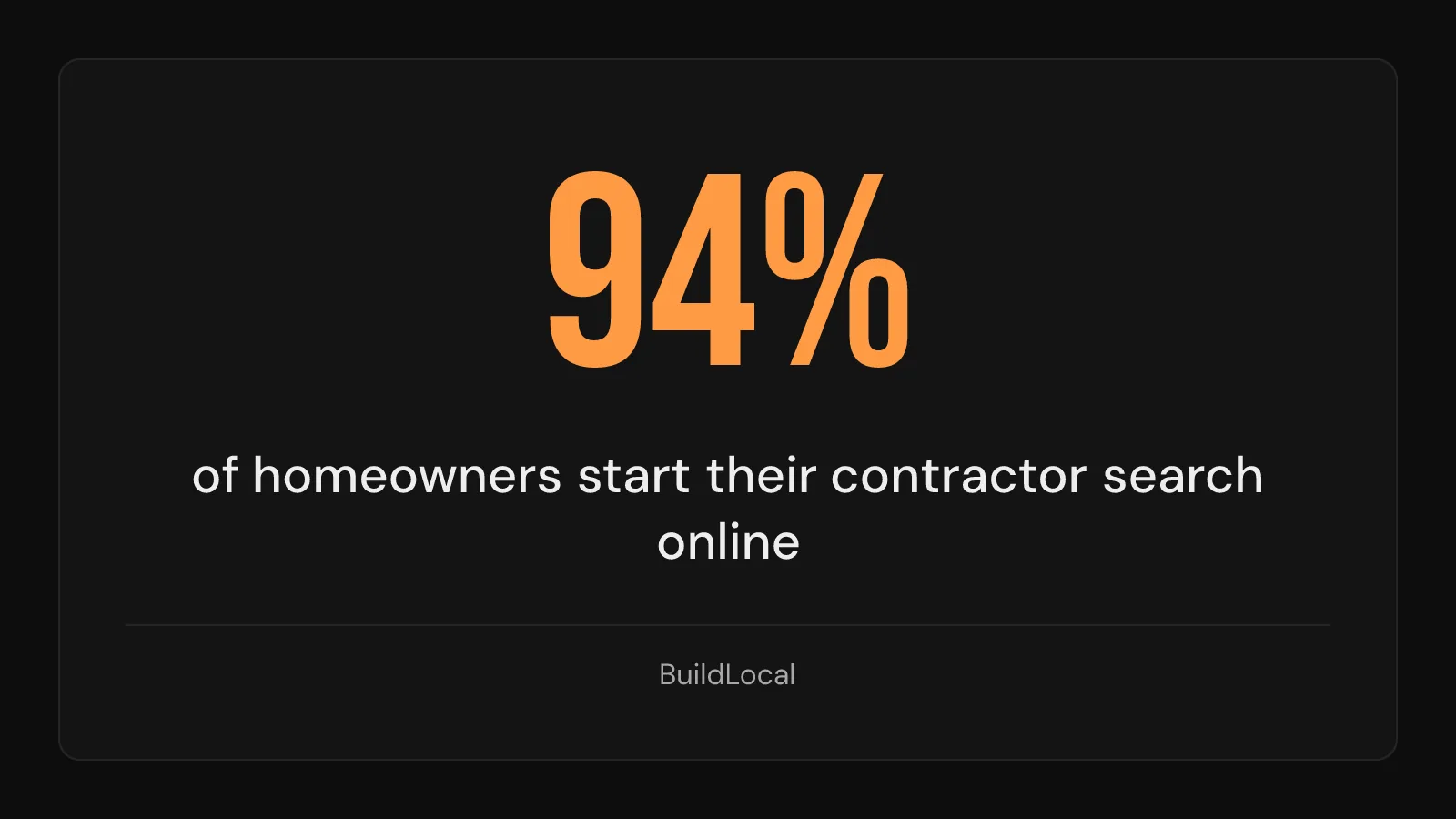
That number does not care whether the plan behind it followed roofing company marketing strategies 2025 or a channel picked 10 years ago on a whim. 98% of the content on roofing websites gets zero traffic, and most of that content belongs to a roofing marketing strategy that was never actually measured past the publish date.
Three numbers actually settle whether a strategy is working, and none of them is call volume alone:
- Cost per booked job, tracked separately from cost per lead or cost per click.
- Close rate by channel, since two channels producing the same number of calls rarely produce the same number of signed jobs.
- Time to first response, since a strategy that produces calls nobody answers fast enough is not really working at all.
Roofing contractor marketing strategies 2025 2026 planning sessions skip this measurement step more often than any other mistake in this article. Marketing strategies for roofing contractors 2025 should be judged the same simple way any year's should: cost per booked job. Cost per click and cost per lead are consolation numbers that do not answer whether the strategy actually worked.
Roofing marketing strategies 2024 got measured by call volume alone at most companies, which hid how many of those calls ever became a signed job. The gap between calls and closed jobs is exactly what roofing marketing strategies 2024 2025 comparisons keep turning up once an owner finally checks.
Who This Framework Fits
This framework fits two kinds of readers:
- The owner-operator running the decision alone. These are typically roofing business owners marketing strategies calls made without anyone else to check the choice against.
- The manager, director, or other decision-maker who inherited the channel. Roofing marketing managers marketing strategies work often lands on someone who was not around when the company picked its first channel and now has to defend it or change it. The same applies to roofing directors marketing strategies conversations at companies running more than one crew, where the storm-surge path and the organic path are usually both partly funded and neither is fully committed to.
Roofing decision makers marketing strategies choices rarely get easier past a certain size. More of the four paths above are usually already partly running at once, which makes picking one properly worth even more.
A company ready to build the organic path from the section above in-house should read what roofing content marketing actually looks like next. A company that would rather hand the local-presence path to someone else should read how to vet a local SEO agency for roofing companies before you hire one first.
Either way, the choice made here gets checked against the numbers from the section above, on the review date the company already set.
A stage-matched strategy is only a starting point. The crew still has to answer the phone once the strategy starts working.
Whichever path a roofing company runs, roofing leads that actually close still come down to what happens in the five minutes after the phone rings, and how to increase conversion on roofing leads is the play-by-play for those minutes. The four paths above only decide which channel the call comes from.
Frequently Asked Questions
How does the 3-3-3 rule apply to a roofing company's marketing strategy?
The 3-3-3 rule is a general content-marketing habit: work in short, repeatable blocks across a handful of channels instead of spreading thin across everything at once. Applied to the four paths above, it argues for picking one or two paths at a time instead of running all four with a fraction of the budget on each.
What are the five core marketing strategies for a roofing company?
Word of mouth and the four paths above cover it: lead-buying, local presence and reviews, organic search and content, and paid speed during a storm season. Most companies already run a version of the first one without calling it a strategy at all. On the residential side, the local-presence and referral paths are laid out step by step in how to generate residential roofing leads.
Can a documented marketing strategy alone get a roofing company to $100,000 in sales?
A strategy picks the right channel for the stage the company is in, but it does not replace fast follow-up or the crew's close rate once the phone rings. A company with a strong strategy and a slow callback still loses jobs the strategy already paid to generate.
How much should a roofing company budget for a real marketing strategy?
There is no single number, since the right spend follows the stage-matching table above rather than a flat percentage. A new company spending heavily on paid ads before it has reviews is overspending on the wrong path, even at a modest dollar amount.
If we already have someone running ads or posting on social media, do we still need a documented strategy?
A documented strategy means a named stage and a defined success number sit behind whichever channel is already running. Without both, even a well-run channel cannot tell anyone whether it should keep getting funded or get replaced.
If social media and paid ads already failed once, what would an actual strategy change?
Most failed attempts skip the stage-matching step entirely and copy whatever a competitor or a listicle suggested trying next. A real strategy starts by naming the stage the company is actually in, then picks the one or two paths that fit it instead of testing everything at once.