What’s the Best Way To Do SEO For Roofing? Here Is the Order
What’s the best way to do SEO for roofing? Fix your Google Business Profile first. That single fix outranks almost anything else on this list, and most roofing companies do it last instead of first. Then fix the website content that earns zero visits. Then work on links and reviews. Do it in that order. Not all three at once.
What’s the Best Way To Do SEO For Roofing? Start With Your Google Business Profile
Every roofing company competing for local search starts in the same place. Your Google Business Profile alone drives 32% of what decides the local three-pack (Whitespark, 2024), the map listings that show up before a single organic result. A roofing contractor with a modest website and a well-kept profile regularly outranks a competitor who spent far more on the site itself.
Reviews carry real weight too. The businesses holding the top three local spots average more than 200 reviews, according to Localo's analysis of two million Google Business Profiles. That is a steady ask built into how the crew closes every job. It rarely comes from a single push.
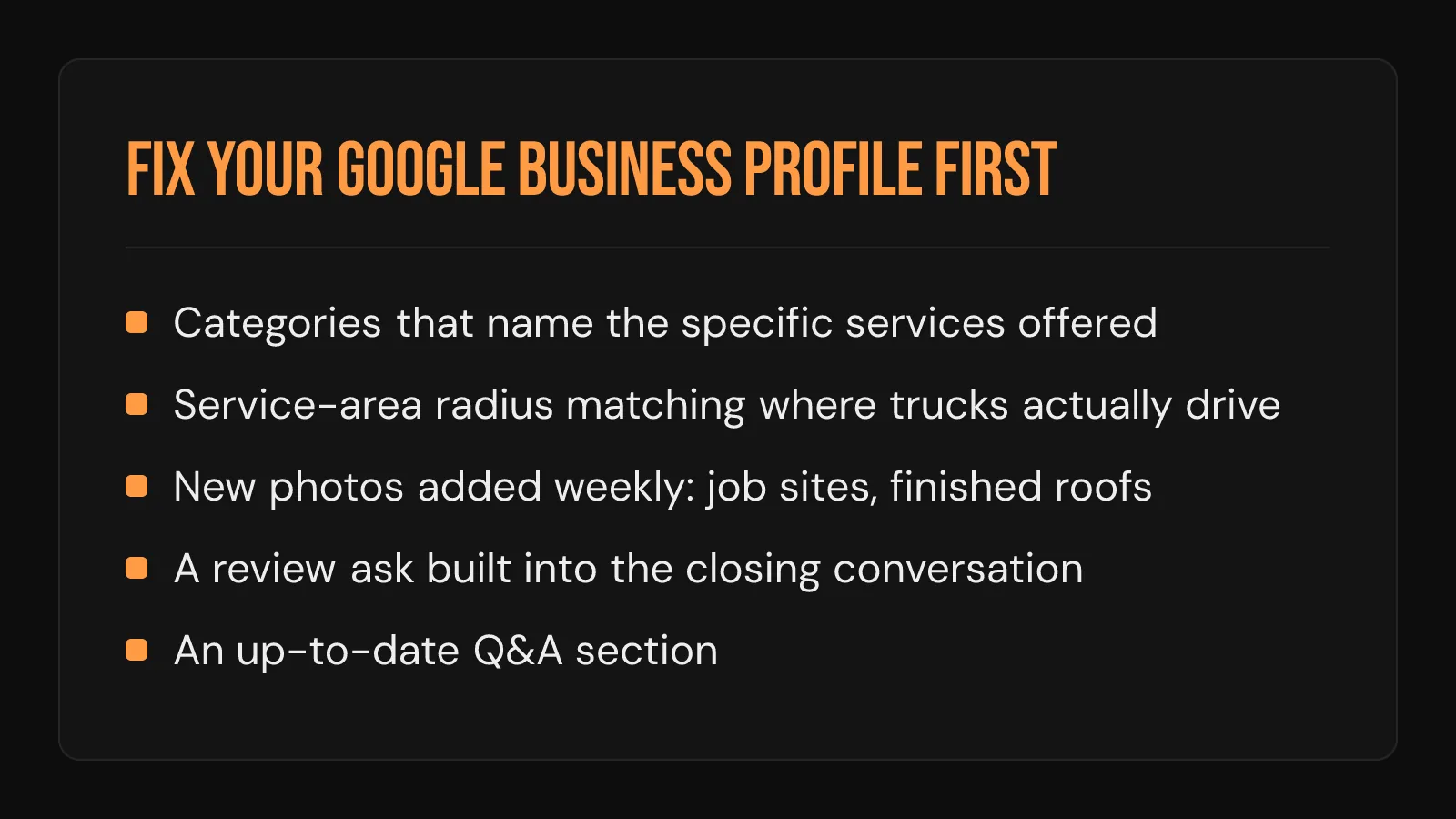
Fix these first:
- Categories that name the specific services offered
- A service-area radius that matches where trucks actually drive
- New photos added weekly: job sites, finished roofs, the crew at work
- A review ask built into the closing conversation on every job
- An up-to-date Q&A section, since anyone can post there
Get this piece right and the roofing SEO work underneath it has something solid to build on. Skip it and everything else here works twice as hard for half the result. Those weekly photo uploads only pull their weight when the alt tags behind them actually describe the job.
Fix the Website Content That Is Currently Earning Nothing
Most roofing websites publish plenty of pages. 98% of the content on roofing websites gets zero traffic, according to Roofing Webmasters. The reason is almost always the same: one homepage trying to describe every service in every city, rather than pages built to answer one real question each.
The fix is specific writing: one real page per service, per city, each answering a question a homeowner actually typed in.
| What most roofing sites publish | What actually ranks |
|---|---|
| One homepage covering every service and city | A separate page per service, per city |
| Generic company history | A page built around one real question |
| Stock photography | Real job photos from real crews |
| No FAQ section | FAQ answers built from real search questions |
A single homepage cannot rank for roof replacement, gutter repair, and storm damage inspection in five different cities at the same time. Search engines reward the specific page every time.
How Local SEO and On-Page SEO Work Together
On-page fixes and local fixes reinforce each other. A title tag naming the right city and service also strengthens the local signals Google already uses to rank the Business Profile. 94% of homeowners start their contractor search online, so the page has to be findable and trustworthy in the same moment. That means title tags naming the specific service and city, schema markup describing the business accurately, and the same name, address, and phone number everywhere the business is listed.A few habits worth building:
- Title tags that name the specific service and city
- Schema markup kept current as services or areas change
- The same business name, address, and phone number on every directory listing
- A step-by-step local SEO checklist for the full mechanical rundown
All of this feeds directly into local SEO built around ranking in the Google Maps three-pack.
The Order That Actually Works
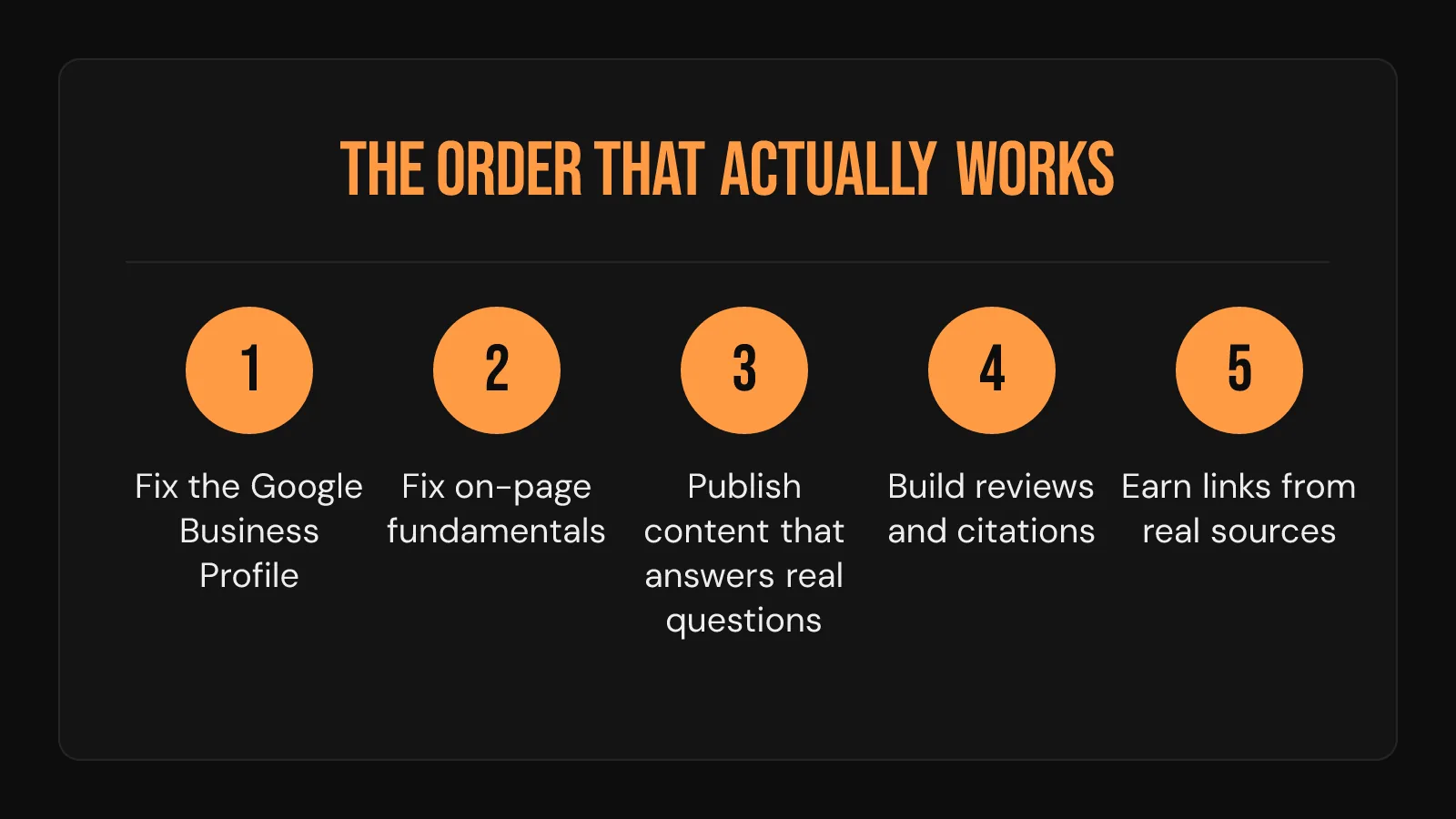
So, what’s the best way to do SEO for roofing? Here is the order, step by step:
- Fix the Google Business Profile first. Categories, photos, service areas, and a steady flow of reviews.
- Fix the on-page fundamentals. Title tags, schema, and consistent business information.
- Publish content that answers a real question. One page per service, per city.
- Build reviews and citations. This is the slow, compounding piece.
- Earn links from real sources. Roofing leads tend to follow naturally once the first four steps are solid.
For the longer walkthrough of each step, the full roofing SEO guide covers the mechanics in more depth.
For a crew that would rather run this in-house, DIY roofing SEO breaks down which of these five steps are realistic to handle without help, and where the workload gets heavy.
Running that order as an ongoing monthly SEO campaign is what keeps steps two through five from quietly stalling out once the first push is done.
Frequently Asked Questions
What is the 80/20 rule for roofing SEO?
The 80/20 rule for roofing SEO holds that roughly 80% of ranking results come from 20% of the work, and for most roofing companies that 20% is the Google Business Profile plus a handful of specific service pages. Chasing every possible tactic at once spreads effort thin. Fixing the highest-impact pieces first ranks faster.
How do I promote my roofing business with SEO instead of paid ads?
The best way to promote a roofing business with SEO instead of paid ads is to earn visibility that keeps working long after the spending stops. It follows the same priority order as everything else here: Google Business Profile first, then the website, then links. Results take longer to show than a paid campaign, but they keep producing calls long after a campaign would have ended.
What are the top SEO strategies for a roofing company?
The top SEO strategies for a roofing company are the same four covered in this guide, worked in order: a complete Google Business Profile, specific service-and-city pages instead of one generic homepage, consistent business information across every directory, and a steady flow of real reviews. Companies that try all four scattered across a year tend to see less movement than companies that fix the profile first and let the rest follow.
Why didn't SEO work the last time I tried it for my roofing business?
SEO usually fails for roofing companies for one of two reasons: the work targeted general visibility instead of the Google Business Profile, or the site content was generic instead of built around real questions. Both are fixable without starting over. Fixing the profile and rewriting the weak pages first usually shows movement faster than starting an entirely new campaign.
Is SEO worth it for a small roofing company, or does it take too long to pay off?
SEO is worth it for a small roofing company, and the payoff timeline depends on the order of operations. Fixing the Google Business Profile first can show movement within weeks, since it needs no new pages or new links. The slower pieces, like content and backlinks, compound over months, which is why they come last in the priority order.