Roofing SEO for B2B Targeting Owners: The Complete Breakdown
Roofing SEO for B2B targeting owners works differently than the residential playbook most roofing companies already know. A homeowner picking a roofer and a property manager picking a commercial roofing vendor are running two different decisions, on two different timelines, convinced by two different kinds of proof. Most roofing SEO content assumes the reader is chasing homeowner calls after a storm, and it never adjusts for the buyer who runs an RFP instead of a late-night Google search. This piece covers what actually changes: who is searching, how they decide, and what a roofing company's SEO has to do differently to earn that business.
What roofing SEO for B2B targeting owners actually means
It means building content, proof, and pages around a commercial buyer instead of a homeowner. That buyer might be a property manager, a facilities director, or the owner signing off on a roof for a warehouse, retail strip, or apartment complex. This piece assumes the reader already has a handle on roofing SEO fundamentals and wants to know what changes when the customer is a business.
Three things change the most:
- The buyer. A homeowner decides for herself. A commercial buyer usually answers to someone else, whether that is an owner, a board, or a regional property management company.
- The proof. A homeowner reads reviews and looks at photos. A commercial buyer wants a project portfolio, a certification, and a real point of contact who has handled a building like theirs before.
- The timeline. A homeowner often decides within days of a leak or a storm. A commercial buyer works from a maintenance schedule or a bid deadline, sometimes months out.
None of this makes commercial work worth more attention than residential jobs. It means a roofing company running one undifferentiated SEO strategy for both buyers ends up with content that fits neither one particularly well. The keywords driving each buyer's research differ just as much, and the full roofing SEO and PPC keyword list covers how to weigh local, service, and problem-based terms against each other before a commercial page ever gets built.
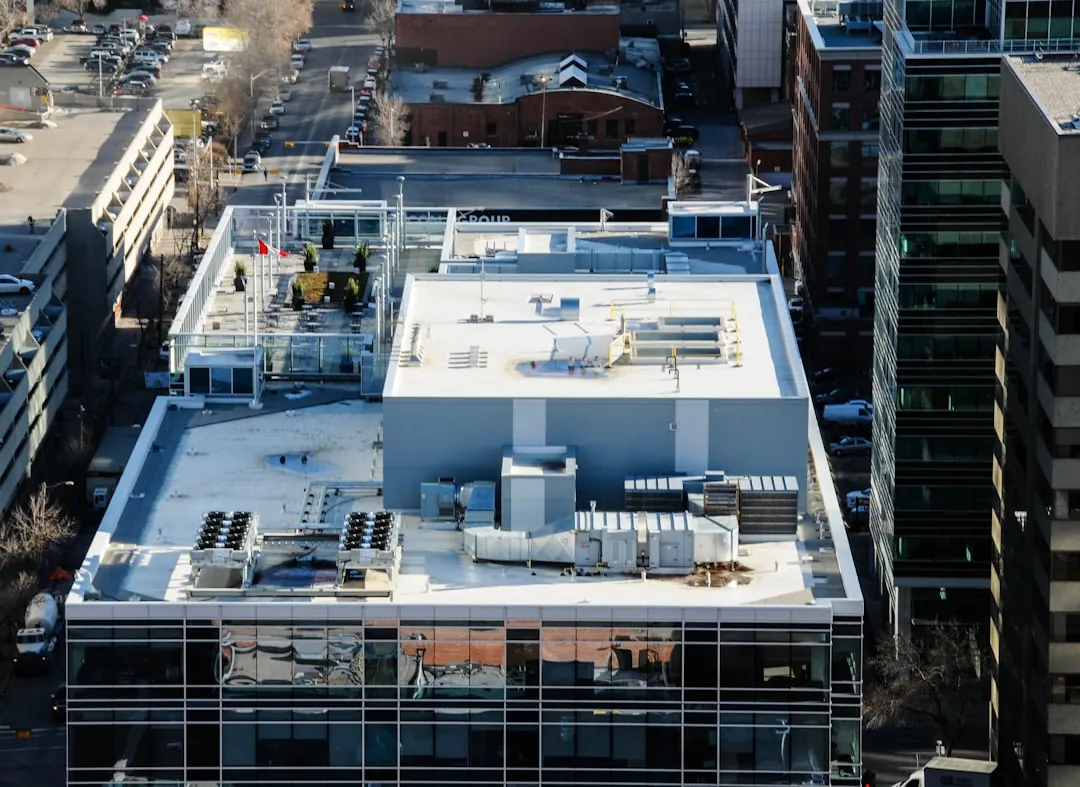
How commercial building owners and property managers actually search and decide
A property manager comparing roofing vendors rarely starts with a plain Google search the way a homeowner does. A homeowner leans hard on reviews and the local three-pack when picking a roofer. A commercial buyer running an RFP barely glances at either one.
The process usually starts before a search bar ever opens:
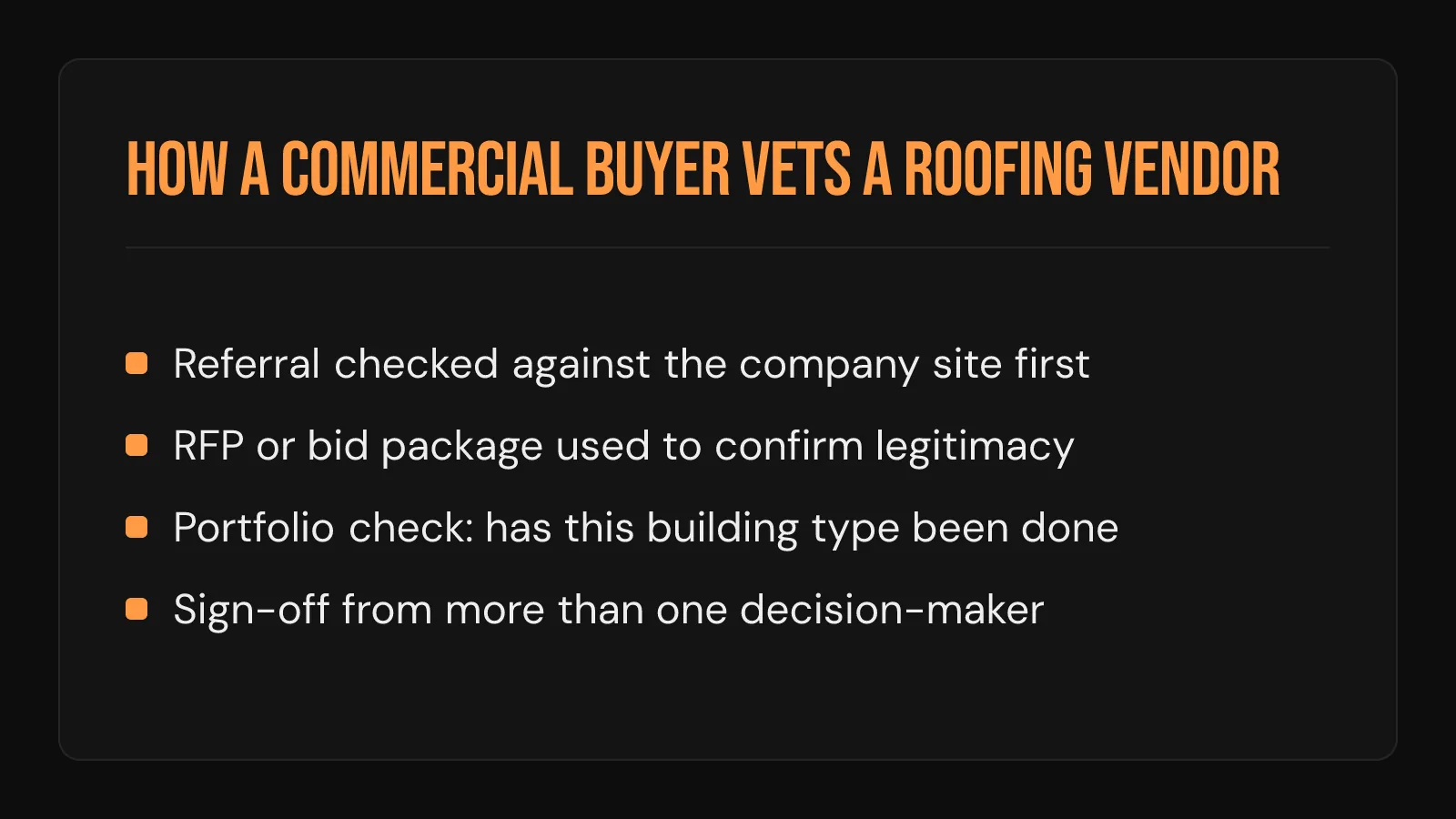
- A referral from another property manager or a general contractor, checked against a company's website before a call gets made.
- An RFP or bid package sent to a short list, where the site confirms legitimacy rather than helping the company get discovered in the first place.
- A portfolio check: has this company handled a building like ours, at this scale, with this roofing system?
- A sign-off from more than one person, which stretches the decision from days into weeks or months.
62% of consumers skip a business they cannot find online, and the same instinct shows up further up the commercial funnel too. A property manager running a background check on a vendor from an RFP list will drop a company whose site reads as residential-only, even when the crew is fully capable of the commercial work. The residential side of that same visibility problem gets more fractured the more a metro splits into separate jurisdictions: Long Island roofing SEO gets rebuilt village by village, town by town, matching the way Nassau and Suffolk actually split the market. The same fragmentation runs statewide out west, where SEO websites for roofing companies in Montana get built one metro at a time because Billings and Missoula sit 345 interstate miles apart.
Residential roofing SEO vs. B2B roofing SEO
The two versions of roofing SEO share one foundation: a fast, credible site with real content on it. Past that foundation, they diverge in almost every direction:
| Signal | Residential roofing SEO | B2B / commercial roofing SEO |
|---|---|---|
| What convinces the buyer | Reviews, photos, response speed | Project portfolio, certifications, a named contact |
| Where the buyer starts looking | A "roofer near me" search or the local map pack | A referral, a vendor list, or an RFP package |
| Content that converts | Service-area pages built around a city and a storm season | Commercial-system pages (TPO, EPDM, metal, built-up roofing) and real project case studies |
| Decision timeline | Days, often after a storm or a leak | Weeks to months, tied to a budget cycle or a bid deadline |
| Who signs off | One homeowner | A property manager, an owner, sometimes a general contractor too |
A roofing company's site can do both jobs, but only if it treats them as two separate tracks with their own pages and their own proof, rather than one generic set of service pages trying to speak to both at once.
The content that actually earns commercial and B2B roofing work
Most roofing websites are built entirely around residential service pages: storm damage, shingle replacement, a city name in the H1. None of that speaks to a property manager evaluating a flat commercial roof.
A roofing company that wants to show up for commercial buyers needs its own dedicated content, built for that buyer on purpose:
- Commercial-system pages. TPO, EPDM, metal, and built-up roofing each earn their own page, because a facilities director searches by system type more than by "roof repair."
- A real project portfolio. Building type, square footage, system installed, and a photo, specific enough that a property manager can match it to their own building.
- Manufacturer and certification credentials, listed plainly, since a commercial buyer checks for them before a call ever happens.
- Case studies written for a facilities-director reader. Scope, timeline, and outcome carry the trust here, the same way a review carries it for a homeowner.
The average roofing site converts 2 to 3% of its visitors. A site built for conversion reaches 7 to 10%. That gap gets more expensive for commercial buyers specifically, because they are already looking for a reason to rule a vendor out, and thin, residential-only content hands them one.
A site still missing the fundamentals should fix those first. The roofing SEO guide covers Google Business Profile, on-page basics, and technical setup, the groundwork every commercial page in this piece still sits on top of.
Where rankings meet booked commercial work
Ranking for roofing SEO for B2B targeting owners does not do much on its own if the page underneath it cannot handle what a commercial buyer needs next:
- A fast reply, ideally same day, instead of a contact form that sits unread for days.
- A real point of contact, someone who can speak to commercial work specifically.
- Proof the crew has handled this exact kind of job before, beyond residential work alone.
Small businesses with websites are 2.8x more likely to grow revenue, and 70% of small business homepages never ask the visitor to do anything once they arrive. A commercial roofing page that ranks well but gives a property manager no clear next step wastes the same traffic it worked to earn.
The real payoff is connecting both halves of the system: the content that gets a property manager to the site, and the response that keeps that property manager from moving to the next name on the list. None of it turns into the leads this whole approach is supposed to produce without both pieces working together.
Frequently Asked Questions
Is SEO worth it for a roofing company chasing B2B and commercial-property contracts?
Yes, for the same reason it works for residential jobs: property managers and business owners research vendors online before they ever pick up the phone. A commercial roofing page that shows up when a facilities director searches for a system type or a service area gets considered for the shortlist a company with no visible commercial content never makes.
How is B2B roofing SEO different from residential roofing SEO?
The proof changes, and so does the buyer's starting point. Residential roofing SEO leans on reviews, photos, and the local map pack, while B2B roofing SEO leans on a project portfolio, certifications, and content built around commercial systems instead of a city name alone.
Is organic SEO still worth pursuing for commercial roofing work as emerging answer engines change search in 2026?
Yes, and the two channels reward close to the same signal: clear structure, real proof, and a direct answer to the question a property manager actually asked. A commercial roofing page built around real search intent already tends to satisfy what emerging answer engines look for too.
If we already pay a marketing company, why would targeting B2B owners change our roofing SEO?
Most general roofing SEO retainers default to homeowner content, because that is the larger, higher-volume keyword set most agencies chase first. If commercial work is part of the pipeline, the site needs pages, proof, and case studies built for that buyer on purpose, or that side of the business keeps running on content written for someone else's decision.
Is SEO better than paid ads for winning commercial roofing contracts from B2B owners?
It is not a straight either-or question. Organic content is what a property manager finds while researching a vendor list regardless of whether ads are running, and it keeps working long after an ad budget runs out.