How to Get Roofing Leads From Insurance Companies (Honestly)
If you have searched how to get roofing leads from insurance companies, you have probably pictured a list you can buy. That is not how it works. Insurance companies do not sell homeowner names, and no honest source ever will. What actually happens is quieter. An adjuster remembers the roofer who filed clean paperwork fast. An agent hands out a business card after a client's claim gets approved. A homeowner googles a few names because an adjuster told them to get quotes, and finds one roofer first. This piece walks through what building that channel really looks like, and where the honest line sits between marketing for insurance-referred jobs and touching the claim itself. The Trust Process handles the marketing and stays out of the claim itself.
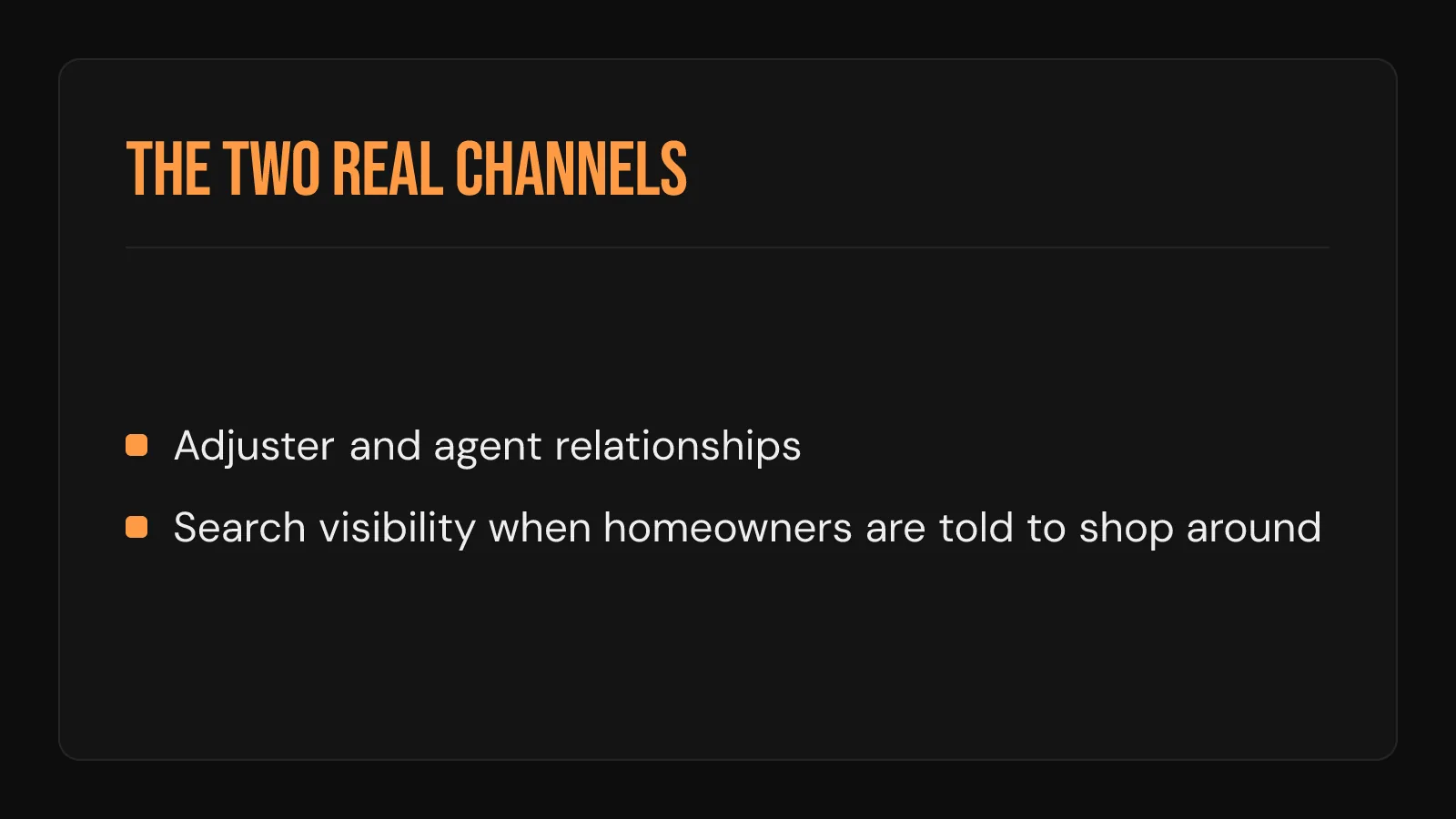
How to Get Roofing Leads From Insurance Companies: The Two Real Channels
Search "how to get roofing leads from insurance companies" enough times and you will find people selling insurance-company contact lists or claims databases. Do not buy one. There are only two channels that actually produce these jobs, and both run on trust earned over time.
- Adjuster and agent relationships. An adjuster who trusts your documentation, your timeline, and your communication will mention your name to the next homeowner who asks who to call.
- Search visibility at the exact moment a homeowner is told to shop around. Most adjusters will not name one contractor. They tell the homeowner to get a few quotes, and the homeowner opens Google.
Neither channel is instant. Both beat paying per lead for the same shared list four other roofers already have, which is the same case how to get more roofing leads makes about paid platforms more broadly. Both channels also lean on the same foundation: content marketing that produces roofing jobs is what gives an adjuster, an agent, or a searching homeowner a reason to remember your name at all.
Why Insurance-Referred Leads Convert Differently Than a Purchased List
A purchased lead starts cold. An insurance-referred lead starts with a homeowner who already trusts the person who sent them your way, and that changes the entire conversation.
| Purchased or Shared Lead | Insurance-Referred Lead | |
|---|---|---|
| Starting trust | None. You are one of four bids. | Borrowed from the adjuster or agent. |
| Cost pattern | Paid every time whether it closes or not. | Built once, referred repeatedly. |
| Urgency | Homeowner is comparison shopping. | Homeowner already has a claim moving. |
| What wins it | Speed, mostly. | Documentation, communication, and speed. |
Hurricane deductibles run 2 to 5% of insured value. On a $400,000 home that is $20,000 out of pocket before insurance pays a dollar, so the homeowner behind a referred lead is already carrying real financial weight into that first call. You earn the referral by becoming the roofer someone already trusts enough to hand off. That trust disappears fast if you are slow. 62% of homeowners hire the first contractor who answers, referral or not. When a hail storm hits and a whole county starts calling in the same week, that same speed is what decides which hail roofing leads become booked inspections.
Building Real Relationships With Adjusters and Agents
This is the actual work behind how to get insurance roofing leads. It means showing up consistently instead of pitching once and waiting for the phone to ring.
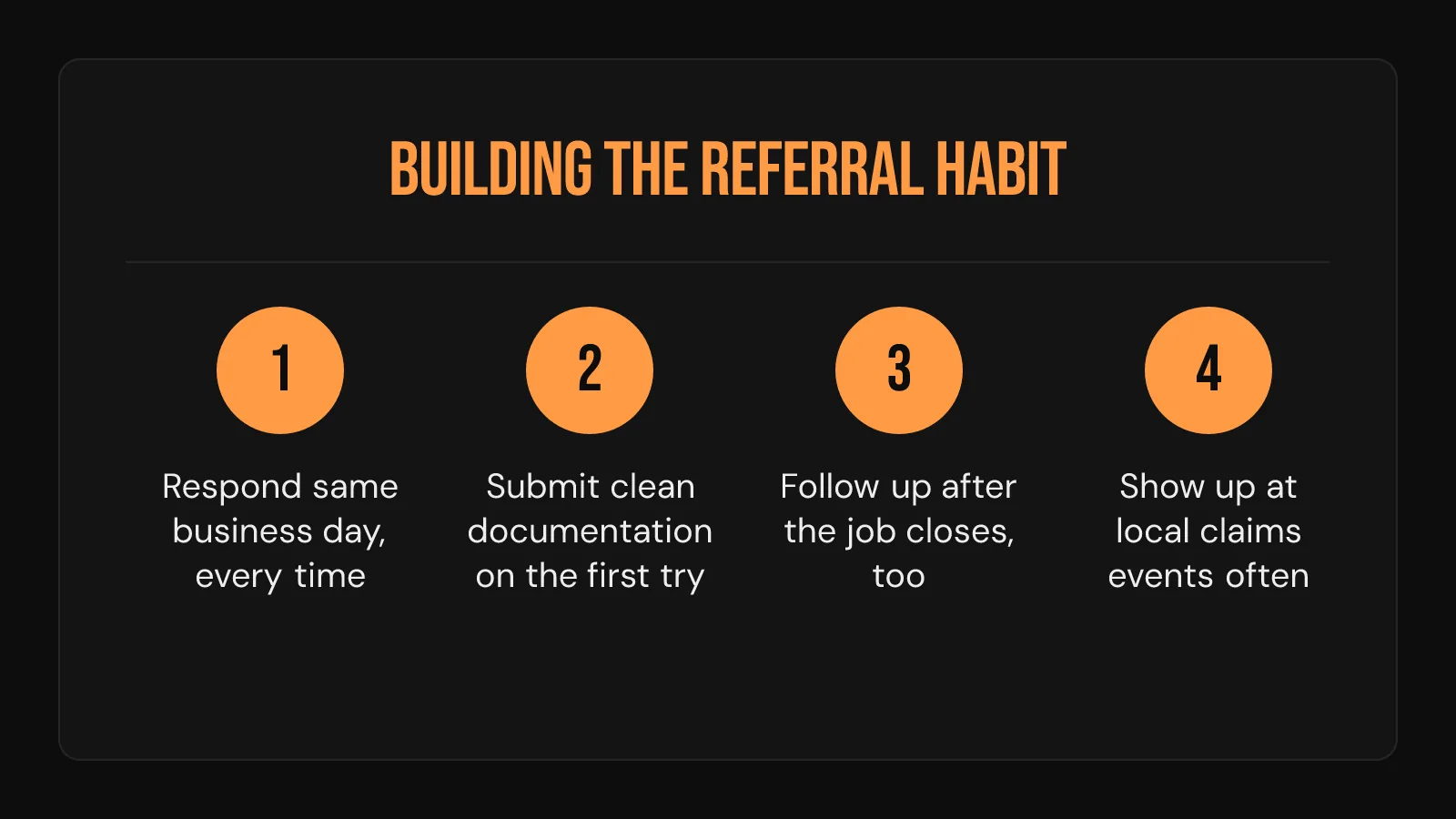
- Respond to every adjuster or agent inquiry inside the same business day, every time, until it is simply expected of you.
- Turn in documentation that is complete on the first submission: photos, measurements, and a scope that matches what the adjuster actually needs to approve the claim, without you touching the approval itself.
- Follow up after the job closes, too, so the adjuster remembers the roofer who made their file easy to close from start to finish.
- Show up at local trade and claims events often enough that your name stops being new.
None of this involves negotiating a claim or telling a homeowner what their insurer owes them. That is the line The Trust Process will not cross, on this page or in any client work.
Showing Up When an Adjuster Just Says Get a Few Quotes
Texas requires no state roofing license. Anyone can call themselves a roofer, which is exactly why homeowners lean so hard on trust signals. That matters most in the exact moment an adjuster sends a homeowner off to get a few quotes instead of naming one company: your online presence decides whether you are one of the names they find. Why local SEO matters this much for roofers comes down to exactly this moment: whoever ranks and reads as trustworthy right then wins the call.
- A complete, active Google Business Profile with real project photos.
- Recent reviews, since 92% of homeowners read your reviews before they ever dial your number.
- A site built around the actual jobs you do instead of generic stock language a homeowner has already seen on five other sites.
This is where local visibility and insurance-adjacent trust intersect, and it is worth vetting a local SEO agency properly before you pay anyone to manage it for you.
This Is Marketing, Handled Separately From Claims Work
Everything above is marketing and relationship-building. None of it is insurance-claim work, and The Trust Process never touches the claim itself, negotiates with an insurer, or promises a homeowner a specific payout. What this work builds instead is a visible, credible presence: the kind that makes an adjuster comfortable enough to say your name out loud, and makes a homeowner comfortable enough to call you first.
If you are ready to stop guessing at how to get roofing leads from insurance companies and start building the channel on purpose, this is the moment to act on it. That is exactly the kind of roofing leads that actually close conversation worth having.
Frequently Asked Questions
How do I get roofing jobs from insurance companies online?
Build a Google Business Profile and website that clearly show your work, your service area, and recent reviews, since most homeowners search online the moment an adjuster tells them to get quotes. The roofer who is easiest to find and easiest to trust in that moment usually gets the call. Getting that first impression right is what web design for roofers actually covers.
Do I need to know the 25% roofing rule to work with insurance adjusters?
It helps to understand it, since it is the widely cited 25% rule many building codes use to decide when a full replacement gets approved instead of a partial repair. Treat it as background knowledge for talking credibly with adjusters. It is never a reason to get involved in negotiating the claim itself.
Do roofers pay insurance companies or adjusters for referred leads?
No. Any roofer offering to pay for a referral is describing a kickback rather than a real relationship. The roofers who earn consistent adjuster referrals do it through clean documentation and fast, reliable communication instead of paying for it.
Is building relationships with adjusters worth it compared to just buying leads?
Yes, over time it is, since a purchased lead resets to zero trust every single time while an adjuster relationship compounds. It takes longer to build, but it stops costing per lead once it exists.
I already tried networking with adjusters and it did not work, so what is different here?
Most attempts fail because they stop after one or two introductions instead of becoming a habit. The roofers who actually get insurance roofing leads treat documentation, response time, and follow-up as routine rather than a one-time pitch to an adjuster's office.