How to Find Commercial Roofing Leads
How to find commercial roofing leads starts with the roofer a general contractor already half trusts, long before the bid ever goes out. Commercial roofing moves through people first and a search box second. A property manager who already knows a crew's name calls that crew first, list or no list. Three real levers move that needle this month: showing up where a commercial buyer already looks, building the relationships that skip the bid entirely, and following up longer than the roofer who quit after one call.
How to Find Commercial Roofing Leads Without Buying Them
Search for this topic and most of what ranks is a data platform selling a filtered contact list: filter by industry, add a location, narrow to asset class, apply more parameters. That is a real product for a certain kind of buyer. It is also a subscription a five-person crew does not need to add to the pile just to land its next commercial account.
The three levers below work without a new tool:
- Visibility. Showing up when a property manager or general contractor searches for a roofing subcontractor near the job.
- Relationships. Being the name a GC or property management company already calls before the bid ever goes out.
- Persistence. Staying in the conversation past the point where most roofers give up.
| Approach | What it costs | What it actually requires |
|---|---|---|
| Buying a filtered contact list | A recurring data-platform subscription | Someone still has to make the calls |
| Visibility, relationships, and persistence | Time, spread out over months | Showing up consistently, month after month |
The rest of this guide covers each one, plus the reason most attempts at the third lever stall before they pay off.
How to Get Commercial Roofing Leads From Search and Referrals
This is the passive half of the equation. How to get commercial roofing leads without picking up the phone first comes down to two channels: being findable, and being referred.
A property manager evaluating an unfamiliar roofer starts the same way a homeowner does. She searches. Cleaning up what that search turns up matters more here, since a thin or outdated Google Business Profile reads as risk to someone hiring a vendor for an entire portfolio of buildings; the same due diligence applies when vetting a local SEO agency for roofing companies to help with that. Content marketing built around commercial-intent searches is what actually gets found by that search in the first place.
| Channel | Who it reaches | Effort |
|---|---|---|
| Local search and Google Business Profile | A property manager searching cold for a subcontractor | Low, mostly setup |
| Commercial-intent content | A GC researching vendors before a bid | Medium, ongoing |
| Referral from a residential client | A homeowner who also owns or manages rental property | Low, one ask |
A profile built to read as credible for commercial work usually goes beyond the residential basics:
- Recent photos from a commercial or multi-unit job alongside the residential ones
- Licensing and insurance information visible on the profile itself
- A service area or description that names commercial and multi-family work directly
The referral channel gets skipped constantly. A crew that just finished a strong residential job rarely asks that homeowner whether she also owns a rental property or sits on an HOA board. That one question costs nothing and often opens a door a cold call never would. That crossover is exactly why sorting your clients into segments surfaces commercial work hiding in a residential list.
How to Generate Commercial Roofing Leads Through Direct Outreach
The active half is different work entirely. How to generate commercial roofing leads through outreach means building the relationships that get a crew invited to bid before the job is ever posted publicly.
Four outbound channels actually produce commercial work for a small crew:
- Direct relationships with general contractors who need a reliable roofing subcontractor for their own commercial jobs
- Property management company contacts who handle roofing across an entire portfolio of buildings
- Plan rooms and bid boards where commercial roofing work gets posted before it is publicly advertised
- Trade association events and local builder groups, where the same GCs and property managers show up year after year
None of these pay off on the first attempt. That is the part most guides on this topic skip entirely, and it is the actual reason the general lead-generation playbook and the commercial version diverge: residential demand often shows up on its own, commercial demand has to be built.
Why Most Commercial Roofing Lead Attempts Stall
44% of salespeople give up after a single follow-up. That statistic explains most of the "we tried outreach and it didn't work" stories in this industry. One call, one voicemail, no callback, conclusion reached: commercial work isn't worth chasing.
Persistence beats pitch quality for the roofers who actually land commercial accounts. The 8% who keep following up past the fifth touch end up with 80% of the business, and roofing is no exception to that math. The same math is why most canvassing programs quit before the door ever pays off: a rep who stops at the second knock never sees the fifth-touch payoff either.
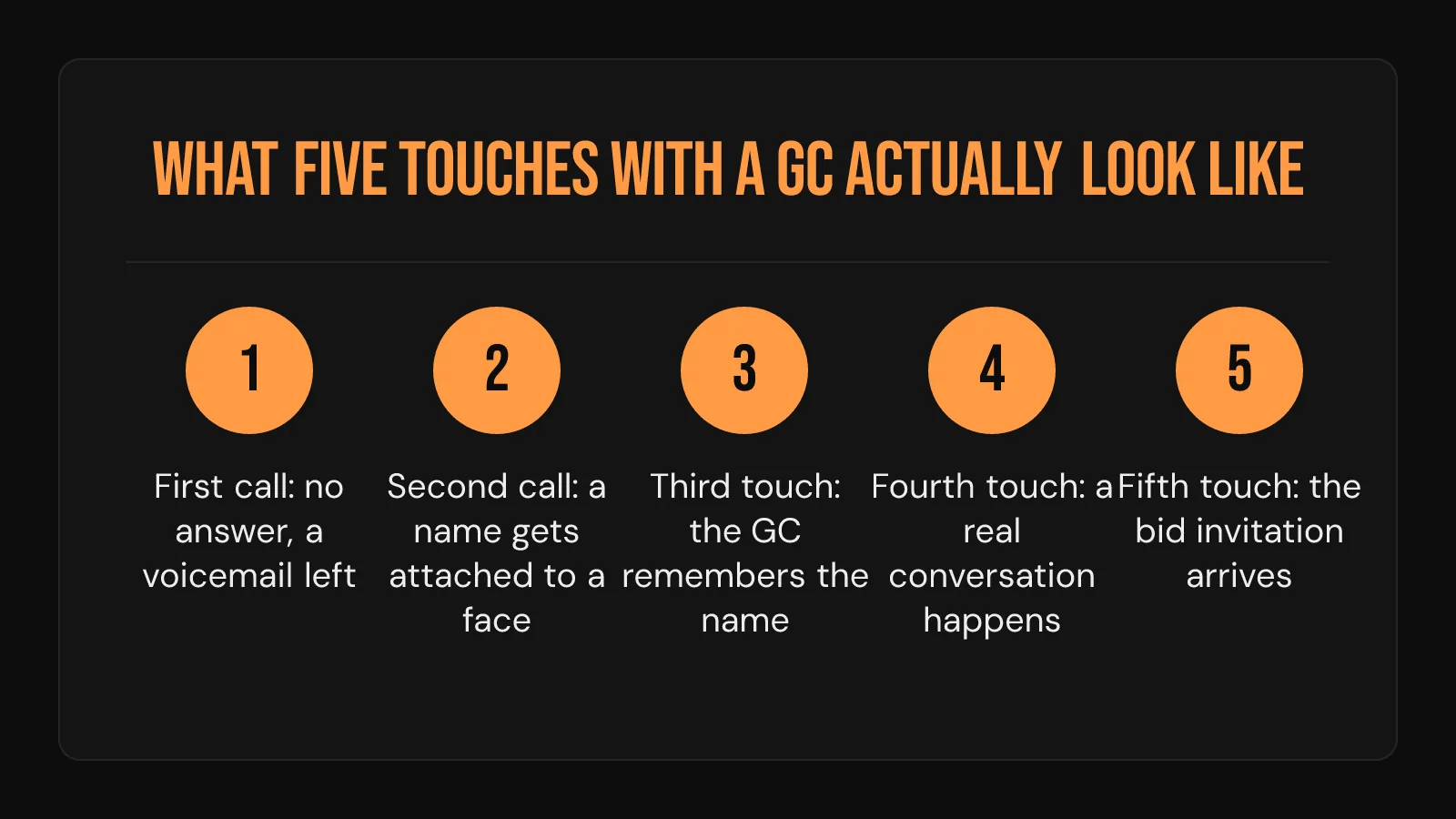
Here is what actually happens across five touches with a general contractor who eventually becomes a client:
- First call: no answer, a voicemail left, nothing back
- Second call, roughly a week later: a name gets attached to a face, still no commitment
- Third touch, often an email or a drop-by: the GC remembers the name now
- Fourth touch: a real conversation happens, usually about a specific upcoming job
- Fifth touch and beyond: the bid invitation actually arrives
The roofers who win commercial work are the ones still calling back after the fourth no.
Turning Commercial Roofing Leads Into Booked Jobs
How to find commercial roofing leads becomes a much smaller problem once visibility and follow-up are both in place. Neither lever works alone. A GC who found a roofer through search still needs someone to answer when he calls back on the fifth touch, and a property manager who was referred in still needs a Google Business Profile that does not read as an afterthought. The commercial roofing marketing examples that landed jobs all pair that visibility with a fast, proof-heavy follow-up.
The Trust Process does not sell or broker commercial roofing leads. The work is making sure the visibility and the follow-up systems behind those three levers actually hold together once the calls start coming in, so the fifth touch gets answered as reliably as the first.
Frequently Asked Questions
How is finding commercial roofing leads different from finding residential leads?
The buyer is a GC or property manager evaluating a vendor relationship. A homeowner reacting to storm damage moves faster and skips most of that evaluation. The sales cycle runs longer here and depends on repeat contact over time, which is the whole difference behind how to find commercial roofing leads compared with residential ones. A homeowner comparing standing-seam or architectural metal options runs on a similar longer clock for a different reason, covered in metal roofing marketing.
Why look beyond the one general contractor already sending us commercial work?
One relationship is one point of failure. The moment that GC's own pipeline slows down, so does the roofing work coming from him. Building two or three more channels, through search visibility and new relationships, protects a crew from depending on a single contact.
What's different about cold-calling general contractors this time if it already failed once?
Most cold-outreach attempts stop after the first call, and the data backs that up: close to half of salespeople quit after one follow-up. The GCs worth landing rarely commit before the fourth or fifth touch, so a single unanswered call was never a real test of whether outreach works.
Does commercial roofing lead volume dry up outside of storm season?
Commercial roofing demand follows a different calendar than residential storm response. It runs on scheduled maintenance, capital budget cycles, and insurance claims tied to a building's own timeline, so the channels above hold up in every season.
Where do property managers and general contractors actually look before hiring a roofing subcontractor?
Google search and a Google Business Profile for an unfamiliar name, existing plan-room or bid-board relationships for a known one. That is why visibility and relationships both matter here together.